
WASHINGTON — Army Secretary Dan Driscoll has resigned after months of tension with Defense Secretary Pete Hegseth over senior-officer removals, promotions and the future direction of the U.S. Army, marking the latest high-level departure from a Pentagon already navigating active military operations and internal leadership upheaval.
President Donald Trump accepted Driscoll’s resignation Monday evening, according to a U.S. official cited by ABC News. The White House praised Driscoll’s work but did not publicly identify a successor or provide a detailed explanation for his exit.
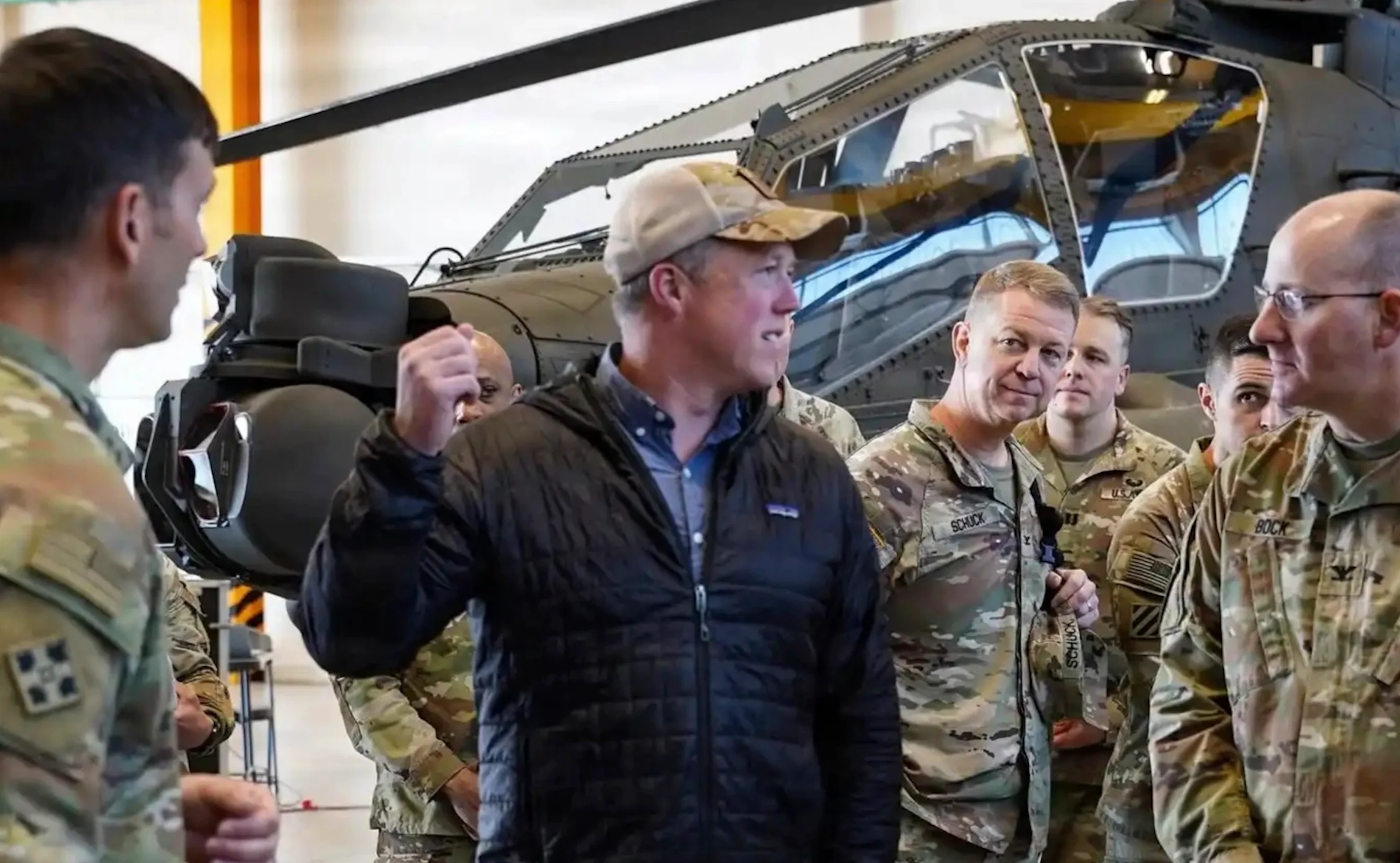
Driscoll’s departure comes while thousands of U.S. Army personnel remain deployed in the Middle East amid the conflict with Iran, and as the service confronts major questions about drone warfare, procurement, force structure and readiness for potential future conflicts.
The resignation followed repeated disagreements between Driscoll and Hegseth, officials and people familiar with the matter said. The most visible source of friction involved Hegseth’s decision to fire or sideline senior Army officers, including former Army Chief of Staff Gen. Randy George, a close associate of Driscoll.
The dispute also reflected a larger contest over who would shape the Army’s next era: the civilian service secretary, who oversees training and equipping the force, or the defense secretary, who has taken an unusually direct role in personnel decisions across the military.
A sudden departure
Driscoll submitted his resignation to the White House after speaking with Trump about the state of the Army, according to a U.S. official. White House spokeswoman Anna Kelly said the administration viewed Driscoll as an effective official who had advanced Trump’s military agenda.
“Secretary Driscoll has been highly effective in advancing President Trump’s agenda to Make America Strong Again at the Department of the Army by providing outstanding leadership during historic military operations, restoring an emphasis on readiness and lethality, assisting with negotiations between Russia and Ukraine, and more,” Kelly said in a statement.
Reuters initially reported that Driscoll had tendered his resignation and that it was unclear whether the White House had accepted it. ABC News later reported that Trump accepted the resignation Monday evening.
Driscoll had served as Army secretary since the Senate confirmed him in February 2025. He was an Iraq war veteran, former cavalry officer in the Army’s 10th Mountain Division, Yale Law School graduate and former adviser to Vice President JD Vance.
His connection to Vance gave him unusual access within the Trump administration and, according to one U.S. official cited by Reuters, may have complicated any effort by Hegseth to remove him directly.
The departure was not entirely unforeseen. The Wall Street Journal reported in August that Driscoll was expected to leave by the end of the year after months of tension with Hegseth. But the timing, as the United States faces an expanding confrontation with Iran, gives the resignation additional significance.
Friction over Army leadership
The most direct source of conflict was personnel.
Hegseth fired Gen. Randy George, the Army’s chief of staff, in April. Officials said the move caught Driscoll off guard. The Pentagon did not publicly provide a detailed explanation for George’s removal, and Driscoll later told lawmakers that he did not know why his top uniformed partner had been dismissed.
Driscoll and George had worked closely on the Army Transformation Initiative, a plan designed to make the service more adaptable, more technologically capable and less dependent on older systems and large-scale procurement practices. A central component involved expanding the Army’s use of unmanned systems, including drones shaped by lessons from the war in Ukraine.
The loss of George intensified concerns among officials who believed the Army needed to move faster in adapting to emerging forms of warfare.
A source familiar with the matter told Reuters that Driscoll raised concerns with the administration about Army modernization and readiness. The source said Hegseth’s removal of generals responsible for transformation efforts had hindered those plans.
The disagreements did not end with George.
Hegseth also pushed out the head of U.S. Army forces in Europe in June and personally blocked promotions of senior Army officers, Reuters reported. ABC News said Hegseth’s removal or sidelining of officers being considered for promotion to general was one of the most notable points of dispute between the two men.
CBS News reported that Driscoll and Hegseth had differed over the direction of the Army and the future of a drone battalion created to study the lessons of Ukraine’s intensive drone warfare. The unit had support from George and Gen. Christopher Donahue, the former commander of U.S. Army Europe and Africa, but was reportedly facing plans to be phased out amid internal disagreements.
The argument was not merely bureaucratic. It concerned how the Army should prepare for a future in which low-cost drones, electronic warfare, artificial intelligence, precision-guided weapons and rapidly changing battlefield tactics can challenge traditional military advantages.
Modernization and the defense industry
Driscoll had built a reputation as an advocate for faster acquisition and a critic of the Pentagon’s traditional relationship with major defense contractors.
“The defense industrial base broadly, and the primes in particular, conned the American people and the Pentagon and the Army,” Driscoll said last year, referring to large defense companies, according to Reuters.
His criticism reflected a broader frustration within parts of the military that large acquisition programs can be slow, expensive and poorly suited to the pace of technological change.
The Army Transformation Initiative was intended to address some of those concerns. It focused on improving readiness while shifting investments toward capabilities likely to matter in future conflicts, including drones, autonomous systems, air and missile defense, electronic warfare and smaller, less expensive weapons systems.
Driscoll’s departure raises questions about whether those efforts will continue at the same pace or be reshaped under new leadership.
Hegseth has emphasized readiness and lethality, language also echoed by the White House in its statement praising Driscoll. But the two officials appear to have disagreed over how to achieve those goals — particularly on the role of senior leaders associated with transformation programs and on the degree to which the Pentagon leadership should intervene in Army-specific decisions.
The outcome could affect contracts, force-design plans, research priorities and the Army’s relationship with emerging defense-technology companies.
A leadership gap during conflict
The resignation adds uncertainty at a moment when the U.S. military faces operational pressure overseas.
The United States remains involved in a conflict with Iran, with thousands of American troops deployed in the Middle East. The Army provides critical capabilities in that environment, including air defense, logistics, intelligence, communications, force protection and ground-based support for regional operations.
The service must also continue balancing its long-term focus on Europe and the Indo-Pacific, where the United States sees major strategic challenges from Russia and China.
Driscoll himself had been assigned a diplomatic role beyond the normal responsibilities of an Army secretary. Trump tapped him to participate in discussions with Russian and Ukrainian officials as the administration sought to advance negotiations to end the war in Ukraine.
That unusual assignment illustrated Driscoll’s standing within the administration and his relationship with the White House. It also made his resignation more consequential than a standard service-level personnel change.
In addition to Driscoll’s departure, Deputy Army Undersecretary Dave Fitzgerald was expected to resign, according to a source cited by Reuters and a U.S. official cited by CBS News. Fitzgerald had focused on innovation within the Army.
The potential loss of both officials could disrupt modernization programs at a time when the Pentagon is trying to adapt to new forms of warfare while maintaining conventional readiness.
No successor was announced immediately.
Hegseth’s Pentagon
Driscoll’s resignation is part of a broader pattern of turnover within the Defense Department under Hegseth.
Reuters described Driscoll as the latest senior official either fired or pushed out in Hegseth’s Pentagon. Several senior officers have retired or left after leadership changes, including George, Donahue and Adm. Alvin Holsey, the former commander of U.S. Southern Command, according to CBS News.
Supporters of Hegseth argue that changing the Pentagon’s leadership is necessary to align the armed forces with Trump’s priorities and to remove officials associated with prior military policies. Critics argue that abrupt personnel changes can weaken institutional knowledge, create instability and discourage experienced leaders from serving in senior roles.
A U.S. official told Reuters that Hegseth viewed Driscoll as a threat within the Pentagon bureaucracy and had long wanted him removed. The Defense Department did not publicly respond to the characterization.
The account underscores the degree to which the dispute extended beyond a single policy disagreement. It reflected competing views about civilian control, leadership loyalty and the balance of authority between the Pentagon’s top office and the individual military departments.
The Army secretary is responsible for civilian oversight of the Army, including its budget, personnel, equipment and readiness. The defense secretary, meanwhile, oversees the entire Defense Department. A productive relationship between those positions is essential to smooth decision-making.
The breakdown between Driscoll and Hegseth suggests that relationship had become untenable.
Congressional reaction and oversight
Driscoll had support on Capitol Hill, including among some Republicans who praised his approach to modernization.
Rep. Pat Harrigan, a Republican from North Carolina, said Driscoll “brought urgency to an institution that cannot afford complacency” and added that his service to the country was “far from over.”
Congress is likely to scrutinize the transition, particularly if the Army faces delays in filling senior civilian and uniformed positions or if transformation initiatives are paused.
Lawmakers may also press the Pentagon for clarity on promotion decisions. Senior military promotions require careful vetting and, for many positions, Senate confirmation. Disputes over who advances into senior command can have long-term effects on the service’s leadership pipeline.
The issue carries political weight because the Army is trying to modernize after two decades in which counterinsurgency missions in Iraq and Afghanistan shaped much of its force structure and procurement. The service now faces pressure to prepare for possible large-scale conflict involving drones, long-range missiles, cyber operations and sophisticated adversaries.
What comes next
Driscoll’s resignation is effective after the White House formally completes the transition process, and it was not immediately clear who would serve as acting Army secretary or who Trump might nominate as a permanent replacement.
The next leader will inherit difficult choices:
- Whether to preserve, revise or slow the Army Transformation Initiative.
- How to fill senior leadership vacancies and manage promotion disputes.
- How to sustain readiness while soldiers remain deployed to the Middle East.
- How to invest in drones, autonomous systems and other emerging technologies.
- How to work with Hegseth and the White House on broader Pentagon priorities.
The choice of successor will offer an early indication of whether the administration wants continuity with Driscoll’s modernization agenda or a more direct realignment with Hegseth’s approach.
For now, the departure leaves the Army without one of its most prominent civilian advocates at a moment of war, institutional change and technological transition.
The White House praised Driscoll’s service. Yet the circumstances surrounding his resignation, including disputes over senior leaders, military readiness and the direction of Army reform, make clear that his departure is also a significant setback for an institution trying to prepare for wars it may not yet fully understand.




