
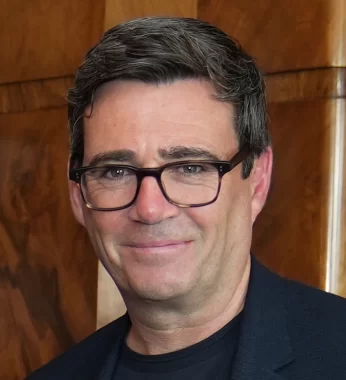
Andy Burnham is a veteran Labour politician who has reinvented himself from Westminster cabinet minister to “King of the North,” and now stands as the leading soft‑left challenger to replace Keir Starmer as Labour leader and potentially become Britain’s next prime minister. A former health secretary and long‑serving MP who became the first directly elected mayor of Greater Manchester, he has built a national profile by championing regional power, public transport, and social justice, while consciously positioning himself outside the London political “bubble”.
Early life and Westminster rise
Born in Aintree, Merseyside, on 7 January 1970, Andrew “Andy” Burnham grew up in a working‑class family in the North West of England, between Liverpool and Manchester. He joined the Labour Party as a teenager, studied at Cambridge University and entered Parliament in 2001 as MP for Leigh, a former mining seat in Greater Manchester.
Burnham quickly rose through the Labour ranks during the New Labour years. He served in ministerial posts at the Home Office, Treasury and Department of Health, before joining Gordon Brown’s cabinet as Culture Secretary in 2008 and then Health Secretary in 2009. In opposition after 2010, he became shadow education, health, and home secretary, giving him a high profile across a range of domestic policy briefs.
Twice he sought the Labour leadership, finishing fourth in 2010 and coming second to Jeremy Corbyn in 2015, but those defeats pushed him to look beyond Westminster. Disillusionment with “conventional politics”, he has said, set in around 2009, when as culture secretary he was heckled at a Hillsborough memorial and came to support families’ calls for a fuller inquiry into the disaster.
Mayor of Greater Manchester and ‘King of the North’
In 2017, Burnham stepped down from Parliament to run for the newly created post of Greater Manchester mayor, winning comfortably and then securing re‑election in 2021 and 2024. As mayor, he chaired the Greater Manchester Combined Authority, steering policy on transport, housing, policing and economic development across 10 boroughs.
His tenure has been defined by an effort to rebuild local control and visibility for a region long overshadowed by London. He pushed through franchising reforms to create the Bee Network, an integrated bus and tram system aimed at bringing public transport back under local oversight and backed initiatives to tackle homelessness and rough sleeping. Under his watch, Manchester city center saw rapid regeneration, with new skyscrapers rising on ex‑industrial land and a growing reputation as a cultural and tech hub.
Burnham’s confrontations with Boris Johnson’s Conservative government during the Covid‑19 pandemic cemented his public image. He accused London of a “London‑centric” approach to lockdowns and financial support, arguing that the North was being forced into restrictions without adequate compensation; the media and supporters began to call him the “King of the North,” borrowing from Game of Thrones. Initially a tongue‑in‑cheek nickname, it has stuck as shorthand for his role as champion of regional England.
Political positioning and ‘Manchesterism’
Burnham casts himself as “soft left”, to the left of Keir Starmer on economic questions, but without the ideological baggage of the Corbyn era. Al Jazeera describes him as a favorite among Labour members who see him as a northern, plain‑speaking antidote to the Westminster establishment, even though he is in fact a former insider.
He has sketched out a philosophy he calls “Manchesterism”, which he defines as putting “people and places ahead of party”, with a focus on towns and regions that, he argues, have been neglected by a London‑centric state. In a post‑by‑election speech highlighted by the Washington Post, Burnham set priorities that include expanding vocational education, improving job opportunities for young people, cutting energy bills and rail fares, and ending what he calls “trickle‑down economics,” which he says has failed areas like his.
On national issues, he backed a stronger response to the economic fallout from Brexit and has criticized Labour for being too cautious in addressing its regional impacts. He has stressed support for NATO and previously warned he would resign from Jeremy Corbyn’s shadow cabinet if the party moved to leave the alliance, signaling a more traditional Atlanticist stance on defense.
Hillsborough, Everton, and personal profile
Burnham’s politics are tightly bound to his northern identity. A lifelong Everton fan, he has leveraged football’s cultural power while campaigning for justice for the 97 Liverpool supporters who died in the 1989 Hillsborough disaster, earning respect among campaigners for helping push for inquiries and disclosure.
He is married with three children and lives in Leigh, to the west of Manchester, maintaining close ties to the communities he represented in Parliament and then as mayor. Supporters and profile writers often highlight his down‑to‑earth persona, favoring T‑shirts over suits, playing five‑a‑side football and DJing 1990s tracks at charity nights, as part of his appeal beyond traditional political audiences.
This image as an approachable “lad from the North” has been central to his brand, especially when contrasted with London‑based leaders. The BBC notes he is regularly ranked among Labour’s most popular politicians in internal polling, particularly among members and younger voters.
Return to Westminster and Starmer succession talk
By 2026, as Keir Starmer faced mounting criticism over stalled reforms and internal party tensions, attention turned to Burnham as a potential alternative. He initially clashed with Labour’s national executive committee when it blocked him from contesting a by‑election in Gorton and Denton, a move widely seen as an attempt to shield Starmer from a potential rival.
Undeterred, Burnham sought and won selection in the Makerfield by‑election, a safe Labour seat in the North West. In June 2026 he returned to the House of Commons, winning what the Washington Post described as a “landslide” over Reform UK and other challengers, and framed the result as a “turning point” in British politics.
The BBC reports that his return to Parliament clears the way for a third attempt at the Labour leadership, with allies viewing the party’s annual conference in the autumn as a potential launch pad if Starmer’s position weakens further. Within Labour, he is now seen as the most serious soft‑left challenger: popular with members, credible to business and local leaders, and battle‑tested in city‑region government.
Critiques, challenges, and the road ahead
Burnham’s critics argue that his outsider image is overstated for a man who spent years in cabinet and the shadow front bench. Some Labour MPs question whether his strong regional focus and confrontational style with Westminster would translate smoothly to national office, where compromises with the Treasury, business and unions are unavoidable.
There are also questions about policy detail behind slogans such as “Manchesterism” and his ability to build a broad coalition that includes both metropolitan remain‑leaning voters and Leave‑supporting towns. Others note that, despite his popularity, he has twice failed to win the party leadership and still faces internal resistance from figures loyal to Starmer.
Yet the political mood has shifted since those earlier contests. Regional inequality, public services under strain and frustration with centralized decision‑making have all moved closer to the centre of UK debate, creating conditions more receptive to Burnham’s message. With a parliamentary seat reclaimed and his profile at a national high, the question for Labour, and for Britain, is no longer simply who Andy Burnham is, but whether the “King of the North” can convert regional power into a claim on 10 Downing Street.