
MONTEREY, California — Ferrari’s first fully electric vehicle has become the most expensive new car ever sold at auction after a bespoke Luce “Chassis 0” fetched $40 million at RM Sotheby’s during Monterey Car Week.
The sale was not a conventional measure of the coming car’s retail value. The standard Ferrari Luce is expected to start at €550,000, or roughly $640,000, when customer deliveries begin. The $40 million result reflected the singular status of the auction car: the first production chassis of Ferrari’s inaugural electric-vehicle program, built as a one-off through the company’s Tailor Made personalization division and sold to benefit education programs.
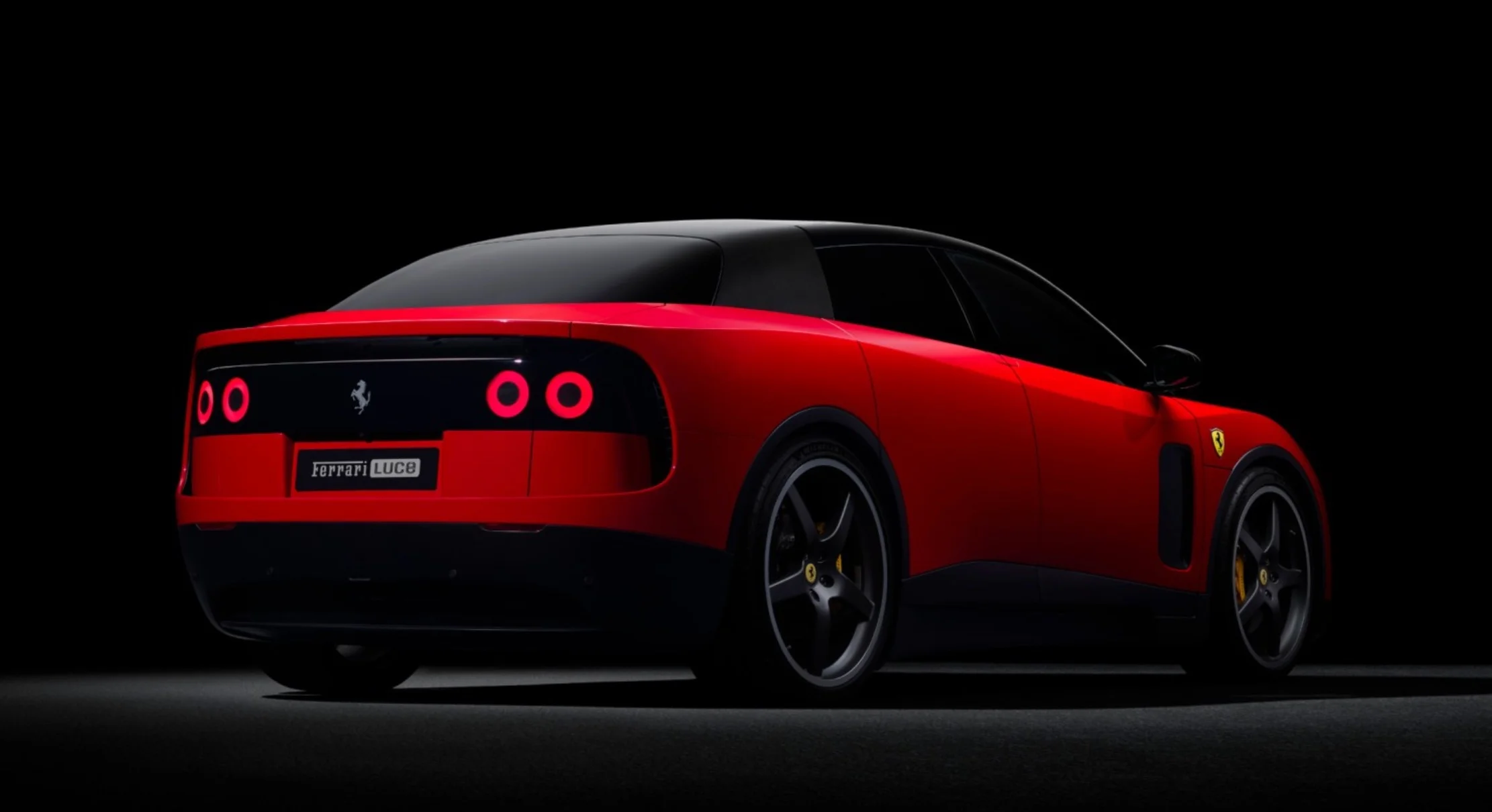
The buyer was Herbert A. Wertheim, a U.S. billionaire investor, optometrist and Ferrari collector, according to Reuters. Ferrari said all of the auction proceeds will be directed through the Ferrari Foundation to education projects for young people in the United States and elsewhere.
The sale gives Ferrari a symbolic early victory as it enters the battery-electric era. The Luce has faced criticism from some enthusiasts who view its four-door, five-seat format and electric powertrain as a sharp departure from the company’s combustion-engine heritage. But the auction result demonstrated that scarcity, heritage and charitable purpose can generate extraordinary demand even for a car representing a major break with Ferrari tradition.
A $40 million record, and what it means
The auction price sets a world record for the highest-priced new car sold at auction, Ferrari said. It eclipsed the prior record held by a customized Ferrari Daytona SP3 that sold for $26 million in 2025.
The sale was conducted without a reserve, meaning there was no minimum price required for the car to be sold. RM Sotheby’s also waived the standard buyer’s premium, allowing the full $40 million hammer price to go to the Ferrari Foundation rather than allocating part of it to auction fees.
That structure makes the figure different from an ordinary luxury-car transaction. The buyer was acquiring a highly customized, historically significant first production example, while also making a charitable contribution. The $40 million price should therefore not be read as a market benchmark for the standard Luce, which Ferrari plans to sell at a much lower, though still ultra-luxury, retail price.
Still, the sale carries strategic importance. Ferrari is launching the Luce at a moment when some established automakers are rethinking or slowing parts of their electric-vehicle strategies amid uneven consumer demand, price competition and questions about charging infrastructure.
The auction showed that Ferrari can frame its first EV not merely as an emissions-free alternative to a gasoline model, but as a collector-grade object tied to the brand’s history and craftsmanship.
For Ferrari, that distinction may be essential. Its customers do not generally buy cars only for transportation. They buy design, performance, rarity, cultural status and a connection to an Italian marque whose identity has long been defined by engines, racing and exclusivity.
The Luce: Ferrari’s electric debut
The Luce is Ferrari’s first fully electric production car. It is a five-seat, four-door model that represents a major departure from the two-seat supercars and grand tourers most closely associated with the company.
Ferrari unveiled the vehicle in May, and the launch immediately sparked debate among enthusiasts, investors and automotive analysts. Some traditionalists criticized the styling and questioned whether a battery-electric vehicle could deliver the emotional character associated with Ferrari’s V8 and V12 engines.
The company’s challenge is substantial. Ferrari has built its global reputation around internal combustion engines whose sound, response, and mechanical drama are central to the ownership experience. Electric motors offer immediate torque and potentially extraordinary acceleration, but they do not replicate the sound or tactile sensation of a high-performance gasoline engine.
Ferrari has sought to position the Luce as a distinct product rather than a direct replacement for any existing model. The car is intended to combine electric performance with the comfort, luxury and usability of a more spacious grand tourer.
The €550,000 starting price places it well above most luxury EVs and reinforces Ferrari’s strategy of competing at the highest end of the market. The company is not attempting to win the electric-vehicle race through volume. It is attempting to preserve scarcity and pricing power while expanding its technology base.
Deliveries of the standard Luce are expected to begin in the fourth quarter of 2026, while the $40 million auction car is expected to return to Ferrari’s Maranello headquarters before being delivered to its owner in the first quarter of 2027.
What made “Chassis 0” unique
The $40 million car was not simply an early example from the Luce production line. It was designated “Chassis 0,” identifying it as the first production chassis of Ferrari’s new electric-vehicle program.
It was created through Ferrari Tailor Made, the company’s bespoke program that allows customers to commission individualized colors, materials, finishes, and design details. The auction vehicle included a unique Madreperla semi-gloss exterior finish, and other details developed specifically for the car.
The vehicle was also produced with input from Jony Ive, the British designer known for his work on Apple products including the iPhone. Ive’s involvement added another layer of interest because his design reputation extends well beyond the automotive world.
The association with Ive helped reinforce Ferrari’s effort to present the Luce as an object of design as much as an engineering achievement. Electric vehicles often face a challenge in differentiating themselves when powertrains become less visible to owners. Ferrari’s answer is to emphasize materials, form, customization, and the story embedded in the vehicle.
That approach is familiar to high-end collectors. In the classic-car market, a vehicle’s value can depend on provenance, rarity, original specifications, ownership history, and significance within a manufacturer’s broader story. “Chassis 0” has all of those qualities from the moment it leaves the factory.
Its sale price reflects that unique position. The vehicle is not just the first Ferrari EV. It is the first production example of a major technological transition for one of the world’s most valuable automotive brands.
A charity sale with global ambitions
Ferrari said the $40 million proceeds will support educational programs through the Ferrari Foundation, a U.S.-based 501(c)(3) charity.
The foundation’s involvement transformed the auction from a conventional collector-car sale into a philanthropic event. The buyer’s payment will support initiatives aimed at helping young people access education in the United States and elsewhere, Ferrari said.
Charity auctions are a well-established part of Monterey Car Week, the annual gathering of collectors, automakers, auction houses and enthusiasts on California’s central coast. The event has become a major marketplace for rare and historic vehicles, but it also serves as a showcase for new luxury cars, design concepts, and automotive-brand positioning.
For Ferrari, the event offered an ideal setting. Monterey brings together buyers who understand collector value and are willing to pay for rarity, heritage and exclusivity. The decision to sell “Chassis 0” there placed the company’s electric future directly before its most committed customer base.
It also allowed Ferrari to make a statement without relying entirely on technical specifications or performance data. A record charity price can carry a message that is easier for the public to understand: Ferrari’s electric debut may be controversial, but it has already attracted extraordinary interest.
A debate over Ferrari’s electric future
The Luce’s launch prompted resistance from some Ferrari purists. Critics have argued that a fully electric Ferrari lacks the engine sound and mechanical character that define the brand. Others have questioned the car’s design and its practical four-door layout.
Ferrari faces a broader industry question: can legacy performance brands move toward electrification without weakening the qualities that made customers value them in the first place?
For Ferrari, the answer cannot simply be faster acceleration. Many electric vehicles already deliver rapid acceleration, and luxury customers have numerous options. The company must make the Luce feel unmistakably Ferrari through driving dynamics, craftsmanship, limited production, personalization and brand experience.
The $40 million auction does not settle that debate. One record-setting, charity-driven sale cannot prove that broad consumer demand for the standard Luce will be strong. But it gives Ferrari a valuable narrative: its first EV is not merely tolerated by collectors; its first example has become a landmark in the collector-car market.
The company’s sales strategy will now be tested by deliveries. Customers who pay €550,000 for a production of Luce will expect more than symbolism. They will judge how the car performs, how it feels to drive, how it charges, how it holds value, and whether Ferrari has created an electric experience worthy of its badge.
Why the sale matters beyond Ferrari
The Luce auction result is relevant beyond one brand because it illustrates a possible path for luxury automakers to navigate the electric transition.
Mass-market manufacturers must compete on battery range, charging, price, software and production scale. Ferrari operates under different rules. Its business depends on limited supply, high margins, and powerful emotional loyalty. That allows it to treat electrification as an expansion of the brand’s craftsmanship rather than solely a regulatory or technology requirement.
The $40 million result also shows the enduring power of firsts. Collectors place premium value on historically important vehicles: the first model of a new generation, the final example of an old engine, the first car owned by a notable figure, or a special commission created for a milestone.
“Chassis 0” combines several of those factors. It is the first production unit of Ferrari’s first EV, a bespoke Tailor Made vehicle, connected to a charitable purpose and sold at one of the world’s most prominent collector-car events.
The sale’s larger message is that Ferrari’s electric era has begun with a record. Whether that momentum translates into a successful production model will depend on what happens after the auction, spotlight fades.
For now, the $40 million Luce stands as an unusual symbol of the industry’s transformation: an electric car valued not only for battery technology or performance, but for history, design, scarcity and a donation intended to extend its impact beyond the road.