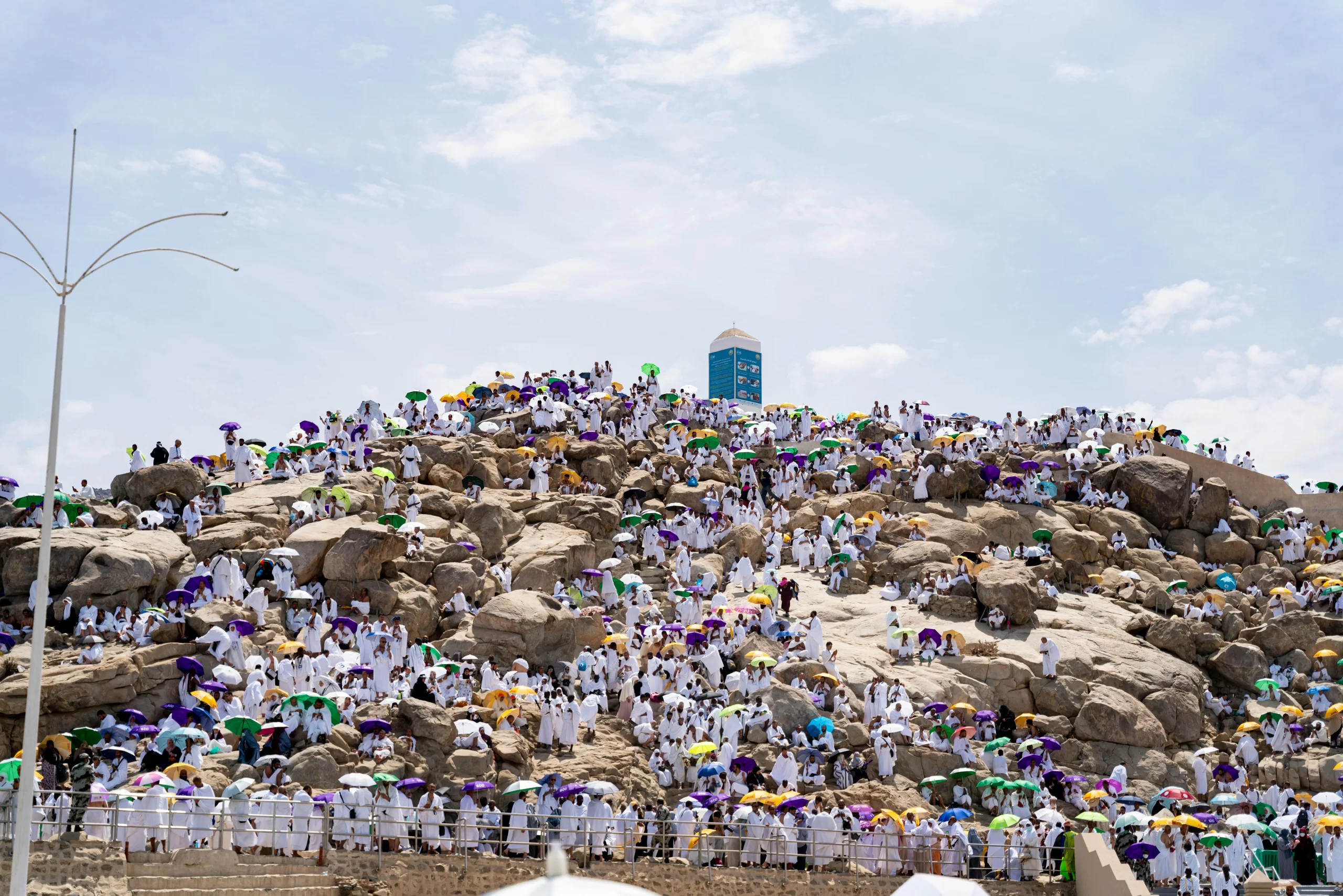
More than 1.5 million Muslim pilgrims gathered at Mount Arafat in western Saudi Arabia on Tuesday, standing for hours in searing desert heat for the most sacred day of the annual Hajj pilgrimage. Clad in simple white garments and sheltering under umbrellas, worshippers raised their hands in prayer on the rocky hill and surrounding plain where Prophet Muhammad is believed to have delivered his final sermon more than 1,400 years ago.
At the “Mount of Mercy,” Hajj reaches its summit
From the early hours of Tuesday morning, convoys of buses and long streams of pilgrims on foot moved from the tent city of Mina to the plain of Arafat, some 20 kilometers east of Mecca. By mid‑morning, the 70‑metre hill known as Jabal al‑Rahmah, the “Mount of Mercy,” and the surrounding plateau were carpeted with worshippers in white ihram garments, symbolizing unity, and equality before God.
The ritual “standing” at Arafat, known in Arabic as wuquf, is widely described as the pinnacle of the Hajj: Islamic tradition holds that a pilgrim’s Hajj is incomplete without it. PBS, quoting religious scholars, notes that the Prophet Muhammad’s farewell sermon was delivered on this plain and that a key Quranic verse proclaiming the completion of the religion was revealed here, giving the site enduring spiritual weight.
Under a midday sun that pushed temperatures close to 40 degrees Celsius, worshippers recited verses from the Quran, raised their hands in supplication and wept openly as they asked for forgiveness, mercy, and good health. “It is an indescribable feeling,” one 35‑year‑old Egyptian engineer told Al Jazeera as he climbed Arafat for the first time.
Heat, umbrellas, and a massive logistical operation
This year’s Arafat day unfolded under scorching conditions, with recent highs in the Mecca region reaching 44 degrees Celsius, according to local media and official advisories. Saudi authorities urged pilgrims to stay hydrated, avoid prolonged exposure and use umbrellas as they performed mostly outdoor rituals that can stretch over five or six days.
Images and video from Arafat showed crowds huddled under a sea of light‑colored umbrellas, while volunteers lined the routes handing out water bottles, juice, food parcels and shaded rest spots. Security personnel and medical teams were deployed along roads and walkways to manage crowd flows and treat cases of heat stress.
Turkey‑based outlets reported that around 1.8 million pilgrims headed to Arafat on Tuesday, citing Saudi Press Agency figures on convoys and crowd management. Other international news organizations, including AP and Al Jazeera, put the overall Hajj attendance at just over 1.5 million people, noting that a Saudi official had announced that number of foreign pilgrims entering the kingdom before the rituals began.
Despite the huge numbers, state media said traffic from Mina to Arafat remained “smooth” under an extensive security and logistics plan, with pilgrims scheduled to perform combined midday and afternoon prayers at the Namirah Mosque before remaining in supplication until sunset.
A global gathering under the shadow of conflict
The Arafat gathering, by design, is borderless: pilgrims come from every continent, speaking dozens of languages, united by the same intention. Yet this year’s Hajj has taken place against the backdrop of war and political tension in the wider Middle East.
Al Jazeera notes that more than 1.5 million pilgrims made the journey to Saudi Arabia “despite ongoing conflict that sees the United States and Israel in opposition to Iran, casting a significant shadow over the region.” Pakistan’s Dawn similarly reports that over 1.5 million participants have joined Hajj “amidst the ongoing conflict in the Middle East fueled by the US and Israeli actions against Iran.”
Iran’s own contingent illustrates the impact. Dawn and other outlets say around 30,000 Iranians are taking part this year, roughly one‑third of the 86,000 who were originally expected. Iranian state news agency IRNA has blamed the drop on the prevailing “wartime situation,” even as authorities in Tehran have encouraged those who can travel to complete the pilgrimage.
Despite these tensions, the atmosphere on the ground at Arafat remained focused on prayer and reflection. “People are very aware of what is happening in the world, but here they are trying to concentrate on their relationship with God,” one reporter quoted a pilgrim from Nigeria as saying.
What happens after Arafat: Muzdalifah and “stoning the devil”
As the sun set over the plain of Arafat, the vast crowds began moving again, this time toward Muzdalifah, an open area where pilgrims spend the night under the sky. There, they perform the sunset and night prayers and collect small pebbles for the next day’s ritual in Mina.
The stones are used in the symbolic “stoning of the devil” at Jamarat, where pilgrims throw seven pebbles at each of three concrete pillars representing Satan, reenacting the Prophet Ibrahim’s rejection of temptation in Islamic tradition.
The sequence, standing at Arafat, spending the night at Muzdalifah, then proceeding to Mina for the stoning and the Eid al‑Adha sacrifice, forms the core of the multi‑day Hajj rites. After completing the stoning and sacrifice, pilgrims return to Mecca to perform a farewell circumambulation of the Kaaba before heading home.
For many, however, the emotional peak has already passed at Arafat. Saudi media frequently describe the Arafat day as “often the most memorable” part of Hajj, a time when pilgrims feel a unique intensity of closeness to God and a cleansing of past sins.
Personal devotion in a vast crowd
Despite the sheer scale of the event, much of the reporting from Arafat focuses on individual stories of devotion. PBS describes pilgrims raising their hands “with sincerity,” some sobbing as they seek “divine forgiveness, mercy, blessings, and health.”
Al Jazeera’s correspondent at the site interviewed first‑time visitors who had saved for years to make the trip, including a young engineer from Egypt who said, “It is an indescribable feeling” to stand where the Prophet spoke his last sermon. Footage from TRT World shows pilgrims from Indonesia, Turkey, West Africa, and Europe taking turns to climb partway up the rocky slope, finding any spare patch of ground to sit, read or simply look out over the crowd.
For many Muslims, being at Arafat brings life events into sharp focus. One elderly pilgrim from South Asia told a local channel she was praying for her children’s health and for peace in conflict‑hit regions. Another, from Europe, said he had come “to ask God to forgive my mistakes and to make me a better person when I go back.”
Managing faith and risk in a warming world
The scenes at Arafat also highlight the growing challenge of managing mass religious gatherings in an era of rising temperatures. Saudi health officials have repeatedly warned of heatstroke dangers and have expanded shaded areas, misting stations and emergency response units during Hajj seasons that increasingly coincide with the hottest months.
This year, officials urged pilgrims to follow strict guidance: drinking plenty of water, avoiding direct sun in the midday hours where possible, and looking out for vulnerable companions. Volunteers and civil‑defense units stood ready along Arafat’s slopes and plains to transport those in distress to cooling centers and field hospitals.
At the same time, pilgrims, and religious leaders stress that the physical hardship is part of the spiritual meaning of Hajj. “We endure this heat for God’s sake,” one pilgrim told a regional broadcaster at Arafat. “It reminds us of our weakness and His mercy.”
A moment of unity amid fractured politics
As the buses and walking groups left Arafat for Muzdalifah on Tuesday night, they carried with them snapshots of a global faith community at a time of regional strain.
News outlets from Saudi Arabia to Pakistan have stressed that over 1.5 million people still made the journey this year despite war, uncertainty, and economic pressures, underscoring both the centrality of Hajj in Muslim life and the scale of the logistical effort to host it.
For those who stood on the Mount of Mercy, the politics receded, at least for a day. “We are all equal here,” a pilgrim from West Africa told TRT World. “Kings and workers, rich and poor, we wear the same cloth and ask the same Lord to forgive us.”
Whether that sense of unity can survive the return journeys through a region still on edge remains to be seen. But for a few intense hours at Arafat, under a white sun and a sea of white cloth, the world’s fractures gave way to a shared, ancient ritual, one that millions of Muslims will carry back into their lives long after the desert dust has settled.