
NEW YORK — Novak Djokovic’s pursuit of a record 25th Grand Slam singles title ended in a stunning first-round defeat at the U.S. Open on Sunday, when unseeded Argentine Mariano Navone outlasted the four-time champion in a five-set match marked by heat, illness and an apparent back problem.
Navone, ranked No. 49 in the world, defeated the 39-year-old Serbian 7-6 (5), 5-7, 4-6, 6-2, 6-1 in four hours and 36 minutes at Arthur Ashe Stadium. The result was Djokovic’s first loss in the opening round of the U.S. Open and his first defeat in the opening round of any Grand Slam tournament since the 2006 Australian Open.
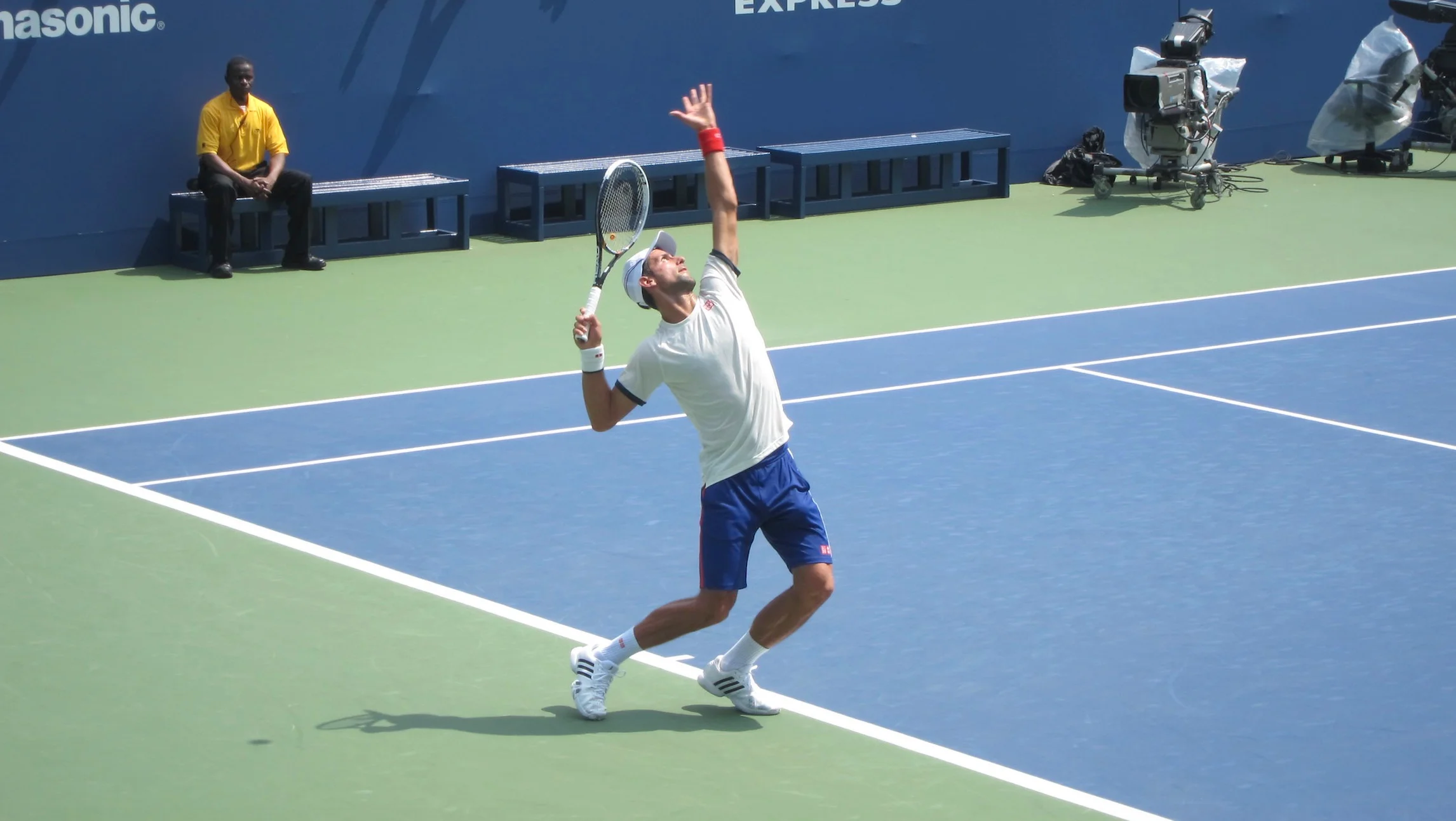
Djokovic, the No. 4 seed, had never previously lost a first-round match in 20 appearances at Flushing Meadows. The defeat also ended one of the most closely watched storylines of the year’s final major: whether the Serbian could win a 25th Grand Slam singles title and move alone ahead of Margaret Court’s record of 24.
Instead, Navone produced the biggest victory of his career, resisting Djokovic’s fightback and taking control as the veteran’s physical struggles became increasingly apparent in the final two sets.
“Five sets, against the GOAT, it’s not something you do every day,” Navone said in his on-court interview. “I’m very happy. It means a lot to me. It’s a dream come true.”
For Djokovic, the loss was a painful reminder that even one of tennis’ most durable champions now faces a harder physical calculation in the later stages of his career.
A historic upset at Ashe
The match began with Djokovic appearing to establish control.
He raced to a 3-0 lead in the first set against Navone, a 25-year-old Argentine who entered the match without a Grand Slam title or a victory of comparable scale. But the humid conditions at Flushing Meadows soon became a factor, and a short delay to close the Arthur Ashe Stadium roof because of rain interrupted the momentum.
Navone broke back to level the set at 4-4, then forced a tiebreaker. He won it 7-5, drawing a sharp reaction from a crowd that had arrived expecting Djokovic to make a routine advance into the second round.
Djokovic responded in the way he has so often during his career. He steadied himself, claimed the second set 7-5 and appeared to find another gear in the third. After vomiting into a courtside bin, Djokovic broke Navone for a 5-4 lead and served out the set despite an uneasy final service game.
At that point, the match seemed to be returning to a familiar pattern: Djokovic absorbing an early challenge, solving the tactical puzzle and using his experience to pull away.
But Navone did not fade.
The Argentine raised his level in the fourth set as Djokovic’s serving deteriorated. A back issue appeared to restrict Djokovic’s movement and power, especially late in points and during his service motion. Navone capitalized, winning the fourth set 6-2 and then taking the decider 6-1.
Djokovic was in tears shortly before Navone completed the upset.
The result was not only an early exit. It was Djokovic’s earliest departure from a Grand Slam tournament in two decades, since he lost to American Paul Goldstein in the first round of the 2006 Australian Open.
Fitness questions become decisive
Djokovic arrived in New York with questions about his fitness and limited match preparation.
He had played only one singles match after reaching the Wimbledon semifinals, losing in his opening match at the Cincinnati Open to Argentina’s Thiago Agustin Tirante. In that match, Djokovic struggled in intense heat and humidity, dropped to his knees during an 18-minute service game and received treatment before losing 2-6, 6-4, 6-4.
“It’s simply a health issue I have,” Djokovic said after the Cincinnati defeat. “It’s been troubling me for the past few years. I have a lot of problems, especially when there’s high humidity and heat.”
Those concerns followed him to New York.
The U.S. Open is often considered one of the most demanding Grand Slam tournaments because of its hard courts, late-summer heat, humidity, night sessions and the physical load of a potential seven best-of-five-set matches. For a player who turned 39 this year, those conditions can turn a single difficult match into a major obstacle.
Djokovic has repeatedly defied age in recent seasons, reaching the Australian Open final this year after beating Jannik Sinner in a five-set semifinal and later making another Wimbledon semifinal.
But Sunday’s defeat demonstrated the increasingly narrow margin he must manage. He still has the skill, tactical intelligence and competitive resilience to challenge any opponent. Yet he has less capacity for long matches, abrupt physical setbacks and the kind of recovery demands that were once routine during his most dominant years.
Against Navone, Djokovic’s ability to find a solution was ultimately overtaken by the physical toll of the contest.
Navone’s defining victory
For Navone, the win represents a transformative moment.
The Argentine entered the match as a clear underdog against one of the sport’s greatest players and one of the tournament’s most decorated champions. Djokovic owns four U.S. Open titles, reached a men’s-record 10 finals in New York and has spent much of the past two decades defining the standard for elite men’s tennis.
Yet Navone played with increasing confidence as the match wore on.
He was composed in the first-set tiebreaker, resilient after Djokovic took the next two sets and aggressive when the Serbian began showing visible physical limitations. Rather than simply waiting for Djokovic to make errors, Navone extended rallies, maintained pressure from the baseline and took advantage of a declining serve.
His reward was a victory few players achieve in a career: a win over Djokovic in a five-set Grand Slam match on the sport’s largest stage.
The emotional scale of the achievement was evident in his post-match remarks. Navone called Djokovic “the GOAT,” an acknowledgment of the stature of the opponent he had beaten.
For Argentine tennis, the upset adds a significant Grand Slam success at a time when younger players from the country are seeking to establish themselves beyond clay-court events. Navone’s breakthrough came not on his preferred European clay but on the hard courts of New York, against the most experienced opponent imaginable.
The win also sends Navone into the second round with confidence and attention that few expected before the draw was played.
The end of a record chase
Djokovic’s loss removes one of the tournament’s central attractions: his attempt to become the first player to win 25 Grand Slam singles titles.
The Serbian is tied with Margaret Court on 24 major singles championships, though their records were achieved in different eras and under different competitive conditions. A U.S. Open victory would have given Djokovic sole possession of the overall record and added a fifth title in New York to his collection.
His path had appeared more open after Jannik Sinner withdrew from the U.S. Open with a right-knee injury. But the draw still included formidable opponents, led by defending champion Carlos Alcaraz, along with Alexander Zverev and a younger group of contenders including Americans Ben Shelton and Taylor Fritz.
Djokovic’s loss changes the complexion of the men’s draw immediately.
Alcaraz, the defending champion, now has one less Grand Slam-winning obstacle in his section of the tournament. Other leading players will also see a more open path through a field that began with Djokovic as one of its most experienced and dangerous contenders.
It is too early to treat the defeat as a final verdict on Djokovic’s future. He has returned from difficult losses before, and his achievements have long been built on an unusual capacity to respond to adversity. A first-round exit at one major does not erase the fact that he reached the final in Australia and the semifinals at Wimbledon this year.
But it does raise sharper questions about how he will manage the schedule, physical preparation and recovery required to compete for major titles.
A rare moment of vulnerability
Djokovic’s career has been defined as much by endurance as by talent.
He has built his reputation on winning extended matches, reversing seemingly lost positions and sustaining a level of excellence across generations of opponents. His rivalry era with Roger Federer, Rafael Nadal and Andy Murray gave way to a later phase in which Djokovic remained a dominant force against younger players.
At the U.S. Open, he had been especially reliable in early rounds. The opening match was typically the point of the tournament at which Djokovic settled into the event, rather than where his campaign ended.
Sunday was different.
Navone’s victory exposed the reality that no player, regardless of reputation, can fully control the physical demands of elite tennis. Djokovic’s tactical skill and willpower carried him through portions of the match, but illness and a back issue appeared to prevent him from sustaining his level.
The sight of Djokovic in tears before the final games gave the defeat a human dimension beyond the scoreline. For a player accustomed to playing deep into the second week of majors, the loss was an unfamiliar kind of disappointment.
It was also a reminder of the uncertainty that makes Grand Slam tennis compelling. A 49th-ranked player can enter Arthur Ashe Stadium against a four-time champion, endure more than four and a half hours of pressure, and leave with the match that changes his career.
What comes next
Navone will move into the second round carrying momentum from the most important result of his career. His immediate challenge will be recovery after a four-hour, 36-minute marathon that ended close to midnight, as well as the heightened expectations that come with eliminating one of the sport’s biggest names.
Djokovic will leave New York to assess the health problems that undermined his campaign. The coming months will determine whether he adjusts his schedule, prioritizes recovery or targets the 2027 Australian Open as another opportunity to pursue a 25th major title.
For now, however, the defining fact is unmistakable.
Novak Djokovic, who had never lost in the first round of the U.S. Open, has done so for the first time. Mariano Navone, an unseeded player ranked outside the top 40, was the man who ended that streak, and who ended Djokovic’s latest bid for history.