
Ten dollars is easy to underestimate.
It might be a takeout coffee and pastry, a rideshare surcharge, a subscription that goes unnoticed, or a small online purchase made without much thought. But set aside every day, $10 becomes $70 a week, about $304 a month and $3,650 a year.
That amount will not make anyone wealthy overnight. It will not erase high-interest debt, replace a full emergency fund or guarantee retirement security. But used consistently, it can create something more important at the beginning of any financial plan: a saving habit.

The Consumer Financial Protection Bureau says even a small amount of emergency savings can offer financial security and help people recover from unexpected expenses without immediately relying on credit cards, loans or withdrawals from retirement accounts.
For households trying to make progress amid high living costs and competing financial priorities, the $10-a-day approach offers a simple framework. First build a cash buffer. Then reduce expensive debt. Then, once an emergency fund is in place and high-interest balances are under control, direct regular contributions toward long-term investing and retirement.
The formula is not complicated:
$10×365 days=$3,650 per year
What gives the habit power is not the single deposit. It is the combination of consistency, automation, time and, eventually, compound growth.
The first $3,650: More than a number
The first year of saving $10 a day produces $3,650 before interest. For someone with no cash reserve, that can be meaningful.
It could cover a car repair, an insurance deductible, part of an unexpected medical bill, a broken appliance or several weeks of essential expenses. More importantly, it can prevent a financial shock from becoming a debt problem.
The CFPB describes an emergency fund as funds set aside for unexpected expenses or financial emergencies such as car repairs, house repairs, medical bills and loss of income. Without savings, even a small, unexpected expense can push households toward credit cards or loans, potentially creating long-lasting debt through interest and fees.
This is why a daily-savings strategy should not begin with stock picking or a search for the highest possible return. It should begin with resilience.
A person who has $1,000 in accessible emergency savings is not financially invulnerable. But they are better positioned than someone who must put every surprise expense on a high-interest credit card. A dedicated cash reserve creates options: pay the bill, preserve a credit score, avoid expensive borrowing and return to normal budgeting faster.
The right objective will depend on income, household size, job security, insurance coverage, dependents, debt and recurring expenses. A freelancer with sporadic income could need a bigger financial reserve than a salaried worker with steady pay and robust benefits. A homeowner may need a different target than a renter. The CFPB recommends setting a specific savings goal based on the kinds of unexpected expenses a person has faced and the costs involved.
The critical point is that a small start still counts.
Turn daily intent into automation
Saving $10 every day manually can work. Some people like transferring money each morning or dropping cash into a labeled envelope. But habits that depend entirely on memory and willpower tend to break down when schedules get busy.
Automation is the more durable approach.
The CFPB recommends setting up recurring transfers through a bank or credit union, so money moves automatically from checking to savings. The agency also notes that workers paid by direct deposit may be able to split their paychecks between checking and savings accounts.
For a $10-a-day plan, that could mean:
- Transfer $70 from checking to savings every Monday.
- Transfer about $152 every two weeks after payday.
- Transfer about $304 at the start of every month.
- Direct a fixed percentage of each paycheck into a separate savings account.
- Save a portion of tax refunds, bonuses, gifts or freelance windfalls to accelerate progress.
The exact schedule matters less than matching the transfer to income. Someone paid biweekly may find it easier to save $140 or $150 per paycheck than to think in daily terms. Someone with unpredictable income might save 5% to 10% of each payment received, increasing contributions during stronger months.
A separate savings account can also help. The CFPB advises keeping emergency savings somewhere safe, accessible and less tempting to spend on non-emergencies. A bank or credit-union account dedicated to emergencies can create useful psychological distance from a daily spending account.
The balance should remain accessible enough for an urgent repair or medical cost. That makes a standard insured savings account, credit-union account or other low-risk cash account more appropriate for an emergency fund than volatile investments.
Automation does require attention. Transfers scheduled too aggressively can cause overdraft fees if checking balances run low. The CFPB advises monitoring balances with alerts or calendar reminders and adjusting automatic transfers if income or expenses change.
The compounding effect
Saving and investing are related but not identical.
Saving generally prioritizes stability and access to cash. Investing accepts market risk in pursuit of long-term growth. The $10-a-day strategy can serve both goals, but the order matters.
Money needed in the next few months or years, especially emergency savings, should not generally be exposed to major stock-market swings. A market decline that cuts a portfolio’s value just as a person loses a job or faces a large bill is not a useful financial cushion.
Once an emergency reserve is established and high-interest debt is being addressed, however, regular contributions can be invested for long-term goals. That is where compound growth can make a modest daily amount more significant.
Consider a hypothetical example. Assume someone invests $3,650 at the end of every year, earning an average annual return of 7%. This is not a promise, and markets do not deliver steady returns every year. It is simply an illustration of how time and reinvested growth work.
| Years of investing | Total contributed | Hypothetical value at 7% annual return |
|---|---|---|
| 5 years | $18,250 | About $21,000 |
| 10 years | $36,500 | About $50,000 |
| 20 years | $73,000 | About $160,000 |
| 30 years | $109,500 | About $345,000 |
The math behind the illustration is the future-value formula for regular annual contributions:
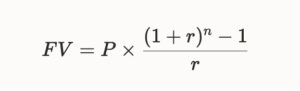
Where P is the yearly contribution, is r the assumed annual return and n is the number of years.
The lesson is not that $10 a day automatically becomes $345,000. It will not if contributions stop, fees are high, funds are withdrawn early or returns are lower than assumed. Inflation will also reduce the future buying power of any nominal dollar amount.
The lesson is that time matters. The earlier and more consistently a person invests, the more opportunity compound growth has to work.
A person who starts at age 25 has a different advantage from someone who starts at 55, even if both contribute the same daily amount. That is not an argument for panic. It is an argument for beginning with what is manageable now.
Prioritize the financial order
The most effective use of $10 a day depends on a person’s financial position.
For someone carrying credit-card debt at a high interest rate, investing while making only minimum payments may not make sense. Paying down expensive debt offers a certain return in the form of interest avoided. A card charging 20% or more can overwhelm the expected long-term gains of a diversified investment portfolio.
For someone without emergency savings, the priority should usually be a small cash buffer first. The CFPB says that putting money aside, even in small amounts, can reduce reliance on debt when an unexpected expense occurs.
For someone whose employer offers a 401(k) match, contributing enough to receive the full match can be particularly valuable. An employer match is not guaranteed across all plans and can come with vesting rules, but when available, it can substantially increase the value of each dollar contributed.
The Internal Revenue Service says the 2026 employee elective-deferral limit for most 401(k), 403(b), governmental 457 and Thrift Savings Plan accounts is $24,500, or 100% of compensation, whichever is lower.
The 2026 annual limit for combined traditional and Roth IRA contributions is $7,500 for people under 50, with an additional $1,100 catch-up contribution for those age 50 and older, subject to income and eligibility rules.
A $10-a-day habit amounts to $3,650 annually, which is below the 2026 IRA contribution limit for eligible savers. That means a person who is eligible for a Roth IRA or traditional IRA could, in principle, direct the entire annual total into one of those accounts while still remaining under the limit. Eligibility, deductibility and tax treatment depend on income, filing status and workplace retirement-plan coverage, so investors should review IRS guidance or consult a qualified tax professional.
A practical priority order may look like this:
- Build a starter emergency fund.
- Pay down high-interest debt.
- Contribute enough to capture any available employer retirement match.
- Strengthen the emergency fund toward a level appropriate for the household.
- Invest consistently for retirement and other long-term goals.
- Increase contributions as income rises.
This is a framework, not a universal rule. A person facing an eviction risk, overdue utility bills, major medical costs or unstable housing may need a different order of operations. Personal finance is personal because cash flow, debt, family obligations and risks are personal.
Finding the $10 without punishing yourself
The daily amount should be realistic. A plan that requires someone to eliminate every pleasure or ignore essential needs is unlikely to last.
Instead, look for spending that offers low value relative to its cost. That may include unused subscriptions, automatic app purchases, excessive delivery fees, convenience-store stops, duplicate insurance coverage, banking fees or spending habits that are no longer intentional.
The goal is not deprivation. It is redirection.
For example, a household might choose one restaurant meal at home each week and redirect the difference to savings. A commuter may take public transit or carpool once a week. A business owner or freelancer may automatically save a portion of every client payment before spending it.
The CFPB suggests using one-time money, including tax refunds, gifts and other influxes, to accelerate an emergency fund. That can be especially helpful for workers whose income varies from month to month.
A person could start with $5 a day, move to $10 after a raise, then increase it by $1 each month or whenever a debt is paid off. The most useful number is not necessarily $10. It is the amount that can be sustained.
Protect the habit from setbacks
Saving rarely happens in a straight line.
A car breaks down. Work hours are cut. A family member needs help. Rent rises. The emergency fund is used for the exact reason it exists. These events can make people feel that saving “failed.”
It did not.
The purpose of emergency money is to be spent in an emergency. The CFPB emphasizes that consumers should not be afraid to use emergency savings when necessary; after using it, the next task is to build it back gradually.
A sustainable saving plan needs a reset strategy. If a $2,000 emergency drains the account, reduce the contribution temporarily if needed, return to a smaller automatic amount and rebuild. Avoid responding by taking on high-interest debt simply to keep the savings balance intact.
Progress also becomes easier to sustain when people monitor it. The CFPB recommends tracking balances through alerts, reminders or a written running total, and encourages savers to recognize milestones before setting a new goal.
That matters because savings can feel invisible until a crisis arrives. A monthly check-in makes the habit visible: $300 becomes $900, then $1,800, then several thousand dollars of options.
What $10 a day cannot do
The $10-a-day message has limits.
It should not be used to suggest that financial insecurity is caused primarily by lattes, personal discipline or a lack of budgeting. Wages, housing costs, health care, childcare, student loans, family responsibilities and economic conditions shape a household’s ability to save.
For many people, $10 a day is simply not available right now. Saving $1 a day, saving only after bills are paid, or focusing first on income support and debt relief may be more realistic. The CFPB recognizes that people living paycheck to paycheck or receiving irregular income can find saving difficult but says even a small reserve can provide some protection.
Small savings are a tool, not a substitute for fair wages, accessible health care, affordable housing or public policy that reduces financial vulnerability.
Still, for people who can set aside a modest amount, the habit can become a foundation. It builds a buffer, creates confidence, reduces the need for expensive debt and provides a bridge to longer-term investing.
The wealth-building story of $10 a day is not about a magical amount. It is about creating a repeatable financial system, one transfer, one paycheck and one year at a time.
FAQs
Is saving $10 a day really enough to make a difference?
Yes, particularly at the beginning. Ten dollars a day equals $3,650 per year before interest or investment returns. That can establish a meaningful starter emergency fund, reduce reliance on expensive debt and become a regular investing contribution once short-term needs are covered.
Should I save $10 a day or invest it?
Start with the purpose of the money. Money you may need for emergencies or near-term goals should be kept in a safe, accessible account. Once you have a sufficient emergency reserve and have paid off high interest debt, you can next invest your long term money based on your goals, time horizon and risk tolerance.
Where should I keep an emergency fund?
The CFPB recommends placing emergency savings somewhere safe, accessible and less tempting to spend on non-emergencies. A dedicated bank or credit-union savings account is a common option.
How can I automate a $10-a-day plan?
Set up a recurring bank transfer of $70 weekly, about $152 biweekly or about $304 monthly. If your employer allows it, you can also split direct deposit between checking and savings. Monitor your checking balance so the transfer does not trigger overdraft fees.
Can $10 a day fund an IRA?
Potentially. Saving $10 a day totals $3,650 annually, below the 2026 IRA contribution limit of $7,500 for those under age 50. Roth and traditional IRA eligibility, tax treatment and deduction rules depend on income, filing status and workplace-plan participation.
What if I cannot save $10 every day?
Use a smaller number. Saving $1, $3 or $5 a day is still a start. Alternatively, save a percentage of each paycheck, client payment, tax refund or bonus. Consistency and a realistic plan matter more than reaching an arbitrary daily target.