WASHINGTON — A record outbreak of the intestinal parasite Cyclospora has renewed scrutiny of the U.S. food-safety system, raising questions about the safety of imported produce, the decline in overseas food inspections and the ability of federal health agencies to identify and contain outbreaks quickly.
The Centers for Disease Control and Prevention has received reports of 18,445 laboratory-confirmed cases of cyclosporiasis acquired in the United States since the season began May 1. The cases include 990 hospitalizations and two deaths, according to CDC data updated Sept. 1.

The scale is extraordinary.
During the same May-through-August period in 2025, CDC received reports of 1,180 confirmed domestic cases, with 66 hospitalizations and no deaths.
Public-health officials have linked a large multistate outbreak to processed iceberg lettuce from central Mexico. CDC says Taylor Farms de Mexico lettuce has been identified as the source of the ongoing outbreak, though officials continue investigating other clusters of illness for which a source has not been confirmed.
The outbreak has affected 49 states and the District of Columbia, turning a foodborne illness that many Americans had never heard of into a national public-health concern.
The surge has also sparked a broader debate about whether the United States has enough inspectors, surveillance capacity and regulatory resources to protect consumers in a food system increasingly dependent on large suppliers and international supply chains.
Federal officials say they have mounted a robust response. Critics, including former and current food-safety officials, say the outbreak has exposed gaps created by years of declining foreign inspections and recent cuts to public-health staffing and surveillance programs.
The immediate crisis may be easing as implicated lettuce has been removed from stores and restaurants. But the questions raised by the outbreak are likely to remain long after the summer produce season ends.
What is Cyclospora?
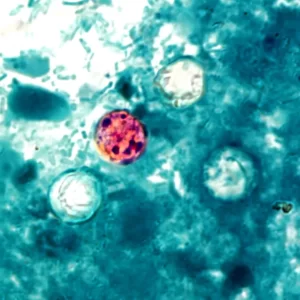
Cyclospora is a microscopic parasite that causes cyclosporiasis, an intestinal illness spread when people consume food or water contaminated with human feces containing the parasite.
Unlike many bacterial foodborne illnesses, Cyclospora can be difficult to identify quickly.
Symptoms often begin about one week after exposure but can appear as soon as two days or as late as two weeks or more. Common symptoms include watery diarrhea, loss of appetite, weight loss, stomach cramping, bloating, gas, nausea and fatigue.
The delayed onset complicates investigations.
By the time a person becomes ill, seeks medical care, receives a diagnosis and reports what they ate, the produce in question may already have been consumed, discarded or removed from stores. Fresh lettuce also has a short shelf life, making it difficult for investigators to collect and test the exact lot that caused an illness.
Cyclospora is not reliably eliminated by simply washing produce. CDC advises consumers to wash hands and fresh fruits and vegetables under running water, but notes that washing alone cannot guarantee removal of the parasite. Cooking produce to at least 158 degrees Fahrenheit, or 70 degrees Celsius, can kill it.
That makes raw leafy greens particularly challenging. Lettuce is commonly eaten without cooking, passes through long supply chains and may be processed in large batches that are distributed across many states.
The parasite is most often associated with fresh produce, including leafy greens, herbs, berries and other fruits and vegetables.
The U.S. cyclosporiasis season typically runs from May 1 through Aug. 31, when warmer weather and produce, consumption can contribute to more cases. But CDC expects to continue receiving reports for weeks because of the delay between exposure, illness, diagnosis and reporting.
The iceberg lettuce outbreak
CDC, FDA, state and local health authorities have identified processed iceberg lettuce from central Mexico as the source of the major multistate outbreak. The implicated lettuce came from Taylor Farms de Mexico, according to CDC.
The outbreak has been associated with shredded iceberg lettuce served at Taco Bell restaurants and bagged salads sold at retail stores.
Taco Bell removed lettuce from some U.S. restaurants after the link was identified. Walmart also recalled certain bagged salad products connected to the supplier.
Taylor Farms said it voluntarily suspended iceberg lettuce sourcing and production from central Mexico and hired independent experts to review food-safety practices at its facility. The company has said it is confident in its food-safety systems and will be transparent as more information becomes available.
The company has not been accused of intentionally causing contamination. In foodborne-outbreak investigations, identifying a source does not always establish the exact point at which contamination occurred.
The supply chain may include farms, irrigation systems, harvest crews, processing plants, transportation companies, distribution centers, restaurants and retailers. A failure at any stage can create risk.
The FDA has not reported a positive product sample for Cyclospora from the implicated lettuce. That is not unusual in an outbreak involving fresh produce. By the time investigators identify a potential source, the relevant food may no longer be available for testing.
The absence of a positive sample does not mean the epidemiological evidence is weak. Public-health agencies often use a combination of patient interviews, purchase records, restaurant data, product traceback and genetic or laboratory information to identify likely sources.
But it does make the investigation more difficult, and leaves consumers with questions about how contamination entered the supply chain.
The scale of the public-health response
The official numbers likely understate the total number of people affected.
CDC’s 18,445 confirmed domestic cases represent laboratory-confirmed infections reported to the agency as of Aug. 31.
CDC is also reviewing 3,491 laboratory-confirmed cases that require further investigation to determine whether they were acquired in the United States or during travel. In addition, the agency is aware of at least 13,505 more cases that are not laboratory-confirmed or remain pending patient interviews and formal reporting.
That means the ultimate number of illnesses associated with the season could be much higher.
The large iceberg lettuce outbreak has contributed significantly to the overall increase, but CDC says it is investigating multiple clusters of Cyclospora infections. Some clusters have not yet been linked to a confirmed food source.
That matters because the current crisis may not be one isolated contamination event. It may reflect several overlapping problems across the produce system.
The FDA’s active outbreak table showed 17 active foodborne-outbreak investigations as of Sept. 3, including seven Cyclospora investigations.
The federal government’s ability to manage such a surge depends heavily on state and local health departments.
In Michigan, for example, local health officials shifted staff from routine work to interview patients, track symptoms and identify foods they had eaten. Reuters reported that Dea Lancaster, a nurse coordinator in Washtenaw County, set aside her usual duties during the height of the outbreak to work on case tracing.
That work is labor-intensive. Patients may not remember exactly what they ate days or weeks earlier. Restaurants may not retain all records. Food ingredients may have been mixed with others in salads, sandwiches or prepared meals.
Without strong local surveillance, national agencies can miss the early clues that reveal a multistate outbreak.
FDA inspections under scrutiny
The outbreak has focused new attention on declining U.S. inspections of foreign food facilities.
FDA inspections of foreign food sites, including the Mexican farm connected to the Cyclospora outbreak, have fallen nearly 35% since 2019, according to agency records cited by the Washington Post and Associated Press reporting.
Foreign inspections fell sharply during the COVID-19 pandemic, when travel restrictions limited regulators’ ability to visit overseas facilities. But critics say the number of inspections has not fully recovered.
The decline is significant because the United States imports a large share of its fresh produce, particularly during winter and off-season periods. Mexico is one of the country’s most important suppliers of vegetables, fruits and leafy greens.
Imported food is not inherently less safe than domestic food. U.S. producers also experience outbreaks, recalls and contamination problems.
But foreign supply chains can create additional oversight challenges. Inspectors may need to coordinate with foreign governments, navigate different legal systems, travel long distances and assess facilities that serve multiple markets.
Food-safety advocates say inspections are one layer of protection, not a guarantee. A facility can pass an inspection and later experience contamination. But fewer inspections can mean fewer opportunities to identify unsafe practices before food reaches U.S. consumers.
The FDA and Department of Health and Human Services have defended their response.
An HHS spokesperson told the BBC that the Trump administration “mounted a robust response to each outbreak” and said FDA investigators were not affected by staffing changes or reductions in force.
Critics dispute that broader assessment, arguing that cuts to public-health capacity can affect not only inspectors but also laboratory surveillance, communications, data analysis and the ability to coordinate with states.
Staffing and surveillance concerns
The Cyclospora outbreak has unfolded during a period of tension over the federal government’s public-health workforce.
Food-safety experts and public-health advocates have argued that staffing reductions and budget cuts at agencies including the FDA and CDC have weakened the country’s ability to prevent and investigate outbreaks.
One major concern is FoodNet, the Foodborne Diseases Active Surveillance Network.
FoodNet tracks infections caused by several major foodborne pathogens and provides detailed information that helps public-health officials understand trends, identify outbreaks and estimate the burden of illness.
In August 2025, HHS scaled down FoodNet’s coverage, reducing mandatory surveillance of several major germs, including Cyclospora, according to reporting cited by Fortune.
The consequences of that change are debated. Federal officials say they continue to have the personnel and tools needed to investigate outbreaks. Critics say the reduction in surveillance could make it harder to detect increases early and understand where contamination is occurring.
The Cyclospora surge illustrates why those systems matter.
The first cases began in early May, but CDC did not issue a health alert until July 14, roughly 10 weeks later, according to reporting by the BBC.
Public-health investigations often take time, especially when symptoms are delayed and food is perishable. But critics say the timeline shows how difficult it has become to move from scattered individual reports to a clear national warning.
The CDC and FDA formally linked the major lettuce outbreak to the supplier on July 16.
By then, thousands of people had already become ill.
Consolidation in the food system
The outbreak has also renewed concern about the concentration of power in the U.S. food supply.
Taylor Farms is one of the world’s largest producers of fresh-cut vegetables and salads. Its products reach major retailers including Walmart, Kroger, Whole Foods and Target, and it supplies restaurant chains including McDonald’s, Taco Bell and Chipotle.
That scale creates efficiency.
Large suppliers can invest in processing facilities, distribution networks, food-safety systems and nationwide logistics. They can supply consistent products to national retailers and restaurant chains.
But scale also creates concentration risk.
When a contamination problem occurs at a supplier that serves many companies, the impact can spread widely and quickly. A single issue may affect grocery stores, restaurants, schools, hospitals and consumers across multiple states.
The Cyclospora outbreak has demonstrated that reality.
The affected lettuce was used in restaurant meals and packaged salads sold under multiple brands. Consumers may not know which supplier processed the product they ate, making it harder to identify patterns early.
Critics of industry consolidation argue that the food system becomes more vulnerable when a small number of processors handle a large share of key products.
Companies argue that centralized systems can improve standards and traceability, especially when compared with fragmented supply chains involving many small operators.
The outbreak does not settle that debate. But it shows how a problem at one facility can become a national event when the supplier is deeply embedded in the food economy.
What consumers should know
CDC says the implicated iceberg lettuce is no longer on the market and that lettuce is once again safe to eat.
Still, consumers concerned about Cyclospora can take basic precautions:
- Wash hands before and after handling fresh produce.
- Rinse fruits and vegetables under running water before eating, cutting or cooking.
- Refrigerate perishable produce promptly.
- Follow recall notices from retailers, restaurants, FDA and CDC.
- Seek medical advice if experiencing persistent watery diarrhea, abdominal cramps, nausea, fatigue or unexplained weight loss after eating fresh produce.
- Tell a health-care provider about recent food exposures, particularly if symptoms are prolonged or severe.
Washing produce is useful for reducing some risks, but it cannot guarantee removal of Cyclospora. Cooking is more effective at killing the parasite, though that is not practical for many salad ingredients.
People with severe symptoms, dehydration, prolonged illness or weakened immune systems should seek medical care promptly.
Cyclosporiasis can be treated with prescription medication. Doctors may order specialized stool testing because Cyclospora is not always identified through routine tests.
The policy questions ahead
The immediate outbreak may decline as contaminated products leave the market and the seasonal window closes. But the policy debate is just beginning.
Lawmakers, public-health groups and food-industry leaders will likely focus on several questions:
- Should the FDA increase foreign food-facility inspections?
- Does CDC need stronger surveillance capacity for foodborne parasites?
- How quickly should agencies issue public alerts when cases rise?
- Should large produce processors face additional traceability requirements?
- How can public-health agencies better identify contamination before products reach consumers?
- What resources do state and local health departments need to interview patients and track outbreaks?
- How should the United States oversee imported produce from high-volume suppliers?
The answers will involve money, staffing, regulation and international cooperation.
Food safety is often invisible when it works. Consumers buy lettuce, berries, eggs or packaged meals without thinking about the farms, factories, trucks and inspection systems behind them.
The Cyclospora outbreak has made that invisible system visible again.
More than 18,000 confirmed cases, nearly 1,000 hospitalizations and two deaths have turned a parasite outbreak into a referendum on whether the United States is adequately prepared to protect the food supply in an era of global trade, concentrated suppliers and strained public-health institutions.