Gunmen have staged simultaneous attacks in and outside Mali’s capital Bamako, with explosions and sustained gunfire reported near key army bases and at several sites across the country’s interior, according to the Malian army and witnesses. The assaults, described by authorities as a coordinated campaign by multiple “terrorist” groups, have set off security operations and road‑block closures around the capital and heightened fears that the West African nation is slipping deeper into a widening insurgency even as it grapples with a crippling fuel blockade and growing international isolation.
What happened in and around Bamako
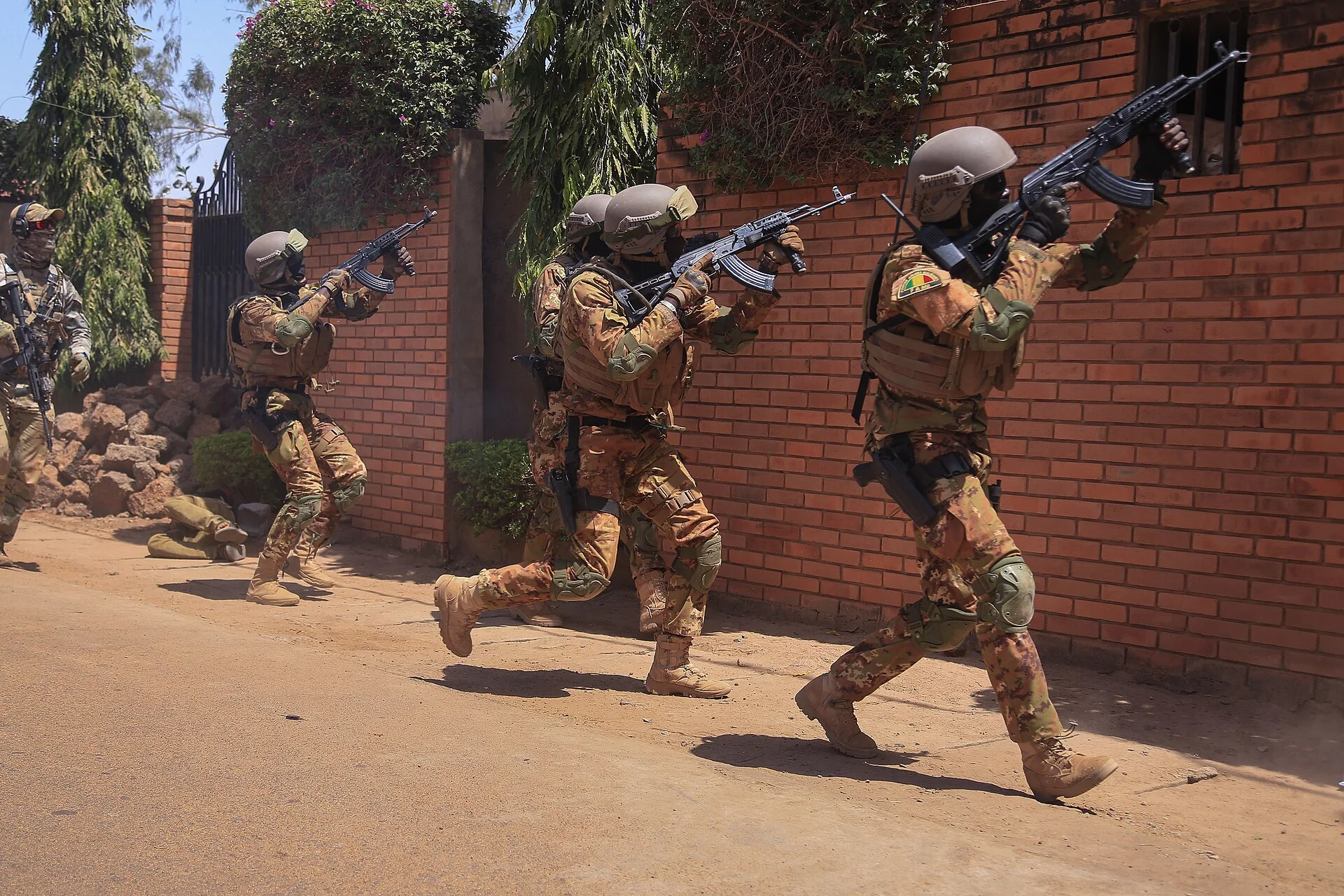
Early Saturday morning, residents in the capital woke to two loud explosions and sustained gunfire near Kati, the sprawling military base outside Bamako that houses Mali’s main army installations. A Reuters witness reported soldiers rushing to the scene and blocking off roads in the area, while security sources described the incident as part of a broader pattern of insurgent attacks on military targets.
Gunfire was also heard near Bamako’s international airport, where a military camp housing Russian mercenary forces is located, according to a resident who spoke to Reuters. The Malian army issued a brief statement saying that unidentified “terrorist” groups had attacked several positions in the capital and elsewhere in the country, without immediately specifying exact locations. The statement said clashes were ongoing and urged the population to remain calm and follow official instructions.
In past years, Mali has weathered multiple attacks on the capital, including a 2024 assault that killed more than 70 people, the first major strike on Bamako since 2015, which overwhelmed local hospitals and underscored the difficulty of defending a sprawling, landlocked city. The 2026 assaults fit that pattern: targeting symbolic security hubs while spreading panic and uncertainty among civilians.
Nationwide surge in violence
The attacks around the capital coincided with renewed violence in several northern and central towns, suggesting a nationwide escalation rather than an isolated strike.
Reuters and local media report that:
- Sevare, a central‑Mali town, saw heavy gunfire and chaos, with one witness saying, “There’s gunfire everywhere,” as security forces raced to respond.
- In the north, Kidal and Gao, both long‑time strongholds of armed opposition groups, were hit by apparent assaults on army or garrison positions.
- Four security sources told Reuters that the al‑Qaeda‑linked Jama’at Nusrat al‑Islam wal‑Muslimin (JNIM) was involved in Saturday’s attacks, though the group had not formally claimed responsibility by early reporting.
A representative of the Azawad Liberation Front (FLA), a Tuareg‑dominated rebel alliance, also claimed on social media that its forces had seized several positions in Kidal and Gao, signaling that Friday’s coordinated strikes may have had both jihadist and separatist dimensions.
Such simultaneity echoes earlier patterns in Mali’s conflict, where insurgents and rebels have used multi‑pronged strikes to stretch overstretched army units and test the resilience of the country’s military‑led government.
The role of jihadists and regional networks
The Malian army has repeatedly blamed Islamist militant groups, primarily JNIM and the rival Islamic State in the Sahel Province (ISSP), for a wave of violence that has spread from northern and central Mali into the south, including the capital region.
JNIM, an al‑Qaeda‑linked coalition, has run a de facto blockade of southern Mali since 2025, targeting fuel trucks and supply routes to suffocate the capital’s economy and pressure the military government. By threatening Bamako’s fuel supply and a series of incremental assaults on military sites, the group has tried to present the government as unable to protect even the heart of the state.
Analysts note that these attacks come amid a broader “coup belt” crisis across West Africa, where military juntas in Mali, Burkina Faso and Niger have pushed out former Western partners like France and turned instead to Russian‑backed forces, only to see insurgent violence evolve from localized raids into a more strategic, nationwide campaign.
ISSP and JNIM operate across porous borders, and Mali has become a critical node in their wider Sahel‑wide networks, which the U.S. and European governments classify as key terrorist threats.
Bamako under pressure
These latest attacks reinforce a narrative that has taken hold in Bamako over the past year: a capital under siege.
A 2025 analysis by the Berlin‑based PRIF think tank describes how JNIM’s blockade of southern Mali has severed key trade routes, fuel supply lines and electricity‑support logistics, leading to shortages and rationing in many towns, including areas near the capital. At the same time, repeated attacks on military sites and the airport have created a sense that security forces are stretched thin and reactive, even as they bolster checkpoints and roadblocks.
Canadian and other foreign travel advisories for Mali repeatedly warn that the risk of terrorist attacks and kidnappings is high, especially in Bamako and surrounding areas, and note that the ability of embassies to provide consular support could be limited if the situation deteriorates further.
For ordinary Malians, the cost of constant alerts and security drags is evident in rising fuel prices, shortages of basic goods and the disruption of daily life.
The role of the military government and foreign partners
Mali has been under military rule since two coups in 2020 and 2021, when army officers ousted elected leaders under pressure from social unrest and a growing security crisis. The current junta, dominated by the Malian Armed Forces (FAMa), has portrayed itself as defending national sovereignty against both foreign influence and jihadist infiltration.
In practice, the military has aligned closely with Russian‑backed forces, including the Russian Africa Corps (successor to the Wagner Group), which provides tactical and logistical support in key areas such as the capital’s airport and major military bases. However, reports from think tanks and human‑rights groups indicate these partnerships have had limited success in rolling back JNIM’s presence, while drawing criticism for alleged human‑rights abuses and opaque, hard‑currency‑based arrangements.
The assaults on Saturday come at a particularly sensitive moment. Western governments, already wary of the Malian junta, have urged citizens to leave the country or limit travel amid worsening security, and the latest wave of violence may deepen that sense of isolation.
What happens next?
The Malian army has claimed that Bamako and other key sites remain under its control, but it has also warned that clashes are ongoing, and that the population should remain vigilant. In the short term, authorities are likely to tighten curfews, checkpoints, and communications restrictions, while investigators try to confirm the scale of casualties and the identity of the groups behind the coordinated strikes.
In the medium term, the attacks reinforce several grim realities:
- Islamist networks in the Sahel are capable of mounting multi‑city, simultaneous assaults on both northern strongholds and the capital region.
- Bamako’s security environment is more fragile than it has been in years, even as the military government insists it is in control.
- The regional spillover risk to neighboring Burkina Faso, Niger and beyond remains high, raising fears of a deeper “domino effect” across the coup belt.
For the people of Mali, Saturday’s explosions and gunfire are another reminder that the conflict is no longer confined to remote northern valleys, it has reached the heart of the nation’s political and economic life, and the question of who can truly secure Bamako remains as urgent as ever.