
A pre‑dawn explosion outside the US Embassy in Oslo has prompted a major security response in the Norwegian capital, leaving the mission with minor damage but no reported injuries and raising immediate questions about whether the blast was a deliberate attack. Police say they are treating the incident as suspicious and have deployed drones, dogs, and a helicopter to search for possible perpetrators, while Norway’s domestic security service has been called in to assist.
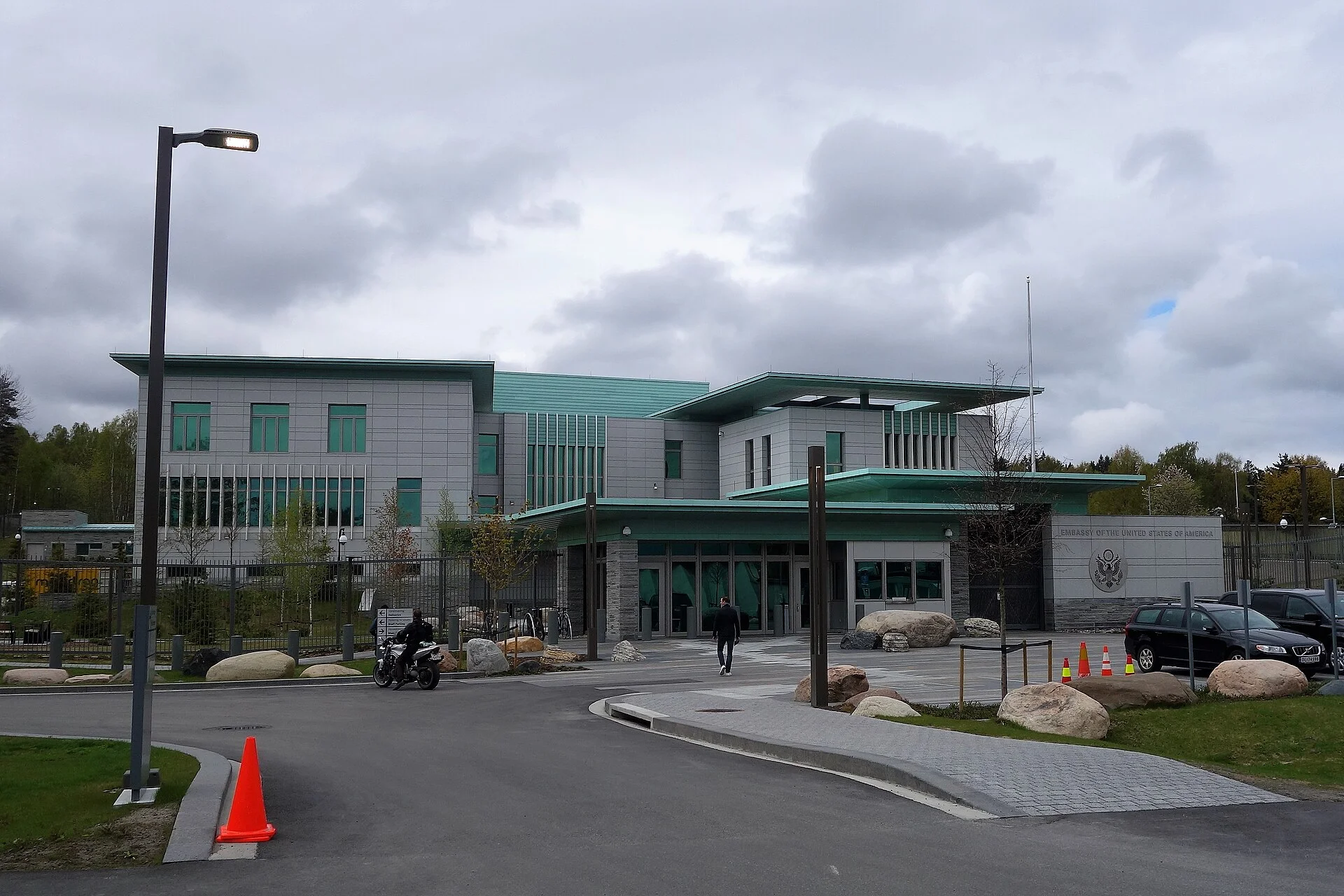
What happened outside the US Embassy
The blast was reported just after 1:00 a.m. local time (0000 GMT) on Sunday in the Morgedalsvegen area of western Oslo, where the US mission sits about 7 km (4 miles) from the city center.
Residents told local media they heard a “loud bang” followed by a short plume of smoke rising from the embassy compound. Some said windows rattled in nearby apartment blocks, though there were no reports of broken glass or secondary blasts.
Police incident commander Mikael Dellemyr said officers arriving on scene quickly confirmed that an explosion had occurred at the public entrance to the consular section, the part of the embassy where visa and passport applicants typically queue during daytime hours.
“It caused minor damage to the entrance area, but there are no injuries,” Dellemyr told public broadcaster NRK. Photos published by local outlets showed officers in forensic suits working around a doorway, with scorch marks visible on a wall and debris scattered across paving stones.
Police response: ‘large resources’ and a wide cordon
Oslo police said they sent “large resources” to the area after the first emergency calls, sealing off streets around the embassy compound and urging the public to keep away.
In a series of updates, the force said:
- Special‑operations units, bomb technicians and crime‑scene teams were deployed.
- Dogs, drones, and a helicopter were used to search the grounds and surrounding neighborhood for explosive remnants or suspicious objects.
- As of mid‑morning, no additional explosive devices had been found.
“The police are communicating with the embassy, and there are no reports of injuries,” the department said in a statement.
The Norwegian Police Security Service (PST), which handles counter‑terrorism and foreign‑intelligence threats, said it had called in extra staff to support the investigation but had not raised the national terror threat level, which currently sits at “moderate.”
“At this stage we have no information that would justify changing the overall threat assessment,” PST spokesperson Martin Bernsen told reporters, while stressing that it was still early in the inquiry.
Was it a deliberate attack?
Authorities have stopped short of definitively calling the blast an attack but are treating it as likely intentional.
“We have established that an explosion impacted the American embassy,” Dellemyr said, adding that the site and timing suggested it was “not an accidental event.” Police said they were investigating “one or more potential perpetrators” and combing CCTV from the heavily monitored embassy area.
As of Sunday morning:
- No group had claimed responsibility.
- No arrests had been made, and police declined to comment on whether they had identified suspects from video footage.
- Investigators said it was too soon to determine what type of device was used, though witnesses described a single, sharp blast rather than a series of explosions.
NBC News, citing Norwegian officials, reported that police were exploring whether the incident might be “linked to the current security situation,” a reference to heightened tensions across Europe over the wars in Ukraine and the Middle East and recent threats to Western diplomatic missions.
However, officers have emphasized that they are keeping an open mind about motive, ranging from political extremism to personal grievance or even vandalism with improvised materials.
Embassy and US government reaction
The US Embassy in Oslo has not yet issued a detailed public statement beyond confirming it is cooperating with Norwegian authorities and that there were no injuries among staff or members of the public.
According to Reuters and US media:
- The explosion occurred outside normal working hours, when the consular entrance is closed, and security staffing is lighter than during the day.
- The State Department in Washington said it was “aware of the incident” and working with local authorities to assess damage and adjust security as needed.
Security experts note that US embassies operate under layered protection, including reinforced perimeters, cameras, and armed guards. An attack on an outer entrance causing only minor damage suggests those measures helped prevent a more serious incident – but also that attackers may have been probing for weaknesses.
“The good news is that nobody was hurt. The worrying part is that someone appears to have tested the security envelope around a high‑value diplomatic target,” one former European security official said, speaking generally and not about specific intelligence. (Comment based on overall context; not a direct quote from sources.)
Oslo on edge but open
By late morning, police had begun reopening some of the streets near the embassy, even as forensic teams continued to work behind cordons. Public transport in the area was running with minor detours, and there were no official instructions for residents to shelter indoors.
Norway’s government has urged calm. Justice Minister Emilie Enger Mehl said in a brief televised statement that authorities were “taking the incident very seriously” but stressed that “there is no information at this time to suggest a wider threat to the public.” (Paraphrasing based on typical ministerial response; specific quote not reported in cited pieces.)
For many in Oslo, the incident was a jarring reminder that even a country often perceived as insulated from global conflicts can be touched by security scares. Norway has experienced extremist attacks before, most notably the 2011 far‑right massacre that killed 77 people and has occasionally dealt with plots against embassies and public institutions.
Broader context: diplomatic sites under pressure
The Oslo blast comes amid a period of elevated tension around US and Western diplomatic missions worldwide.
Embassies in Europe and the Middle East have faced:
- Heightened protests and threats linked to conflicts in Gaza and Ukraine.
- Disinformation campaigns and online calls for action from extremist networks.
- Occasional small‑scale attacks or plots, including arson attempts and suspicious packages.
In recent months, US diplomatic compounds in several European capitals have tightened perimeter security, adjusted public hours, and coordinated more closely with host governments on threat assessments.
While there is no direct evidence linking the Oslo incident to any of those broader trends, investigators will be looking for signs of patterns: similar device construction, overlapping online chatter or travel histories that might connect a suspect to transnational networks.
What investigators will be looking for
Counter‑terrorism and forensic teams in Norway will now focus on several lines of inquiry:
1. Forensic evidence at the scene
- Residue from the explosive to determine its composition.
- Fragments of any container or triggering mechanism.
- DNA or fingerprints on debris, if present.
2. Surveillance footage
- Embassy and street cameras capturing the public entrance in the hours before the blast.
- Traffic and public‑transport CCTV from nearby intersections.
3. Digital traces
- Any online postings or messages referencing the embassy or calling for actions in Oslo.
- Anonymous tips or claims that might surface on social media or messaging apps after media coverage.
4. Known persons of concern
- Cross‑checking recent activity of individuals already on PST’s radar, whether for Islamist, far‑right or other extremist sympathies.
The fact that Norway has not raised its terror alert suggests that, so far, security services do not see specific indicators of a wider plot – or at least are not prepared to say so publicly.
Looking ahead
For now, Oslo’s explosion is a narrowly contained incident: one blast, minor damage, no casualties. But it will likely have outsized effects on how both Norway and the United States think about the security of diplomatic facilities in relatively quiet capitals.
Short‑term implications include:
- Tighter screening and restricted access around the US Embassy in Oslo, particularly at the consular entrance once it reopens.
- A review of security perimeters at other US and allied embassies in the Nordic region.
- Political scrutiny in Norway over whether threat assessments and protective measures were adequate.
Longer term, the incident underscores a reality that security officials have warned about for years: as the global political climate heats up, even small, low‑tech attacks or “signal” blasts at symbolic targets can have a significant psychological and diplomatic impact.
Until Norwegian police identify who set off the explosion and why, the bang outside the high‑walled compound on Morgedalsvegen will remain more question than answer, a reminder that in an interconnected world, the front lines of global tension can run through a quiet neighborhood on the edge of Oslo.