
Key Facts
- Alibaba said it is developing future Qwen artificial-intelligence models with between 5 trillion and 10 trillion parameters, roughly two to four times the size of its current flagship, Qwen 3.8 Max, which has 2.4 trillion parameters.
- The company introduced the Zhenwu V900, an AI chip developed by its T-Head semiconductor arm that Alibaba calls China’s most powerful AI processor.
- Alibaba Chief Executive Eddie Wu said the V900 offers three times the performance of its predecessor, the M890, according to the company’s claims.
- The new chip can be connected in clusters of up to 500,000 units for training and running frontier-scale AI systems, Alibaba said.
- Alibaba expects mass production and commercial release of the Zhenwu V900 in the first quarter of 2027; its Hong Kong-listed shares rose 5% after the announcement.
Alibaba Group has unveiled a new artificial-intelligence chip and announced plans for a future model with as many as 10 trillion parameters, underscoring China’s drive to develop a self-sufficient AI technology stack amid intensifying global competition and U.S. restrictions on advanced semiconductor exports.
The Chinese technology giant said Tuesday that it is developing future Qwen models at a scale of 5 trillion to 10 trillion parameters, a significant expansion from its current flagship model, Qwen 3.8 Max, which has 2.4 trillion parameters. The company also introduced the Zhenwu V900, a next-generation AI processor it described as China’s most powerful, designed to support the immense computational demands of training and deploying increasingly capable models.
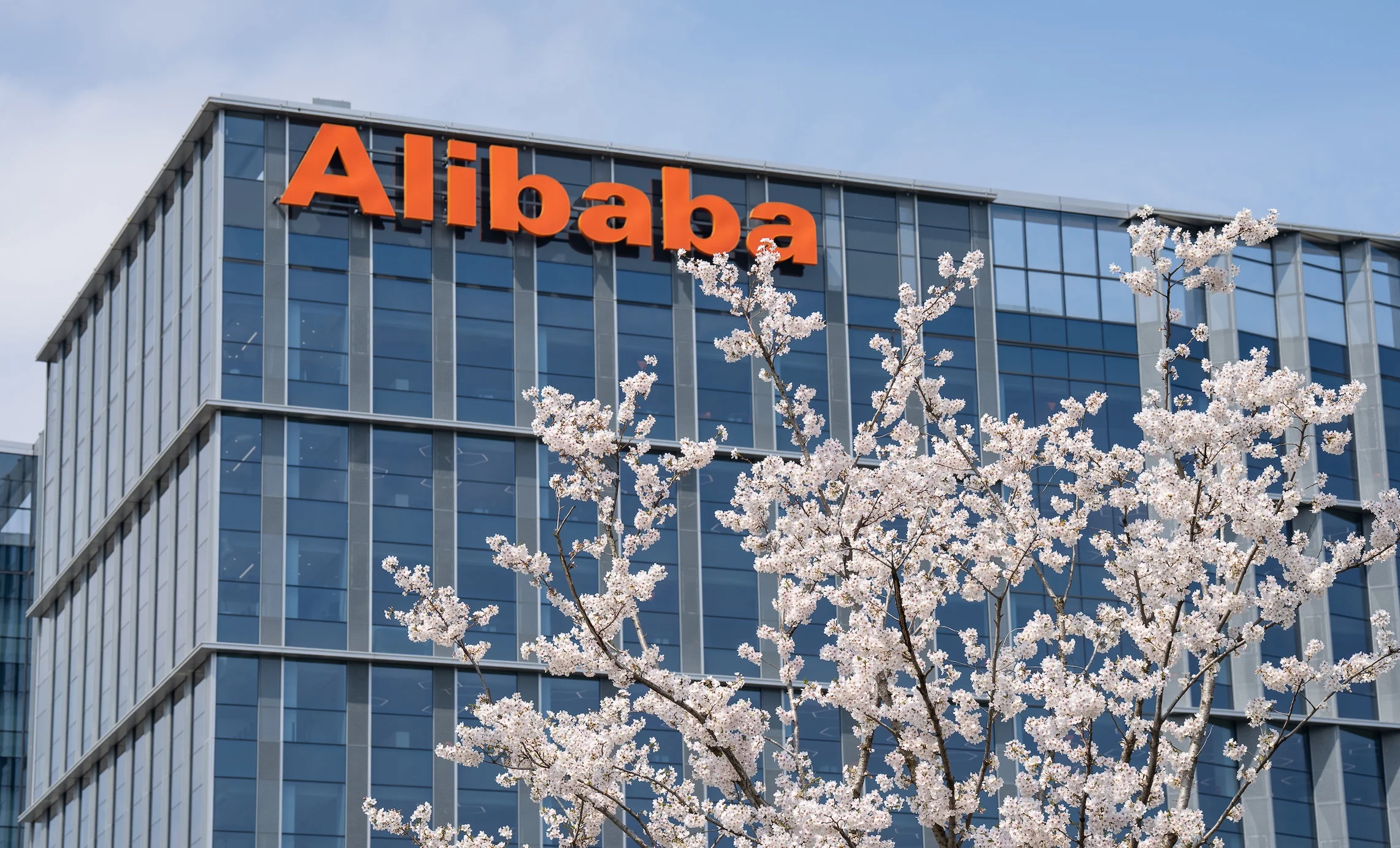
The announcements, made at Alibaba Cloud’s annual Apsara Conference in Hangzhou, position the company to compete on three interconnected fronts: AI models, specialized chips and data-center capacity. The strategy mirrors a broader global shift in which technology companies are seeking to control more of the infrastructure required for AI, rather than depend entirely on outside suppliers.
For Alibaba, that effort has strategic as well as commercial importance. The company is seeking to establish Qwen as a competitive family of large language models while reducing its exposure to the constraints of relying on foreign advanced semiconductors. Its statement comes as the United States and China compete for leadership in generative AI, a contest increasingly shaped by access to high-performance computing and the ability to scale data centers.
Alibaba’s new model roadmap
Eddie Wu, Alibaba’s chief executive, said the company’s Qwen team intends to develop models capable of handling “more complex, longer-horizon tasks” as it pursues what he described as artificial superintelligence, systems that would exceed human capability across a broad range of cognitive tasks.
Parameters are the learned variables within an AI model. They are commonly used as a rough measure of model scale, though they are not a complete measure of quality, efficiency or real-world usefulness. Model performance also depends on training data, architecture, post-training methods, inference efficiency, reasoning techniques and the underlying computing infrastructure.
Still, Alibaba’s proposed scale is striking. A 10-trillion-parameter system would be more than four times the size of Qwen 3.8 Max, based on the company’s stated figures. Alibaba said Qwen 4 is already in training, while later Qwen 4.5 and Qwen 5 models are expected to reach the 5-trillion-to-10-trillion-parameter range.
The announcement reflects a continuing belief among major AI developers that larger models can improve performance on difficult tasks, particularly those that involve sustained reasoning, multiple stages of planning, code generation, scientific analysis and tool use. But it also raises questions about costs, energy use and whether the next advances in AI will come mainly from scale or from more efficient architectures.
Companies in the United States and China are increasingly pursuing both paths. They are building larger systems while seeking ways to reduce the amount of computing required to train and run them. For commercial users, the decisive issue is not the raw number of parameters but whether a model can provide more accurate, reliable and cost-effective results.
Alibaba’s roadmap suggests it intends to compete at the outer edge of AI scale while keeping its Qwen ecosystem relevant to businesses, developers and cloud customers that need models for practical applications.
The Zhenwu V900 chip
The chip announcement is equally important. Alibaba said its T-Head semiconductor unit developed the Zhenwu V900 as a successor to the M890, and that the new processor provides three times the performance of its predecessor. The company did not, in the announcement reported by Reuters, provide a direct benchmark comparison with Nvidia’s leading data-center AI products or disclose comprehensive performance, power-efficiency and software-compatibility results.
That limitation matters. AI chips are judged not only by peak performance but by memory capacity, memory bandwidth, interconnect technology, software tools, reliability, availability and the cost of operating them at scale. Nvidia remains the dominant supplier in advanced AI computing partly because its chips are supported by a mature software ecosystem, including the widely used CUDA platform.
Alibaba’s claim that the V900 is China’s most powerful AI chip should therefore be understood as a company characterization rather than an independently verified global ranking. What is clear is that the company is aiming for a chip capable of supporting the kinds of massive clusters needed for frontier-model development.
Wu said the V900 can be linked in clusters of up to 500,000 chips, enabling large-scale model training and inference. Inference is the process of generating responses or completing tasks after an AI model has been trained; it is increasingly a central cost and performance challenge as AI services gain more users.
Alibaba said the V900 is expected to enter mass production and become commercially available in the first quarter of 2027. Wu also projected “significant growth” in annual AI-chip shipments, signaling that Alibaba sees the processor not merely as internal infrastructure but as part of a broader commercial cloud and technology offering.
Why the move matters
Alibaba’s announcement illustrates how AI competition is expanding beyond chatbots and consumer-facing applications. The competitive contest now spans the full technology chain: model research, semiconductors, networking, data centers, cloud services, developer tools and enterprise software.
A company that can develop its own chips, operate large clusters and offer competitive models may gain greater control over cost, supply and performance. That integrated approach has become especially valuable in China, where U.S. export restrictions have limited access to some of the most advanced AI chips from American firms.
Alibaba is not alone in this effort. Chinese technology companies have stepped up investment in domestic chip design, AI software and cloud infrastructure. But the technical challenge is formidable. Producing a high-performance accelerator is different from building an ecosystem that developers can adopt easily, data-center operators can deploy reliably and customers can use economically.
The Zhenwu V900 is designed to address part of that problem by providing the computing foundation for Alibaba’s own Qwen systems and for its cloud customers. The company’s ability to bring the product into mass production on schedule, and to demonstrate competitive operating performance, will determine whether the announcement becomes a meaningful commercial challenge to foreign AI hardware suppliers.
Alibaba’s stock-market reaction suggests investors viewed the strategy as a sign of confidence. Its shares rose 5% after the company announced the new chip and model plans.
Data centers and the cost of scale
Training models with trillions of parameters requires enormous computing resources. The technology depends on vast arrays of accelerators operating together, high-speed connections between them, substantial power supplies and large-scale cooling systems.
Alibaba said the V900 can operate in clusters of as many as 500,000 chips. Such a figure is a statement of architectural ambition: it indicates that the company is designing for systems far beyond conventional enterprise AI deployments and toward the largest category of frontier-model infrastructure.
The scale also raises questions about electricity consumption and investment. Larger models do not simply require more chips; they require more physical infrastructure, including data-center construction, networking hardware, power agreements and specialized cooling. Alibaba has separately outlined plans to expand its global data-center capacity to more than 20 gigawatts by 2032, according to reporting by Bloomberg and the South China Morning Post.
For governments, that creates a policy challenge. AI has become associated with productivity gains and national competitiveness, but its rapid expansion is also becoming a major energy and infrastructure issue. As companies build ever-larger clusters, they will face more scrutiny over resource use, environmental impact, grid capacity and the location of data centers.
The competitive test ahead
Alibaba’s strategy rests on a proposition shared by other leading AI companies: that the next phase of competition will reward organizations able to combine powerful models with reliable infrastructure.
Its Qwen roadmap offers a clear target, models as large as 10 trillion parameters. Its Zhenwu V900 provides the hardware pillar. And its cloud business supplies a channel for distributing AI tools to companies and developers.
Yet important questions remain unanswered. Alibaba has not disclosed the cost of the new chip, detailed benchmark data against leading global competitors, its manufacturing capacity or the likely availability of the V900 to customers outside its own cloud ecosystem. It is also unclear how efficiently its future models will perform relative to rivals once factors beyond parameter counts are considered.
That uncertainty does not diminish the strategic significance of Tuesday’s announcement. It demonstrates that China’s AI effort is no longer limited to adapting models on imported hardware. Chinese companies are seeking to design the chips, build the clusters and train the frontier models themselves.
For U.S. audiences, Alibaba’s move is a reminder that the AI race is a contest over industrial capacity as much as software innovation. The winning companies will not necessarily be those that announce the largest model. They will be those that can turn computational scale into trustworthy applications, sustainable economics and a robust technology ecosystem.
Alibaba has now set an ambitious benchmark for itself: a domestic AI chip platform capable of operating at frontier scale and a Qwen family potentially reaching 10 trillion parameters. Whether it can deliver those systems on schedule, and persuade customers they are competitive, will be one of the most closely watched tests in global AI development over the next two years.