Key Facts
- Bentley has unveiled the Torcal, its first fully electric production vehicle and a new fourth model line alongside the Continental GT, Flying Spur and Bentayga.
- The five-seat luxury SUV uses a 113-kWh usable battery, dual electric motors and an 800-volt system; Bentley claims up to 375 miles of range under the European WLTP test cycle.
- Two versions are planned: the 810-horsepower Torcal and the 876-horsepower Torcal S, which Bentley says can reach 60 mph in 2.8 seconds with launch control.
- Bentley says the Torcal can charge from 10% to 80% in as little as 16 minutes on a 400-kilowatt DC fast charger, with about 100 miles of claimed range added in seven minutes.
- The Torcal will be designed, engineered and built in Crewe, England. U.K. pricing starts at £173,300, roughly $230,000 at current exchange rates, while first deliveries are expected in the second quarter of 2027. No U.S. pricing, EPA range estimate or U.S. delivery schedule has been announced.
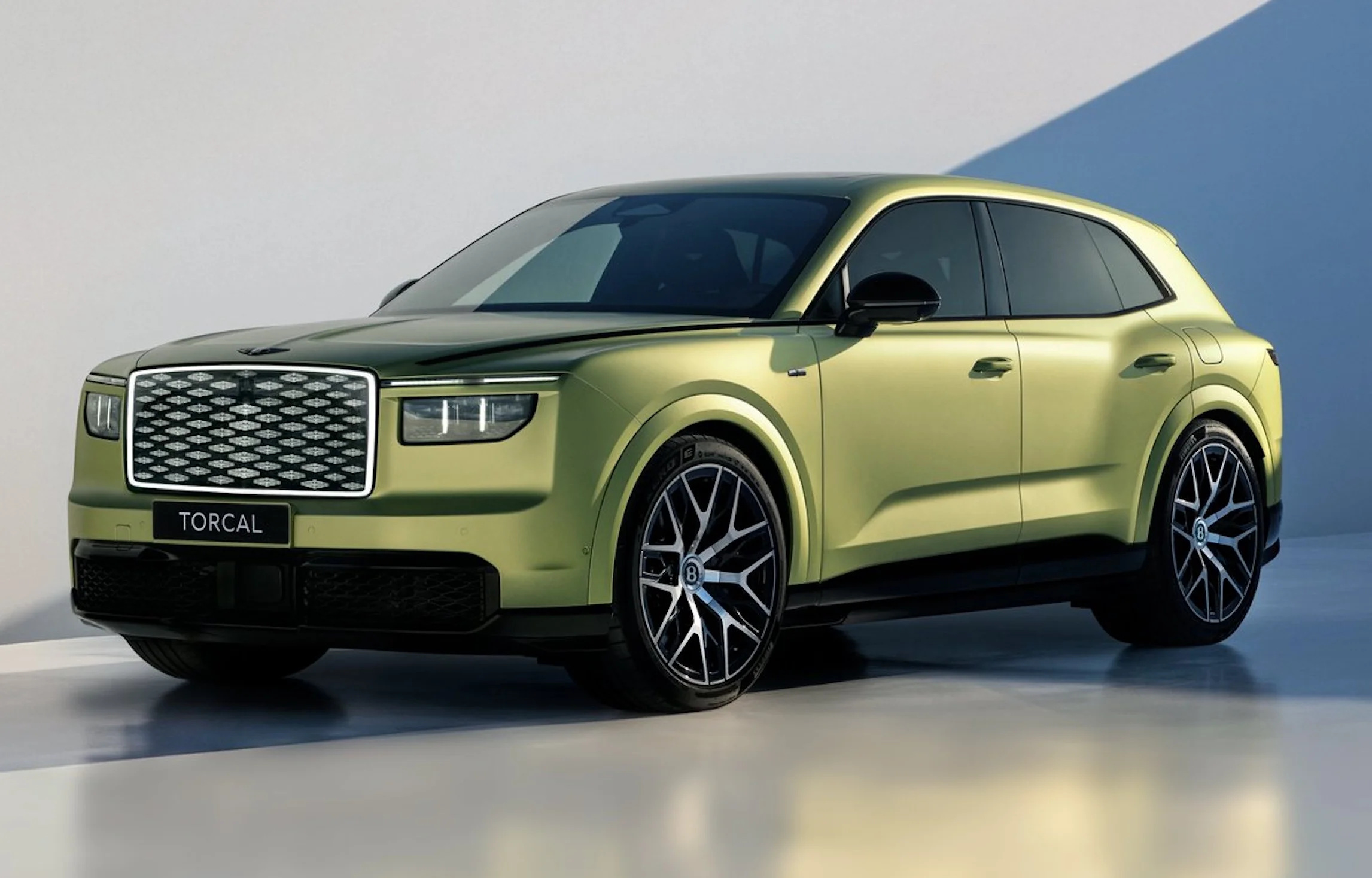
Bentley has entered the battery-electric era with the Torcal, a five-seat luxury SUV that blends more than a century of British grand-touring identity with the performance, charging speed and software-defined systems expected of a modern flagship electric vehicle.
The Torcal is not an electric version of the Bentayga or Continental GT. It is a separate model line, the fourth in Bentley’s range, and its first production vehicle designed from the beginning without a gasoline, plug-in-hybrid or W12 powertrain. The company unveiled the model in London on Wednesday, betting that its affluent clientele will embrace zero-emission motoring if the transition does not compromise design, comfort, performance or exclusivity.
That is a significant bet. Bentley had previously delayed the launch of its first EV until 2026 and dropped an earlier target to become fully electric by 2030, saying demand among its customers had not yet developed quickly enough. The Torcal is therefore both a product launch and a test of whether the ultra-luxury segment is ready to move from combustion engines to battery power.
A new Bentley, not a rebadged SUV
The Torcal becomes Bentley’s first all-electric model and its fourth distinct nameplate. It sits below the Bentayga in overall length, Bentley describes it as its shortest four-door model—yet it remains a substantial vehicle at about five meters long. The package is intended to offer a more urban-focused, road-oriented luxury SUV without abandoning the spaciousness expected in the brand’s upper tier.
Its name comes from El Torcal de Antequera, a limestone rock formation in southern Spain known for its dramatic, weathered landscape. Bentley said the naming was meant to suggest strength, sculptural form and a connection between natural materials and the vehicle’s design.
The exterior preserves familiar Bentley elements while adapting them for an EV. It has a broad, upright stance, diamond-shaped lighting intended to reference the marque’s traditional grille, and a large rear light signature. Because an EV does not require the same air intake as a gasoline car, the Torcal’s front design uses illumination and texture rather than an open grille to preserve the brand’s visual identity.
That balance is central to the vehicle’s commercial logic. Bentley is not attempting to make an anonymous electric SUV. Its challenge is to convince buyers that a battery-powered vehicle can still look, feel and perform like a Bentley, even without the familiar sound and mechanical character of a V8 or W12 engine.
Battery, range and charging
The Torcal uses a 113-kWh net-capacity lithium-ion battery pack made up of 192 pouch cells. The system operates at 800 volts, an architecture increasingly used in premium EVs because it can support faster charging and potentially improve efficiency by reducing electrical losses.
Bentley’s headline range claim is up to 375 miles, or 600 kilometers, under the WLTP standard used in Europe. U.S. buyers should treat that figure carefully: the Environmental Protection Agency’s range test is generally more conservative than WLTP, and Bentley has not yet issued an EPA rating for the Torcal.
The company backs the battery with a 10-year, 100,000-mile warranty. That is notable in a segment where customers may expect long-term ownership and where concerns about battery life can influence resale value and confidence in a first-generation electric model.
Bentley says the Torcal can accept DC fast charging at up to 400 kilowatts, provided drivers can find a compatible high-power charger. Under those ideal conditions, the company claims a 10% to 80% recharge can take about 16 minutes. It also says the vehicle can add roughly 100 miles of driving range in seven minutes.
Those claims would place the Torcal among the fastest-charging luxury EVs. But charging performance in real life varies. It depends on battery temperature, the charger’s actual output, charging-network reliability, weather and how full the battery is when the session begins. A 400-kW charging station is also not yet common in every U.S. market.
For prospective owners, the practical issue will be less the peak figure than how consistently the Torcal can maintain high charging speeds during long highway trips. Bentley will need to provide further details on its U.S. charging strategy, including connector compatibility, navigation-based charging preparation and potential charging-network partnerships.
Performance: the most powerful Bentley yet
Bentley will offer the Torcal in two initial versions, both using one permanent-magnet synchronous motor on each axle and all-wheel drive. The rear motor is paired with a locking differential, a setup designed to help distribute power and preserve traction under acceleration.
| Model | Power | Torque | 0-60 mph | Top speed |
|---|---|---|---|---|
| Torcal | 810 hp | 881 lb-ft | 3.3 seconds | 155 mph |
| Torcal S | 876 hp | 996 lb-ft | 2.8 seconds | 162 mph |
The Torcal S is therefore Bentley’s most powerful production car to date, at least by its published peak-output figures. Its 996 pound-feet of torque is also the highest torque rating Bentley has announced for a production model.
The performance figures are extraordinary for a large luxury SUV, but Bentley is presenting them as part of a comfort-focused experience rather than a track-car identity. The company says it deliberately limited the Torcal’s maximum output below what the shared platform could theoretically support, arguing that still more acceleration would undermine refinement and passenger comfort.
The Torcal is also the first Bentley equipped with fully active suspension. Bentley says the system eliminates conventional anti-roll bars and uses active control to help keep the vehicle stable through corners while retaining a compliant ride. If the technology performs as intended, it could be particularly important in an EV carrying a heavy battery pack low in its structure: the goal is to suppress body roll without making the ride feel stiff or artificial.
As with all early manufacturer claims, independent road testing will be needed to assess the balance between acceleration, handling, braking and the quiet, isolated cabin experience Bentley buyers expect.
Luxury in an electric format
Bentley’s transition to an EV raises a question beyond battery capacity: how does an ultra-luxury brand preserve emotional appeal when it removes the engine that has historically supplied much of its drama?
The company’s answer is to increase the role of materials, sound, technology and personalization.
The Torcal includes four electrically powered doors that can open and close automatically, a switchable-glass panoramic roof and a trunk with 460 liters of capacity, plus a 90-liter front storage compartment, or “frunk.” An optional Naim audio system delivers up to 1,780 watts through 28 speakers.
Bentley has also developed a synthetic driving soundtrack using instruments including drums, viola and bass guitar. The company’s stated aim is not to imitate an internal-combustion engine exactly, but to give drivers an audible sense of acceleration and character in a vehicle that would otherwise be nearly silent.
For some traditional Bentley customers, that may be the hardest part of the transition. The brand built much of its reputation on the effortless force and sound of large combustion engines. The Torcal can offer more immediate torque and faster acceleration, but it must create a different kind of luxury appeal, quietness when desired, sensory engagement when wanted and unmistakable craftsmanship at all times.
Bentley has also equipped the vehicle with 25 radar, camera and sensor units for driver-assistance systems and remote parking. The company has not said the Torcal will offer fully autonomous driving, and buyers should not interpret a large sensor count as a guarantee of self-driving capability. Such systems remain driver-assistance features that require clear operating limits, dependable software and responsible human oversight.
Built in Crewe, on a shared platform
The Torcal will be built at Bentley’s historic Crewe site in Cheshire, England, where the company has operated since 1946. Bentley said it has invested £350 million in factory upgrades, including a new production line for the EV.
The vehicle is based on the Premium Platform Electric architecture, a group platform also used by Bentley’s Volkswagen Group sibling Porsche for the electric Cayenne. Shared engineering gives Bentley access to expensive underlying EV technology, battery integration, 800-volt electronics, motors and software, while leaving room for a distinct body, cabin, suspension tuning and brand identity.
This approach is increasingly common in the luxury industry. Developing a dedicated EV platform alone requires enormous capital, engineering resources and supplier commitments. Sharing the foundational architecture lets a lower-volume manufacturer focus its investment on the elements buyers can see and feel: design, craftsmanship, materials, ride quality and customization.
For Bentley, however, platform sharing brings an additional test. Buyers paying more than $200,000 will expect the Torcal to feel meaningfully different from any related Porsche product. Bentley’s active suspension, interior treatment, styling and performance calibration will need to justify that premium.
Price and availability
Bentley has confirmed U.K. pricing from £173,300 for the standard Torcal and £200,000 for the Torcal S. At current exchange rates, the base price is roughly $230,000, though direct conversions are not reliable guides to U.S. sticker prices because taxes, specifications, import considerations and market strategy differ.
The first customer deliveries are expected in the second quarter of 2027. Bentley has not announced U.S. pricing, U.S. trim levels, EPA range ratings or a specific American delivery timetable.
That leaves several key questions for U.S. buyers unanswered:
- How much will the Torcal cost after U.S.-market equipment and options?
- What real-world EPA range will it achieve?
- Which charging connector and network strategy will Bentley use in North America?
- What driver-assistance functions will be offered in the U.S.?
- How will the company support buyers in markets where 400-kW public charging is limited?
Why the Torcal matters
The Torcal is important because it is an early indicator of how the most traditional luxury carmakers will approach electrification.
Bentley has not attempted to present the EV shift as a rejection of its past. Instead, it is selling the Torcal as an extension of its defining promise: effortlessness. In a gasoline Bentley, that came from a large engine delivering smooth, abundant power. In the Torcal, it will come from instant electric torque, rapid charging, near-silent operation and software-controlled comfort.
The company is entering the market after adjusting its timetable to reflect slower-than-expected EV demand among wealthy buyers. That caution may prove sensible. The Torcal must appeal to customers who have extensive choices: Rolls-Royce’s Spectre, ultra-luxury versions of Porsche and Mercedes electric SUVs, high-performance Tesla models and a growing group of specialized EV makers.
Its strongest early credentials are clear, 810 to 876 horsepower, fast 800-volt charging, a 113-kWh battery, a long battery warranty and a highly personalized luxury proposition. But the real verdict will come when cars reach buyers in 2027 and independent testing determines whether Bentley’s claimed range, charging, comfort and refinement meet the standard implied by the badge.
The Torcal is not just Bentley’s first EV. It is the opening argument for what an electric Bentley should be.