
NEW YORK — Elena Rybakina overcame two-time defending champion Aryna Sabalenka 6-4, 5-7, 6-2 to win her first U.S. Open title on Saturday, ending the Belarusian’s 20-match winning streak at Flushing Meadows and completing her rise to world No. 1.
The 27-year-old Kazakhstan player, who entered the tournament under a cloud of uncertainty after an ankle injury forced her out of the Cincinnati warmup event, delivered a composed and forceful performance at Arthur Ashe Stadium. She claimed her third Grand Slam singles title, adding the U.S. Open trophy to her 2022 Wimbledon championship and Australian Open victory earlier this year.
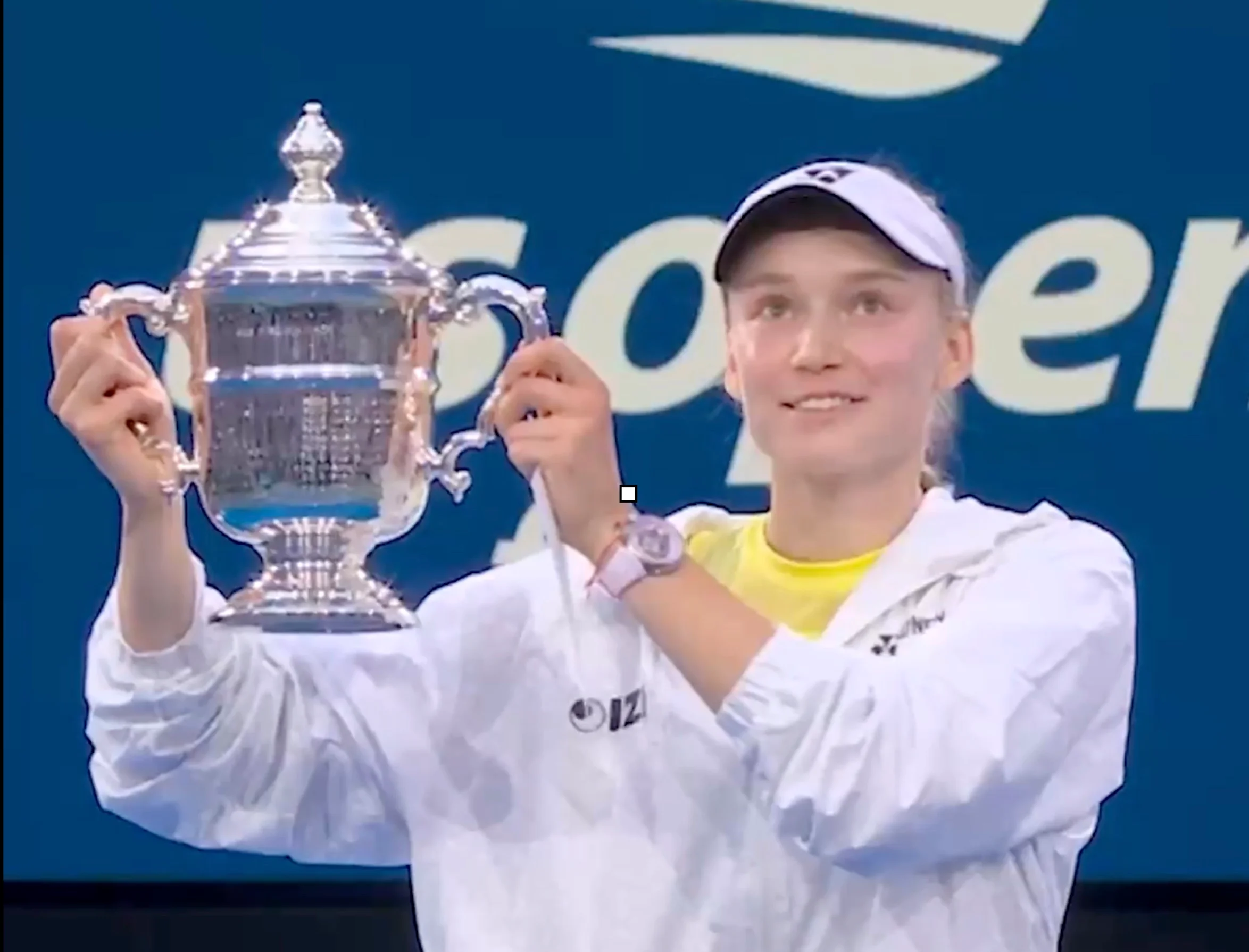
The win also ends Sabalenka’s 99-week reign at the top of the women’s rankings. Rybakina will become the first player representing Kazakhstan to occupy the No. 1 position when the rankings update Monday.
“It’s tough to find words right now, honestly,” Rybakina said after the match. “I didn’t expect nothing like this coming to this tournament. Somehow everything aligned together.”
For Rybakina, the triumph represented more than a breakthrough in New York. It was a confirmation that she has become the defining player in women’s tennis this season: a calm, powerful competitor who defeated Sabalenka in two major finals on hard courts in 2026 and emerged from a difficult summer with the sport’s biggest prize in New York.
A final between the top two
The women’s final brought together the top two players in the world and two of the sport’s most formidable power hitters.
Sabalenka arrived as the two-time defending champion and the No. 1 seed, seeking to become the first woman since Serena Williams to win three consecutive U.S. Open singles titles. She had not lost at Flushing Meadows since 2023 and entered the match with a 20-match winning streak at the tournament.
Rybakina, seeded second, had already secured the No. 1 ranking by reaching the semifinals. But winning the U.S. Open would give her ascent an emphatic conclusion.
Their rivalry had become one of the most compelling in women’s tennis. The New York final was their third meeting in a Grand Slam championship match, after the Australian Open final in January and another major title match earlier in their careers. Rybakina had beaten Sabalenka in Melbourne to capture the Australian Open, and Saturday’s result gave her a second major victory over the Belarusian in the same season.
The contrast between the players was evident from the opening set.
Sabalenka brought her familiar intensity: big serving, aggressive returning and emotional reactions to both winning and losing points. Rybakina responded with the cool demeanor that has become her competitive signature, absorbing pressure and repeatedly striking flat, penetrating groundstrokes from both wings.
The first meaningful opening came in the fifth game. Rybakina broke Sabalenka’s serve to move ahead 3-2 after a double fault from the defending champion. Sabalenka, visibly frustrated, was assessed a code violation after sending a ball into the stands.
Rybakina maintained the advantage, holding firm under late pressure to take the opening set 6-4.
The opening set was significant because it disrupted Sabalenka’s preferred rhythm. The defending champion had built her New York success on imposing power early, controlling points with her serve and first-strike tennis. Rybakina’s ability to keep the ball deep and redirect pace prevented Sabalenka from settling into that familiar pattern.
Sabalenka fights back
The second set showed why Sabalenka remains one of the game’s most dangerous competitors.
Rybakina’s level dipped midway through the set, allowing Sabalenka to attack more aggressively. The Belarusian found sharper angles, used a well-timed drop shot and produced a backhand crosscourt winner that helped her force a deciding set.
Sabalenka’s recovery was not simply technical. It was emotional.
After the tension and frustration of the first set, she found a way to reset. She roared after key winners, summoned the Arthur Ashe crowd and pushed the match toward the kind of physical, high-risk exchange in which she has often excelled.
At 5-5, Sabalenka broke Rybakina to move in front and closed the set 7-5, transforming the final from a controlled Rybakina performance into a three-set test of nerve.
For a moment, it appeared the defending champion might complete another familiar New York escape.
Sabalenka had been one of the most reliable hard-court players in the women’s game, and her U.S. Open record showed her ability to raise her level in decisive moments. A third straight title was still within reach.
But Rybakina did not allow the second-set loss to redefine the match.
The decisive set
The third set belonged to Rybakina.
Sabalenka began strongly, holding serve in a tense opening game that included another emphatic roar after a backhand winner. But Rybakina’s steadiness soon reasserted itself. She found a higher gear with her groundstrokes, pressed Sabalenka from the baseline and capitalized when the defending champion’s margin for error narrowed.
Rybakina broke twice and surged to a 5-2 lead. Her tennis remained direct and disciplined: serve efficiently, strike cleanly from the back of the court, avoid the emotional swings that had begun to affect her opponent, and make Sabalenka hit one more ball.
On match point, Rybakina delivered an ace to seal a 6-2 final set and one of the most significant victories of her career.
The title came with a record $5.5 million winner’s prize, according to Reuters.
For Sabalenka, the loss ended a bid to join an elite group of women who have won three consecutive U.S. Open titles. Serena Williams won three straight from 2012 through 2014, while Chris Evert won four consecutive titles from 1975 through 1978.
Sabalenka leaves the 2026 Grand Slam season without a major title, despite reaching the final in New York and maintaining a high level throughout the year. Rybakina, by contrast, now has two major trophies this season and the No. 1 ranking.
From injury doubt to champion
Rybakina’s victory was especially striking because of how uncertain her preparation had been.
An ankle injury forced her to withdraw from the Cincinnati tournament less than three weeks before the U.S. Open, raising doubts about whether she would compete in New York at all. Rybakina said she had not played for seven days before the tournament and remained uncertain about her physical condition until the eve of the event.
That made her run through the draw more impressive.
Rybakina did not merely survive the opening rounds. She defeated former champions Naomi Osaka and Coco Gauff before overcoming Sabalenka in the final. Her semifinal victory over Gauff was a three-set comeback, with Rybakina recovering from a set down to win 3-6, 6-4, 6-4 and reach her first U.S. Open final.
The final against Sabalenka then required a different kind of response. Rather than recover from an early deficit, Rybakina had to withstand a defending champion’s second-set surge and restart the match in the third.
Her ability to do both speaks to a broader change in her career. Long recognized for clean ball-striking and an unusually powerful serve, Rybakina has occasionally faced questions about her durability and consistency across long tournaments. This season, she has answered those questions with major titles and a ranking ascent.
“I honestly was coming here for the last 10 years and it never was successful,” Rybakina said, referring to her prior experiences in New York. “I am falling in love with New York more and more.”
A historic moment for Kazakhstan
Rybakina was born in Moscow but has represented Kazakhstan since 2018, a decision that transformed her sporting trajectory and has made her one of the most prominent athletes in the country’s tennis history.
Her rise to No. 1 is a landmark moment for Kazakhstan. She becomes the first Kazakhstani player, man or woman, to reach the summit of the singles rankings.
The achievement reflects both her individual success and Kazakhstan’s investment in tennis infrastructure, player development and international competition. The country has worked for years to build a stronger presence in the sport, and Rybakina’s success gives that effort its most visible result.
For global tennis, her ascent also continues a period of depth in the women’s game. The sport has no shortage of elite players, Sabalenka, Coco Gauff, Iga Swiatek, Naomi Osaka and others remain major-title threats, but Rybakina’s performance in 2026 has separated her from the field.
She now holds three majors, has beaten her closest ranking rival in two Grand Slam finals this year, and has demonstrated the ability to win at Wimbledon and on the hard courts of Melbourne and New York.
The rivalry that will shape 2027
Rybakina and Sabalenka appear positioned to continue shaping women’s tennis.
Their final in New York had the ingredients of a long-term rivalry: contrasting emotional styles, overwhelming power from both players, high-stakes meetings on the biggest stages and a competitive balance that can shift from tournament to tournament.
Rybakina’s victory does not diminish Sabalenka’s place among the sport’s leading figures. The Belarusian remains one of the most accomplished players of her generation, a two-time U.S. Open champion and a relentless hard-court competitor. Her run at Flushing Meadows, 20 straight victories before Saturday, remains a measure of her dominance in New York.
But the balance of power has changed.
Rybakina will enter the next season not simply as a major winner or a dangerous contender, but as the player everyone must chase. Her game has few obvious weaknesses when the serve is working, and her baseline timing is sharp. Against Sabalenka, she combined pace with patience, proving she can win not only through raw shot-making but through tactical control and emotional discipline.
For Rybakina, the season’s final major has delivered both a trophy and a new identity.
She is no longer the player with potential to become No. 1. She is the world’s top-ranked player, the U.S. Open champion and the woman who denied Sabalenka a third straight New York crown.
A final defined by composure
The lasting image of the final may be the contrast between the competitors.
Sabalenka fought, roared and tried to force the match into a contest of raw aggression. Rybakina remained quiet, composed and relentless. When the momentum shifted in the second set, she did not panic. When the third set opened tightly, she did not overreach.
She trusted the game that had carried her through the draw.
That trust produced the defining result of her career.
With an ace on match point, Rybakina claimed the U.S. Open, her third Grand Slam title and the No. 1 ranking. The injury doubts that shadowed her arrival in New York had disappeared, replaced by a historic achievement for Kazakhstan and a new era at the top of women’s tennis.