
STRASBOURG, France — Canada and the European Union are moving toward a deeper economic and security partnership that could make Ottawa the bloc’s first “associate member, an unprecedented status aimed at strengthening trade, defense, technology and strategic autonomy in an increasingly fractured global order.
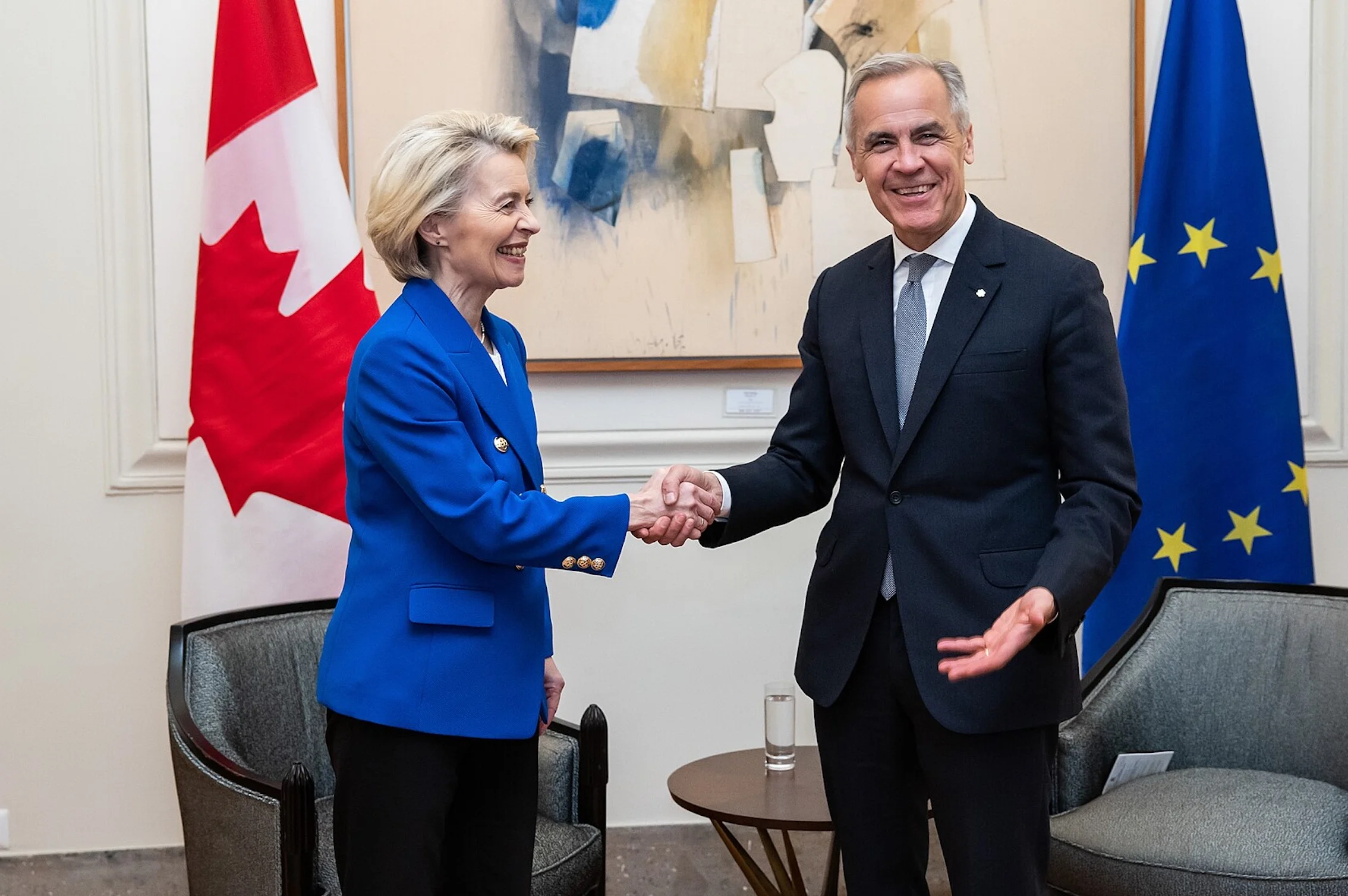
The proposal is still largely conceptual. There is no existing EU legal category called associate membership, no agreed text defining its rights or obligations, and no guarantee that all 27 EU member states will endorse it. But the political signal is unmistakable: Canada and Europe want to reduce strategic vulnerability by working more closely on energy, critical minerals, artificial intelligence, defense production, Arctic security and supply chains.
European Commission President Ursula von der Leyen proposed opening a path for Canada to become the EU’s first associate member during her annual State of the Union address Tuesday. Canadian Prime Minister Mark Carney welcomed the prospect of what he called a stronger and more ambitious alliance, while stressing that Canada is not seeking full EU membership.
For Canada, the initiative reflects an urgent attempt to diversify beyond an increasingly tense relationship with the United States. For the EU, it offers a chance to draw a resource-rich, democratic G7 partner closer at a time of war in Ukraine, competition with China and uncertainty about U.S. trade policy.
Here are the main takeaways from the proposed Canada-EU alliance.
1. This is not EU membership
The first and most important point is what the proposal is not.
Canada is not applying to join the European Union. Carney has said explicitly that Ottawa is not seeking membership but rather a “unique alliance” with the bloc.
That distinction is practical as well as political.
Full EU membership is reserved for European states and involves extensive alignment with EU laws, participation in institutions, contributions to the EU budget, legal obligations and representation in EU decision-making. Member states have voting rights in the Council of the European Union, representation in the European Parliament and access to the European Court of Justice.
Canada is seeking something different: a deeper relationship that expands economic, technological and security cooperation without changing its sovereignty or becoming part of the EU’s formal political structure.
Von der Leyen’s phrase, “associate member,” is therefore more of a political invitation than a completed legal category.
Reuters reported that no associate membership status currently exists in EU treaties. The idea would have to be developed from scratch or constructed through a package of agreements, which means its legal form, scope, governance and approval process remain unclear.
The concept is unprecedented. That creates opportunity, but also uncertainty.
| Question | Current answer |
|---|---|
| Is Canada joining the EU? | No. Carney says Canada is seeking a unique alliance, not membership |
| Is “associate membership” an existing EU category? | No. It has no defined place in current EU treaties |
| Will Canadians automatically gain EU citizenship? | No such proposal has been agreed |
| Would Canada get a vote in EU institutions? | No details have been defined; full voting rights are tied to membership |
| Could Canada gain greater market access? | Possibly, but terms would require negotiation and regulatory alignment |
| Is the agreement final? | No. It is a proposal and talks are still at an early stage |
The absence of a rulebook is one reason officials and analysts are cautious. A new category may be flexible enough to serve Canada and the EU. But it may also be difficult to negotiate because both sides must define rights and obligations without an existing model.
2. The alliance builds on CETA
Canada and the EU already have a major economic relationship through the Comprehensive Economic and Trade Agreement, known as CETA.
The trade deal was signed in 2016 and entered provisional application in 2017. It eliminated most tariffs between Canada and the EU, opening markets for goods and services and creating new rules for investment, procurement and regulatory cooperation.
Von der Leyen now wants the relationship to move “from CETA to an Alliance for the Future,” creating what she called a “common prosperity and economic security space.”
The shift matters because CETA is primarily a trade agreement. The proposed alliance would address a broader set of strategic concerns:
· Advanced manufacturing.
· Technology and AI.
· Defense industrial capacity.
· Arctic cooperation.
· Energy security.
· Critical minerals.
· Batteries and supply chains.
· Quantum computing.
· Cybersecurity.
· Satellite and digital infrastructure.
· Economic security.
The difference is not only economic. It is geopolitical.
CETA was negotiated in an era when free trade was the dominant framework for international economic policy. The new alliance reflects a world where governments are more concerned about supply-chain disruption, energy security, industrial capacity, economic coercion, cyber threats and strategic competition.
For Canada, a stronger agreement with Europe could create new routes for investment and exports. For the EU, it could secure access to a trusted partner with substantial supplies of energy, critical minerals and technological talent.
3. The U.S. relationship is the immediate catalyst
The proposed alliance is not formally aimed against the United States. Von der Leyen said the partnership is “not against anyone else.”
But the timing makes the context clear.
Canada’s relationship with Washington has deteriorated sharply since President Donald Trump returned to office. Trade talks collapsed last month, tariffs have affected tens of billions of dollars in cross-border commerce, and Trump has renewed threats to impose new duties on Canadian vehicles, trucks and auto parts beginning Jan. 1.
Carney has pledged to double Canada’s non-U.S. trade over the next decade, seeking to reduce a longstanding dependence on its southern neighbor.
Canada’s economic relationship with the United States remains enormous. The two countries share one of the world’s deepest trading relationships, integrated supply chains and a long land border. No partnership with Europe can quickly replace that connection.
But that is not the immediate goal.
The goal is diversification. Canada wants more options for exports, investment, technology partnerships, energy routes and security cooperation. The EU wants more reliable access to resources and partners outside an international system increasingly shaped by U.S.-China rivalry.
The proposed alliance is therefore best understood as a hedge against uncertainty.
It is a way for Canada and the EU to reduce overreliance on any single market, supplier, transit route or security partner.
4. Critical minerals are at the core
Critical minerals are likely to be among the most important practical parts of any Canada-EU agreement.
Canada holds important reserves of minerals needed for electric vehicles, batteries, renewable-energy systems, electronics, defense technologies and advanced manufacturing. These include lithium, nickel, cobalt, graphite, rare earth elements and other strategic materials.
Europe needs more secure and diversified access to those inputs as it tries to build domestic clean-energy and technology industries while reducing dependence on Chinese supply chains.
Von der Leyen specifically identified raw materials, batteries and industrial cooperation as areas for expanded partnership.
For Canada, this could mean more investment in mining, processing, refining, transportation and battery manufacturing. It could also create opportunities for Indigenous communities, provinces and local industries, though such projects would still face serious questions about environmental effects, permitting, local consent, infrastructure and economic benefits.
For the EU, a Canada partnership could help reduce exposure to supply disruptions or political pressure from countries that currently dominate critical-mineral processing.
The opportunity is substantial, but so is the challenge. Mining projects take years to develop. Processing capacity is expensive. Environmental standards are demanding. And global mineral markets remain volatile.
The alliance can create a framework for cooperation. It cannot instantly produce new mines, refineries or supply chains.
5. Energy cooperation could reshape trade routes
Energy is another major pillar.
Canada is a large producer of oil, natural gas, hydroelectric power and uranium. Europe is seeking more secure energy sources following Russia’s invasion of Ukraine and subsequent disruption of longstanding energy ties.
Officials have discussed infrastructure that could allow Canadian energy to reach Europe more effectively, including new shipping routes and possible pipeline connections. The Wall Street Journal, cited by Reuters, reported discussions involving infrastructure to ship Canadian energy to the EU.
That idea is strategically appealing but technically difficult.
Canada’s energy infrastructure has historically been oriented toward the United States. Redirecting significant volumes toward Europe would require new export terminals, pipelines, liquefaction capacity, shipping arrangements and regulatory approvals.
The economics also matter. Global gas markets are competitive, and long-term infrastructure requires confidence that demand will justify the cost.
Still, energy cooperation does not depend only on natural gas.
Canada and Europe can also work together on:
· Nuclear fuel and uranium supply.
· Hydroelectric and renewable-energy technologies.
· Grid systems and energy storage.
· Hydrogen and clean-fuel projects.
· Carbon-management technologies.
· Energy-security planning.
The broader point is that energy security has returned to the center of foreign policy. Canada’s resources give it leverage; Europe’s market and capital give it a reason to deepen ties.
6. Defense and Arctic cooperation are growing
The proposed alliance would include integrating defense industrial bases, a significant phrase in an era when Western countries are struggling to replenish ammunition, air-defense systems, drones and other military equipment after years of supplying Ukraine.
Canada is already a NATO ally and a close security partner of European countries. A deeper industrial relationship could involve joint procurement, defense manufacturing, research partnerships, cybersecurity and supply-chain cooperation.
The Arctic will also be a “flagship joint project,” von der Leyen said.
That reflects growing concern about the High North.
Climate change is opening Arctic routes and increasing competition for resources. Russia has a significant military presence in the region. China has increased its Arctic interests. Canada and European states, particularly Nordic countries, see the Arctic as an area where surveillance, infrastructure, shipping rules, environmental protection and security cooperation will become increasingly important.
Canada’s geography gives it a central role. Europe brings political, financial and technological capabilities. A joint Arctic agenda could therefore become one of the alliance’s clearest strategic components.
7. AI, data and digital infrastructure are no longer side issues
Technology cooperation is another key element.
The EU and Canada are discussing a possible tech alliance covering AI, cloud storage, data centers, satellite networks, cybersecurity and undersea cables.
These are not abstract policy areas. Undersea cables carry most international internet traffic. Cloud computing supports businesses and governments. AI systems are becoming central to economic productivity, defense planning, health care and industrial design. Satellite networks support communications, navigation and Arctic monitoring.
For Canada, deeper digital ties with Europe could create alternatives to reliance on U.S. cloud platforms, data routes and technology providers. For Europe, Canada offers a trusted North American partner with advanced research institutions, energy resources and a growing technology sector.
But the same questions that complicate trade will apply here:
· Whose data-protection rules will apply?
· How will Canadian and EU AI regulations interact?
· Can companies transfer data freely?
· Who will fund digital infrastructure?
· How will cybersecurity responsibilities be shared?
· Can systems remain secure from state-backed threats?
The alliance may make joint investment easier, but it will not erase differences in regulatory culture or commercial interest.
8. Worker mobility is possible, but unconfirmed
One of the most politically attractive ideas is greater freedom for Canadians to live and work in Europe, especially in strategic sectors.
Reuters reported that Carney had discussed the possibility of visa-free work and residency rights for Canadians with European leaders, including French President Emmanuel Macron.
No agreement has been announced.
A mobility arrangement could make it easier for engineers, researchers, energy specialists, defense workers, health professionals and technology talent to move between Canada and EU countries. It could help businesses fill skills gaps and support joint projects.
But it would also raise politically sensitive questions about immigration, labor rights, professional accreditation, social benefits and national control over borders.
The EU’s single market is built on freedom of movement among member states. Extending comparable rights to Canada would be a major departure and would likely require careful negotiation.
At this stage, it is better understood as an ambition rather than a policy.
9. The biggest obstacle is turning political symbolism into law
The alliance has strong political momentum. It also faces serious institutional barriers.
Von der Leyen can propose a direction, but the EU’s 27 member states would need to agree on any substantial new relationship. Some governments may welcome deeper Canada ties; others may be cautious about creating a special status that could complicate EU enlargement or set a precedent for other countries.
Reuters reported that EU officials and diplomats were surprised by the proposal. One diplomat said “nobody really knows what it means,” while another warned that von der Leyen could be overpromising.
The legal challenge is equally important.
If Canada sought deeper access to the EU single market, it might need to align more closely with EU standards and regulations. That could make Canada a “rule-taker” in areas where it has no formal vote, similar to the trade-off faced by non-member countries that seek close market integration.
Canada’s laws and standards have historically been shaped most strongly by its relationship with the United States. Aligning more deeply with European regulations could create new complexity for Canadian companies that operate across North America.
This is the alliance’s central tension: Canada wants more access and autonomy, but closer integration usually requires accepting common rules.
What happens next
Carney has said Canada and the EU will begin formal discussions next month.
The immediate next steps will likely focus on defining priorities rather than negotiating a final associate-membership treaty.
Expect early work on:
· Critical-minerals supply chains.
· Defense procurement and industrial coordination.
· AI, cloud and digital infrastructure.
· Arctic security and research.
· Energy and clean-technology investment.
· Trade facilitation and regulatory cooperation.
· Worker mobility for strategic sectors.
The term “associate membership” may survive or may be replaced by a more precise legal label. The substance matters more than the title.
For Canada, the alliance is a strategic bet that diversification can provide more economic security and political room to maneuver. For the EU, it is a test of whether the bloc can build new forms of partnership with democratic allies without diluting the meaning of full membership.
The potential is real. So are the obstacles.
A Canada-EU alliance could become one of the most consequential transatlantic arrangements of the next decade, not because it replaces the U.S.-Canada relationship, but because it gives both sides more choices in a world where trade, technology, energy and security are increasingly inseparable.