A 7.5‑magnitude earthquake has struck off Japan’s northeastern coast, triggering a tsunami warning and prompting tens of thousands of people to flee to higher ground, 15 years after the cataclysmic 2011 disaster that left the country deeply scarred. The undersea quake hit roughly 10 kilometers (6 miles) beneath the Pacific Ocean off the coast of Iwate prefecture, sending waves toward the Sanriku area and prompting a red‑level warning for potentially dangerous surges reaching up to 3 meters (about 10 feet).
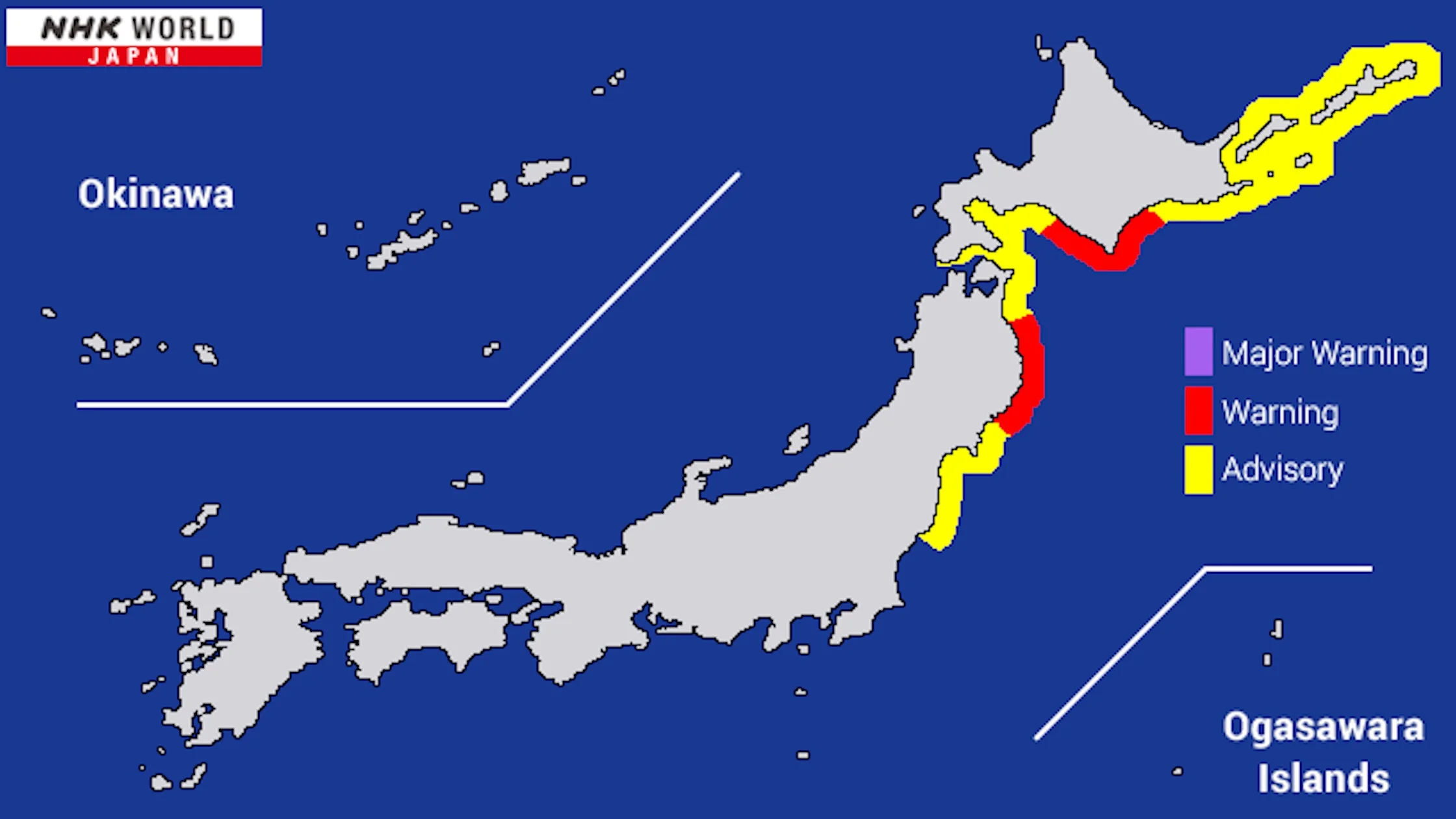
Epicentre and initial impact
The Japan Meteorological Agency (JMA) says the earthquake struck at about 4:04 p.m. local time (07:04 UTC) off the coast of Iwate prefecture, on the northeastern side of the main island of Honshu. The epicenter was roughly 10 kilometers beneath the sea surface, making it a shallow, crust‑disturbing event with strong potential to displace water and generate a tsunami.
Reuters and the Associated Press report that the JMA has rated the quake at magnitude 7.5, with the initial tremor felt over a wide inland area, shaking buildings, and sending commuters and office workers staggering into the streets. Video clips circulating on social media show water sloshing out of tanks, objects tumbling from shelves, and traffic coming to an abrupt halt as the quake passed.
So far, Japanese authorities have reported no immediate deaths and only scattered injuries, though the full toll may not be clear until the aftershock and tsunami risk phases pass.
Tsunami warning and evacuation orders
The undersea nature of the quake prompted JMA to issue a tsunami warning for the nearest coastal regions within minutes. The agency warned that waves of up to 3 meters (about 10 feet) could reach the Sanriku coast, where the 2011 tsunami had already devastated towns and villages.
Authorities tell people in Iwate, neighboring coastal prefectures, and parts of Hokkaido to move quickly to higher ground or evacuation centers and not to stay near the coast or river mouths. NHK and other outlets report that the first wave, measured at about 40 centimeters (16 inches), arrived at the port of Miyako in Iwate, with subsequent surges expected to be larger.
Prime Minister Sanae Takaichi has urged residents in affected areas to “immediately evacuate inland or to higher ground, and not to approach the coast until the all‑clear is given,” according to live‑blog coverage from Sky News and other outlets.
The Pacific Tsunami Warning Center has echoed Japan’s alert, telling people in the region to stay away from the coast or rivers, follow local evacuation instructions, and move to higher ground.
Why this quake is especially sensitive for Japan
The Sanriku coast, where the tsunami warning is focused, was the epicenter of the March 11, 2011 earthquake and tsunami, a magnitude‑9.0 undersea rupture that triggered waves more than 10 meters high and led to the Fukushima nuclear disaster.
That event killed more than 22,000 people, displaced roughly half a million and forced tens of thousands from their homes, leaving permanent scars on the landscape and the national psyche. Older residents in the region have lived in evacuation‑ready houses, coastal walls, and memorials ever since, and the 2011 anniversary has only recently passed.
Japanese media and commentators stress that the 2026 quake is smaller in magnitude and that the first‑reported tsunami was far below 2011’s scale, but the automatic association with that earlier trauma heightens the psychological impact. One NHK correspondent in Iwate told BBC that many residents are evacuating “with their hearts in their throats,” reliving memories of the 2011 evacuation but grateful for improved early‑warning systems and infrastructure.
Japan’s early warning system in action
One of the most striking features of the event is how quickly the warnings went out.
Within seconds of the quake’s detection, Japan’s dense network of seismometers and ocean‑bottom sensors transmitted data to the JMA, which triggered:
- Earthquake early‑warning alerts that went to mobile phones, TV, and radio across the region, giving people tens of seconds to drop, cover and hold on.
- Tsunami warnings and advisories that were flashed to local governments and coastal municipalities, allowing them to activate sirens and evacuation orders.
International outlets describe the response as a textbook example of the country’s preparedness apparatus: trains halted, some bullet services suspended, and local officials ordered to begin evacuations even before the first wave arrived.
Analysts note that Japan’s focus on sea‑level‑measurement buoys, coastal sirens and mandatory evacuation drills has turned the nation into a global model for tsunami risk‑management, even as the underlying seismic hazard remains extreme.
Aftershocks and the risk of a larger event
As with most large quakes, the region has felt multiple aftershocks in the hours since the main shock, some still strong enough to shake buildings and keep residents on edge. The JMA has warned that the risk of additional, potentially damaging tremors will remain elevated over the coming days, urging people to stay alert.
Geologists also flag that the western Pacific around Japan sits on the Pacific Ring of Fire, where the Pacific Plate dives beneath the Eurasian Plate, building up stress that can be released in major earthquakes. The 7.5‑magnitude event, while smaller than the 2011 quake, still represents a significant release of energy in a seismically hyper‑active zone.
The tsunami warning system has been particularly cautious because smaller quakes can sometimes trigger larger‑than‑expected surges when the fault geometry and seafloor topography align in a way that amplifies the wave. That is why authorities are stressing evacuation until the final all‑clear, even as the first wave was relatively modest.
Government and international response
Japan’s national government has activated crisis‑management protocols, with the prime minister’s office coordinating with the JMA, the Self‑Defense Forces and local governments. Reports indicate that military units are on standby to help with evacuation support, logistics and search‑and‑rescue if the tsunami causes significant damage.
The country has also received offers of support from the United States and other regional partners, with the U.S. State Department and UN agencies monitoring the situation and readying humanitarian assistance if needed. The Pacific Tsunami Warning Center continues to assess regional‑wave risk, although its initial guidance has aligned with Japan’s own warnings.
What people need to watch now
As the immediate warning‑issuing phase passes, attention will shift to:
- Tsunami height and damage – How high the waves actually run and how much harm they do to coastal structures, ports and infrastructure.
- Casualty and infrastructure assessments – Reports from local governments on injuries, missing persons, building damage and power‑outage extent.
- Aftershock hazards – Continued monitoring by the JMA and local officials, as well as guidance to residents on staying cautious even after the first waves recede.
Japanese officials have emphasized that people should not return to the coast until the tsunami warning is fully lifted and local authorities give the go‑ahead.
A reminder of Japan’s fragile resilience
For a country that has lived under the shadow of the 2011 catastrophe, the 7.5‑magnitude quake is both a test and a reminder. The early‑warning system appears to be working as intended, giving people critical seconds to take cover and then minutes to reach higher ground.
But Japan also remains acutely vulnerable: its population is dense, its coastline is long and complex, and the tectonic plates beneath it continue to grind. How the nation fares in the coming hours and days, in terms of lives saved, injuries treated, and coastal communities protected, will shape both the immediate response and the next phase of Japan’s ongoing effort to live safely on one of the planet’s most active seismic margins.