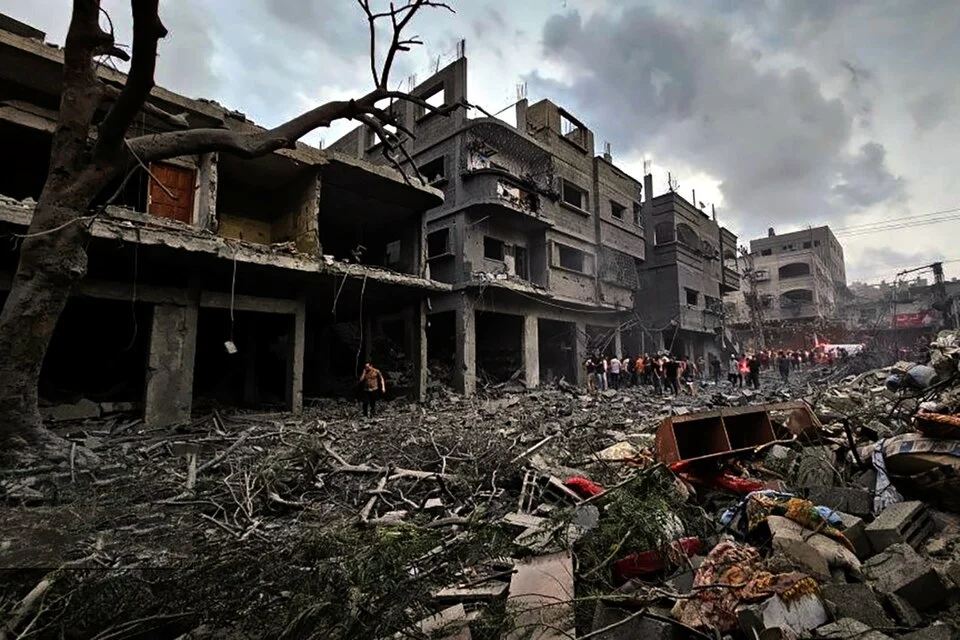
Global risk monitors, insurers and conflict trackers agree on one point in 2026: the world is not sliding back to “normal” after a turbulent decade but edging into a new era in which political violence, economic fragmentation and great‑power rivalry are the rule rather than the exception. Whether that adds up to a permanent age of global instability, or a painful transition to a different kind of order, now depends on how governments, markets and institutions respond to overlapping shocks that show few signs of easing.
Risk dashboards are flashing red
The World Economic Forum’s Global Risks Report 2026 captures the mood bluntly: uncertainty is the defining theme of the global outlook. In its latest survey, 50 percent of experts expect the next two years to be “turbulent” or “stormy,” rising to 57 percent over a 10‑year horizon; just 1 percent foresee a calm decade.
Two threats stand out in that ranking:
- Geoeconomic confrontation, from tariff wars to weaponized supply chains, is named the single risk most likely to trigger a material global crisis in 2026, and the top two‑year risk through 2028.
- State‑based armed conflict follows close behind, reflecting a world in which live wars risk spilling across borders.
Corporate risk assessments tell a similar story. Allianz’s 2026 risk barometer notes that “political risks and violence” have climbed to their highest‑ever global position, with war the peril companies now worry about most. Its brief lists not just the headline conflicts in the Middle East and Europe, but also fighting in Africa and Asia and the spread of drone and air strikes as routine tools of statecraft.
On the ground, conflict‑data group ACLED says a “new normal” has emerged: worldwide, conflict and political violence now top 550 incidents a day, with air and drone strikes at all‑time highs and defense spending rising to sustain them.
More wars, closer to home
The Council on Foreign Relations’ annual “Conflicts to Watch” assessment concludes that “the world continues to grow more violent and disorderly.” Its 2026 watchlist highlights not only front‑page wars, in Gaza, Ukraine and between Iran and Israel, but also a tier of medium‑likelihood flashpoints: state fragility in Lebanon, renewed sectarian conflict in Syria, terrorist gains in Somalia and Yemen, and renewed risk of fighting between India and Pakistan.
Strikingly, the survey again flags growing political violence and popular unrest in the United States as a high‑likelihood, high‑impact contingency, after a brief downgrade in 2025, underscoring that internal instability in a major power is now itself a global risk.
Eurasia Group’s Top Risks 2026 puts this even more starkly, naming “US political revolution” as Risk 1 and arguing that President Donald Trump’s efforts to “dismantle checks on his power” and weaponize the machinery of government make the United States “the principal source of global risk in 2026.” In this view, the world’s traditional anchor of order is increasingly a driver of volatility.
Fragmentation is corroding globalization
Beyond the battlefield, experts see a slower‑moving but equally destabilizing trend: the fracturing of the economic order that underpinned decades of globalization.
The 2025 Geneva Report, summarized by Brookings, warns that Russia’s invasion of Ukraine, US–China rivalry and tariff campaigns have begun to split trade and finance into rival blocs, reversing years of integration. Deeper fragmentation, it concludes, would mean:
- higher costs from duplicated payment systems and supply chains
- more volatile capital flows and exchange rates
- weaker sanctions, as countries develop ways to bypass Western‑dominated networks
- and an emerging world of multipolar reserve currencies, complicating crisis management.
IMF economist Adam Posen describes this as the “corrosion of globalization,” arguing that linking market access to “political loyalty tests or side payments” is increasing the vulnerability of all but the largest economies to foreign shocks and sudden stops in dollar liquidity.
An Atlantic Council brief on fragmentation and the global financial safety net similarly warns that new restrictions on capital and trade flows are likely to bring greater volatility in coming years, at a time when the traditional anchor, the IMF‑centered safety net, is itself under strain.
A contested multipolar world
The World Economic Forum characterizes 2026 as “an age of competition,” with a contested multipolar landscape emerging as cooperation mechanisms crumble and trust “loses its value.” CaixaBank Research sketches the underlying power shift: a rising China building new alliances and dependencies across Eurasia, Africa, and Latin America, and an “old hegemonic power” (the US) rebalancing the playing field with tariffs, defense‑spending demands, and more transactional diplomacy.
The paradox, the report notes, is that the supposed provider of stability has become “one of the main hotbeds of uncertainty,” and that traditional allies in Europe and Asia could be among the most exposed to shifting rules. An EY geostrategic outlook for 2026 echoes this, predicting that geopolitical volatility will persist and that the US role in reshaping the global operating environment will be “highly significant,” with China, the EU and others continuously adapting.
This is not a simple return to a Cold War‑style two‑bloc world. Instead, analysts describe overlapping coalitions, fluid “minilateral” groupings and tactical hedging by middle powers, patterns that make the system more complex, and potentially more accident‑prone.
Economic reckoning and domestic stress
Instability does not flow only from geopolitics outward; it also runs the other way, from domestic economics back into international politics.
The Global Risks Report notes that economic downturn has seen one of the sharpest jumps in perceived severity over the past year, behind only geoeconomic confrontation. Section 2.4, titled “An economic reckoning,” warns that over the next two years, debt‑sustainability concerns, and potential asset bubbles, in a context of rising economic confrontation, could usher in a new phase of volatility that further destabilizes societies and firms.
The IMF likewise cautions that more fragmented trade and finance increase the vulnerability of many economies to foreign shocks and unsustainable debt, especially when access to markets and technologies becomes entangled with politics. In low‑ and middle‑income countries, that mix can amplify grievances and fuel protests or coups; in advanced economies, it can feed populist backlashes that then reshape foreign policy.
ACLED’s data points to exactly that feedback loop: governments are generating more conflict not only across borders, but also against domestic groups and protesters, especially in Africa and Latin America. As climate shocks, food prices and fiscal pressures rise, the risk is that unrest becomes a structural feature, not an episodic one.
So, are we in a new era?
Taken together, these indicators make a strong case that the world is already operating in a more structurally unstable environment than a decade ago:
- More wars and armed incidents, including between or involving great‑power allies.
- Higher and more interconnected political, economic and climate risks, with geoeconomic confrontation at the center.
- A fracturing financial and trade system that could make future crises harder to manage.
- Major‑power domestic politics, from Washington to other capitals, now themselves top‑tier global risks.
Yet several reports also stress that this need not be a descent into chaos. The WEF frames 2026 as a moment when “stability is under siege,” but not yet lost, and calls for renewed efforts to shore up multilateral rules in areas from climate to debt relief. The IMF and Atlantic Council argue that adapting institutions, clarifying when and how to lend to countries at war and reinforcing the global safety net, could still provide a buffer against the worst outcomes.
In that sense, the better question may not be whether we have entered a new era of global instability, but what kind of era it will be: a prolonged phase of unmanaged fragmentation and recurring shocks, or a difficult but ultimately contained transition to a less US‑centric, more plural world order.
The data so far tilt toward the first scenario. Whether they stay there will depend on choices made in a handful of capitals, and on whether institutions built for a more predictable age can evolve fast enough to steady a far more volatile one.