
Google Groundsource is a new AI methodology from Google Research that turns messy real‑world information, especially news and public records, into structured data that can be used for forecasting and analysis, starting with natural disasters like urban flash floods. It sits alongside Google’s broader “grounding” tools for Gemini and Vertex AI, which connect models to external data, so their answers are tied to verifiable sources instead of guesswork.
What is Google Groundsource AI?
Groundsource is described by Google Research as a “scalable methodology” that uses Gemini models to convert unstructured global news into historical data. In its launch blog, Google says the first Groundsource dataset covers 2.6 million records of urban flash floods, extracted from years of media coverage, and turned into a machine‑readable database.
A separate tech report on the project frames Groundsource as an AI‑powered pipeline that processes “millions of public records, municipal reports, infrastructure data and more”, to generate predictive signals for crisis events. While the initial focus is climate and disasters, the core idea is general: use large language models to read the world’s paper trail at scale and continuously update a knowledge base that other models or applications can query.
How Groundsource works under the hood
Google’s description points to three main stages in the Groundsource pipeline:
Ingesting unstructured text at scale
Groundsource pulls in vast amounts of open information, news articles, municipal reports, scientific summaries, infrastructure logs and other public documents. These sources are highly heterogeneous and scattered, which makes them hard to use directly in traditional models.
Using Gemini to extract structured “signals”
Gemini models are applied to this corpus to identify and normalize key facts: for example, where and when a flood occurred, what type it was, what infrastructure failed, and what consequences were recorded. The AI essentially annotates and standardizes events that were previously just paragraphs in a newspaper or PDF.
Building an updating, queryable dataset
The extracted information is stored as structured records that can be analyzed statistically or used as input to forecasting models. Because news and reports keep coming, Groundsource is designed as a continuously updating methodology rather than a one‑off scrape.
The end result is not just a single model, but a data layer: a large, cleaned, event‑level dataset that others can plug into for prediction, risk scoring or research.
From Groundsource to disaster prediction
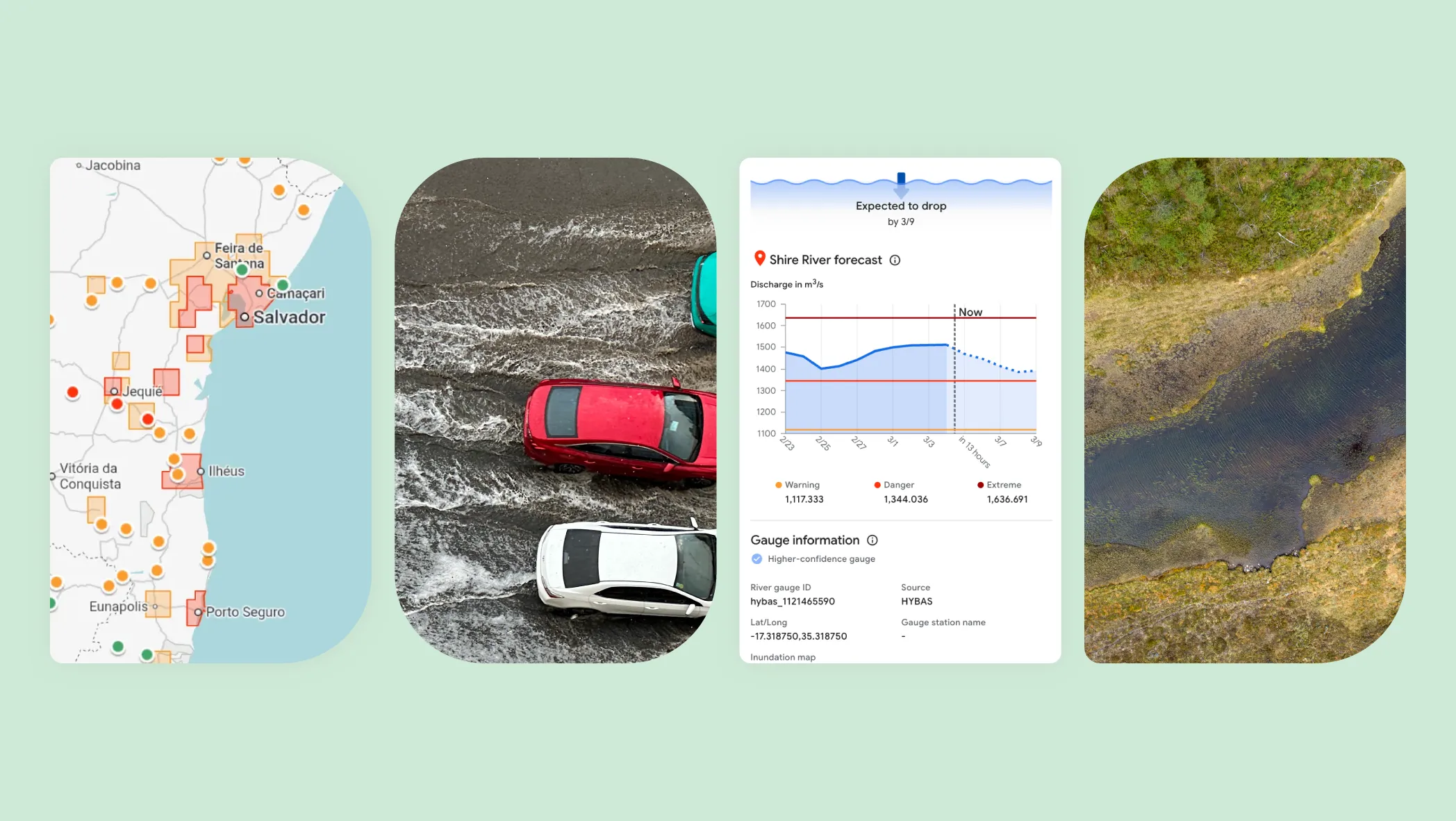
Google explicitly links Groundsource to its existing climate‑tech work, especially FloodHub, which already provides river flood forecasts in dozens of countries using physical and hydrological models.
The promise of Groundsource is to “supercharge that existing framework” by adding rich, real‑world context:
- Historical patterns of where flash floods hit cities, beyond official gauge networks.
- Relationships between rainfall, drainage, land use and reported damage.
- Local vulnerabilities that may not appear in satellite or sensor data but do show up in local news and municipal documents.
By training or calibrating models on this richer event history, Google argues that cities and agencies can get earlier and more granular warnings, especially in urban environments where official data is sparse.
How it fits into Google’s broader “grounding” strategy
Groundsource sits alongside a wider set of “grounding” tools that Google is rolling out for Gemini in Vertex AI and Firebase:
Grounding in Vertex AI and Gemini API
Google defines grounding as connecting a generative model to external information, from Google Search, Google Maps, or a company’s own documents, so answers can be checked against verifiable sources. This reduces hallucinations and lets models answer questions about recent events or specific datasets.
Google Search grounding
Developer docs show how apps can enable a “Google Search” tool so that Gemini decides, at inference time, whether to run web searches, incorporate results and return grounded responses with citations and groundingMetadata. That’s aimed at real‑time knowledge.
Vertex AI grounding and dynamic retrieval
Vertex AI offers “grounding” and “dynamic retrieval” so Gemini can mix Google Search with private data stores, only calling external data when needed to keep costs down but accuracy high.
In this ecosystem, Groundsource provides another type of ground truth: instead of live search results, it’s a curated, historical event database derived from the news. Gemini models can then be grounded either in this Groundsource dataset, in Search, or in customer data, depending on the use case.
Why Google built Groundsource now
Two trends help explain the timing:
The limits of traditional datasets
Many disaster‑risk models rely on small, manually compiled datasets that lag reality and miss local details. Yet the world is awash in unstructured text that contains those details—if you can read it at scale.
The need for trustworthy AI outputs
As generative AI becomes more widely deployed, enterprises and the public sector are demanding evidence‑backed answers, particularly in high‑stakes domains like climate and infrastructure. Groundsource is a way to pre‑build that evidentiary base from open sources.
Google’s research blog presents Groundsource as both a climate‑resilience tool and a proof‑of‑concept for how AI can continuously turn global reporting into data, not just prose.
Potential uses beyond floods
Although the first open dataset targets urban flash floods, the underlying methodology is not flood‑specific.
Based on Google’s description, similar pipelines could be applied to:
- Wildfires and heatwaves, where news reports capture local impacts faster than official statistics.
- Infrastructure failures, such as bridge collapses or power outages.
- Conflict and displacement, by structuring event reports for humanitarian planning.
- Public‑health incidents, like disease outbreaks mentioned in local media before they show up in formal surveillance data.
In each case, Groundsource‑style AI would continuously scan and structure open information into datasets that can be analyzed and fed into predictive models or dashboards.
What Groundsource means for AI and data work
For AI practitioners and policymakers, Groundsource signals a few shifts:
From models to pipelines
The value is increasingly in the data pipeline, how AI ingests, cleans, and structures the world’s text, rather than just in the model’s raw generation ability.
From static datasets to living knowledge bases
Instead of one‑off dataset releases, methods like Groundsource aim to maintain living, updating corpora that reflect ongoing events.
Closer links between journalism and data science
Because Groundsource leans heavily on news media as a signal, it implicitly treats journalism as raw input for quantitative analysis, not just narrative. That raises both opportunities (better early warning) and questions (bias, coverage gaps).
In practical terms, Google Groundsource AI is best understood as a bridge: a way to convert what humans write about the world into the kind of structured evidence that both forecasters and generative models can rely on.





