Rising 250 meters above the Bouregreg valley between Rabat and Salé, the Mohammed VI Tower has become the centerpiece of Morocco’s tallest and one of Africa’s most prominent skyscrapers, a $700‑million, 55‑story monument that the kingdom proudly brands as a statement of economic and technological ambition. Named for King Mohammed VI and inspired in design by a Saturn‑V‑style rocket poised for launch, the tower mixes opulent urban real estate with a push toward energy‑efficient construction, creating more than 100,000 square meters of mixed‑use space just across from the Moroccan capital’s Royal Palace and Zaha Hadid–designed opera house.
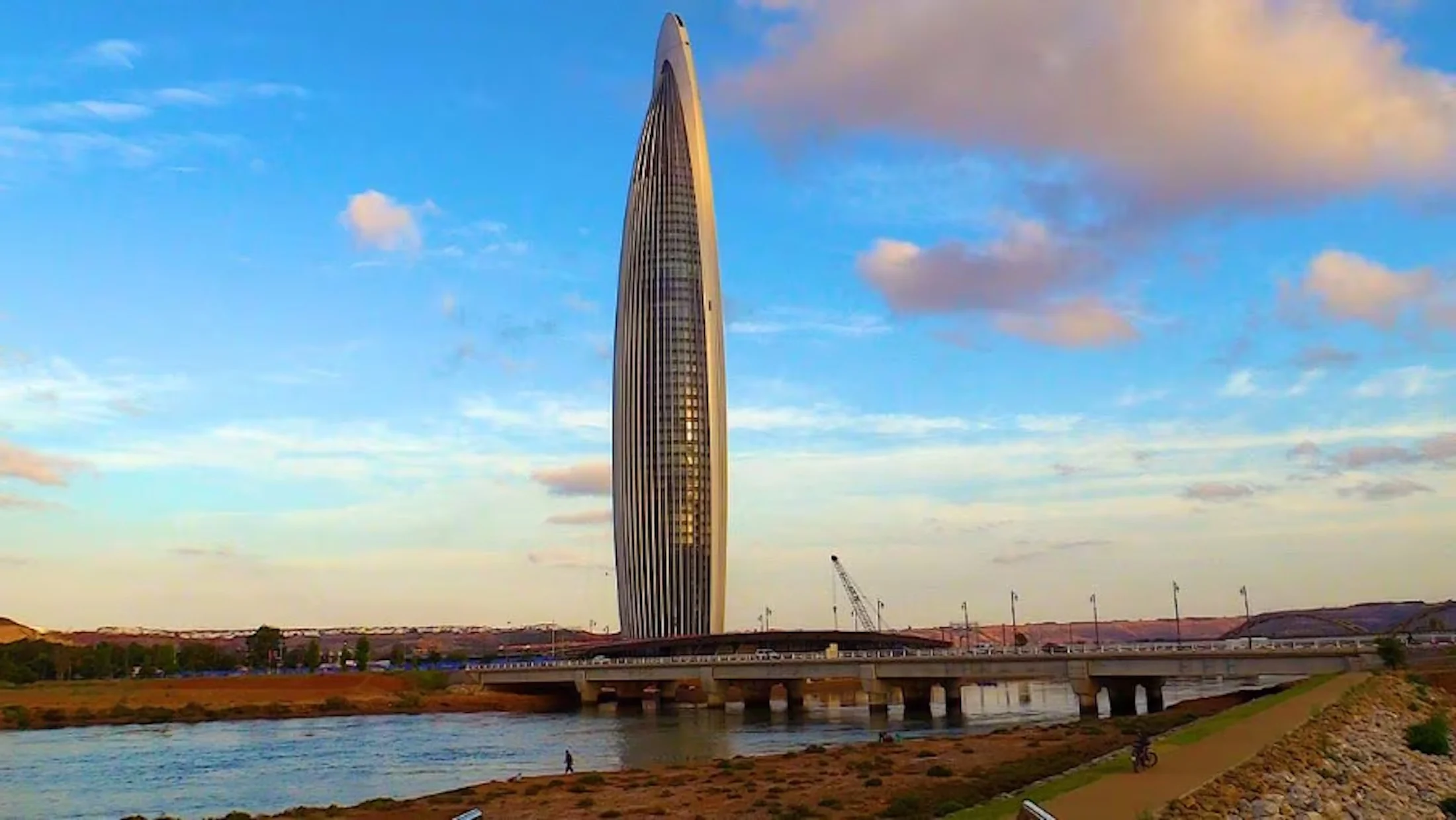
The shape of ambition in concrete
The Mohammed VI Tower stands precisely at the symbolic intersection of old and new. It looms beside the Grand Theatre of Rabat, designed by Zaha Hadid, and offers sweeping views of the royal capital, the Atlantic Ocean, and the twin cities of Rabat and Salé.
At 250 meters and 55 floors, the building is the tallest in Morocco and the third‑tallest in Africa, according to architectural and business‑media coverage. Engineers and the Belgian‑Moroccan developer BESIX, which led construction alongside the Moroccan group TGCC, say the rocket‑like silhouette is more than a gimmick: it is a deliberate nod to exploration and vertical ambition, echoing the Saturn V launch vehicle that sent Apollo astronauts to the moon.
The tower’s construction spanned eight years and involved more than 2,500 workers from over a dozen countries, according to the Associated Press and local reports. From the outside, the building is visible from up to 50 kilometers away, its tapered, tapering form designed to reduce wind load and present a clean, columnar profile against the sky.
A mixed‑use vertical city
Inside, the Mohammed VI Tower functions almost like a stacked city, with separate zones for hospitality, business, commerce, and private living. The project is a mixed‑use flagship within the wider Bouregreg‑valley redevelopment, which aims to transform the area into a modern waterfront district linked to the capital.
According to AP, Bloomberg, and African business outlets:
- The tower houses a luxury Waldorf Astoria hotel, bringing international‑brand hospitality into the heart of the Moroccan capital area.
- It includes premium office spaces intended to attract regional and global firms that might otherwise anchor in Casablanca or other North African hubs.
- High‑end residential apartments and upscale retail and dining add a residential‑lifestyle component, turning what would once have been a strictly commercial skyscraper into a 24‑hour vertical neighborhood.
The complex is served by 36–38 elevators and technical terraces, with total floor area exceeding 102,800 square meters (about 1.1 million square feet). For a country where the skyline has long been defined by traditional low‑rise architecture, the tower’s footprint and internal density mark a marked shift toward a more vertical, high‑density urban model.
Green ambitions in a high‑rise frame
Amid the glitz, the developers and Moroccan officials are also stressing the building’s energy‑conscious design.
The Mohammed VI Tower incorporates roughly 3,900 square meters of photovoltaic panels, part of a drive to cut the building’s electricity load and align it with Morocco’s broader push for renewable energy and sustainable construction. Leila Haddaoui, deputy chief executive officer of O Tower, the development arm of the project, says the tower has an installed capacity of 11.6 megavolt‑amperes (MVA) and achieves about 40% energy savings compared with a “standard reference” building of similar size and use.
That figure is central to the narrative that the Mohammed VI Tower is more than a vanity project: it is framed as a model for future Moroccan high‑rises, combining iconic design, high‑end amenities, and lower per‑square‑meter energy demand.
The man behind the rocket‑shaped vision
The Mohammed VI Tower is as much a monument to Othmane Benjelloun as it is to the king whose name it bears. Benjelloun, a 93‑year‑old billionaire, and chairman of the holding group SA MAârif, controls Bank of Africa, a major financial institution across North and West Africa that was once state‑owned and is now a privately run powerhouse with branches in multiple countries.
Tower‑management statements say the skyscraper idea traces back to Benjelloun’s 1969 visit to NASA, where he attended a spaceflight simulation prior to the Apollo 12 lunar mission. Inspired by the launch‑pad image of the Saturn V rocket, he reportedly conceived the tower as a vertical symbol of ambition and technical prowess.
The project is led by O Tower, a company created specifically to manage the skyscraper and the wider Bouregreg‑valley urban‑renewal program. That initiative positions the tower as the anchor of a broader transformation of the riverfront into a “City of Light”‑style district, blending public spaces, green infrastructure and modern transports with new commercial and cultural venues.
Symbolism, jobs, and the wider Bouregreg‑valley plan
The Mohammed VI Tower is already a national symbol visible at the micro‑scale: it has been printed on Morocco’s 200‑dirham note, which is worth about 20 dollars, linking the building directly to everyday commerce and national identity.
Officials and business‑media outlets say the project is projected to create or sustain:
- 450 direct jobs within the tower and its management structures.
- Roughly 3,500 indirect jobs in construction, services, hospitality, and downstream supply chains.
For a region that has long been overshadowed by the economic pull of Casablanca, the new tower is being sold as a way to reposition Rabat and Salé on the international map, especially among tourists and investors who might previously have gravitated toward the country’s largest city.
The tower also sits near other bold architectural moves, including the Grand Théâtre de Rabat and any planned additions to the Bouregreg‑valley corridor, suggesting a deliberate clustering of landmarks that could anchor a new axis of cultural and economic gravity for the capital region.
What this means for Morocco’s skyline, and its ambitions
The 700‑million‑dirham skyscraper is, at its core, a statement of vertical ambition.
Morocco has long been a major player in North‑Africa tourism, renewable energy, and regional finance, but its built‑environment narrative has typically leaned on historic medinas, coastal resorts and relatively low‑rise administrative centers. The Mohammed VI Tower signals a willingness to stack land use vertically, experiment with cutting‑edge engineering, and stake a claim in the upper tier of African tall‑building landmarks.
At the same time, Casablanca still holds designs of its own: developers have revived plans for the Atlantic Tower, a 390-meter mixed-use skyscraper that, if completed, could claim the title of Africa’s tallest building. That project, also positioned as a symbol of Morocco’s rising global profile, underscores that the Mohammed VI Tower is not an isolated showpiece but part of a broader trajectory toward denser, higher‑rise urbanism across the country.
For residents of Salé and Rabat, the new 250‑meter silhouette has already begun to redefine the way they see their cities from the riverbank. For investors and tourists, it offers a flashy, photogenic emblem of a nation that has long marketed itself as a bridge between Africa and Europe now reaching for the skies.