A historic heat dome gripped the central and eastern United States over the Fourth of July weekend, forcing dozens of parades, concerts, fireworks displays and landmark celebrations marking the nation’s 250th birthday to cancel, postpone or scale back operations, as more than 185 million Americans were placed under heat alerts and at least one death was blamed on the scorching conditions.
The extreme heat, which sent temperatures soaring past 100 degrees Fahrenheit from Washington to New York, threatened to overshadow the Semiquincentennial, the 250th anniversary of American independence, on the very weekend it was meant to be celebrated with the largest slate of civic events in a generation. The National Weather Service has repeatedly identified heat as the deadliest weather-related hazard in the United States, deadlier than tornadoes, hurricanes and lightning combined, and this week’s conditions were no exception, as hospitals, emergency crews and city officials scrambled to respond even as festivities went on in modified form across the country.
A Nation’s Birthday, Scorched
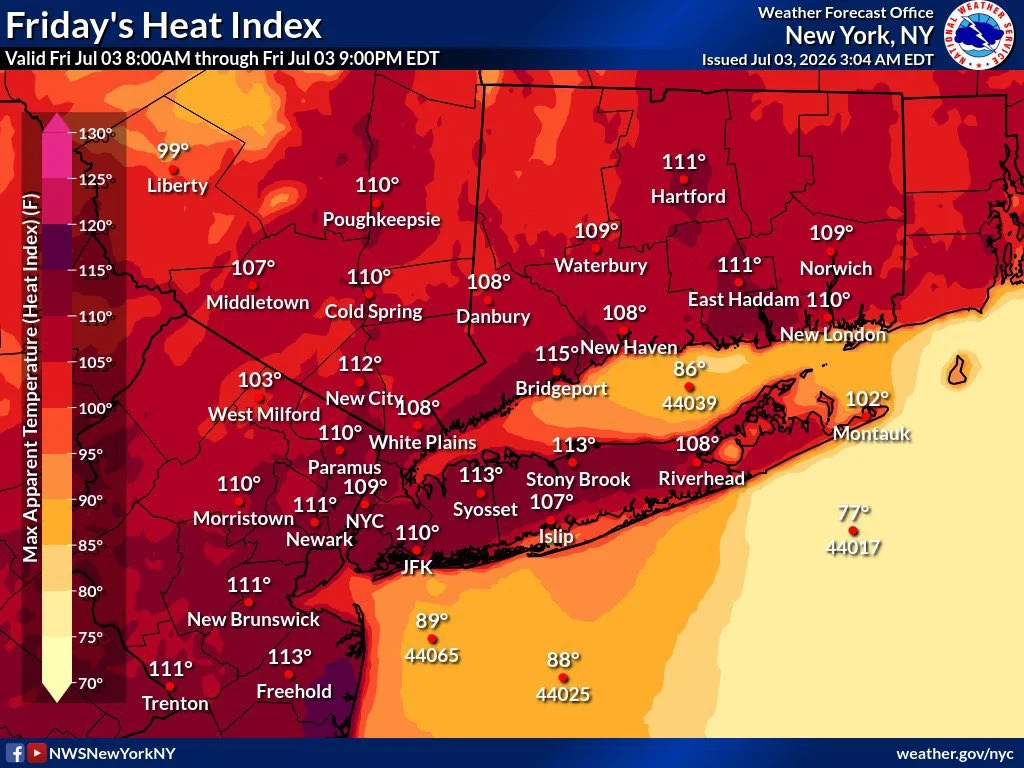
The National Weather Service reported that more than 185 million people were under heat alerts on July 3 as a sprawling heat dome parked itself over the central and eastern U.S., pushing heat indexes as high as 115 degrees Fahrenheit in some areas. In Washington, D.C., the temperature reached 100 degrees with a heat index of 111 degrees at 2 p.m. on July 3, and forecasters projected a high of 103 degrees on the Fourth itself, which would make it the hottest Independence Day on record in the capital, surpassing a mark set in 1919. An extreme heat alert remained in effect through July 5.
Philadelphia hit 103 degrees on July 2, tying a record set in 2001, while New York City endured its third consecutive day of extreme heat. AccuWeather meteorologists said the stretch could rank as New York’s second most intense heat wave since 2000, and forecasters in Virginia described it as the state’s most significant heat wave since July 2012. New York City emergency management officials noted that roughly 500 New Yorkers died from heat-related illness the previous year, underscoring the stakes as the city activated 500 cooling centers across its five boroughs.
From Parades to Silence
Nowhere was the disruption more visible than in Philadelphia, where organizers called off the “Salute to Independence Semiquincentennial Parade”, one of the largest parades ever planned in the city, with participants representing every state, just hours before its scheduled noon start on July 3. Wawa Welcome America, the parade’s organizer, confirmed the cancellation even as floats sat lined up and ready along the route. Philadelphia’s mayor declared a heat health emergency, the city trimmed the viewing schedule for the FIFA Fan Festival at Lemon Hill Park, and a Thursday evening concert by the U.S. Army Field Band and Soldier’s Chorus was scrapped entirely.
In Washington, the Great American State Fair on the National Mall, the centerpiece of President Donald Trump’s America 250 celebrations, organized under the Freedom 250 banner, temporarily closed Friday afternoon as temperatures hit 101 degrees, reopening at 5 p.m. with cooling tents and misting stations for visitors. U.S. Capitol Police delayed public entry to the “Capitol Fourth” concert, holding gates closed until 7 p.m. to limit crowd exposure during the hottest part of the day.
The cancellations rippled outward. In Maryland, Takoma Park scrapped its July 4 parade and street party, Laurel canceled its parade outright, and Annapolis shortened its Independence Day parade route and pushed it to 6:30 p.m. Saturday. Virginia’s Loudoun County called off its events, and in Bristol, organizers canceled “Salute America 250: A Symphony Spectacular,” saying the orchestra could not safely perform outdoors in the heat. Across New York’s Hudson Valley, the toll was extensive: Ardsley and Newburgh canceled their July 4 celebrations, Wallkill scrapped its fireworks, Port Jervis called off its Food Truck Festival, Tarrytown and Carmel postponed summer concerts, Woodbury pushed its celebration to the following weekend, and Middletown moved a Thursday concert to August while relocating a Friday show to a new venue.
Utah’s City of Beaver canceled its Fourth of July celebration entirely because of the Cottonwood Fire, a 94,000-acre blaze that has become the largest wildfire burning in the nation. Earlier in the week, extreme heat had already forced cancellations of a farmers’ market in DeWitt, Michigan, a movie screening in Fairfield, Ohio, and a food truck festival in Warwick, New York, while Colorado saw multiple America 250 events canceled or postponed.
Lives at Risk
The human toll of the heat wave was already being counted. A 68-year-old man died July 2 in Bethel Township, Berks County, Pennsylvania, after trimming bushes in temperatures above 100 degrees; the Berks County Coroner’s Office ruled the cause of death a heart attack brought on by heat exhaustion, according to CNN. Upwards of 100 people were treated for heat-related injuries at a single event in Berks County, with dozens hospitalized.
In Washington, D.C., Fire and EMS crews treated 44 patients on the National Mall on Friday, with 11 transported to local hospitals, according to ABC News. In New York City, the health department recorded 32 emergency room visits for heat-related illness on July 1 alone, prompting officials to keep 500 cooling centers open across the boroughs. Mayor Zohran Mamdani urged New Yorkers to stay indoors and said the city had activated its emergency heat protocols. “We are asking every New Yorker to check on their neighbors, especially the elderly, and to avoid being outside during peak heat hours,” Mamdani said, as the city worked to keep residents safe through the holiday weekend.
Data from the Centers for Disease Control and Prevention shows at least 13,000 Americans have died from heat-related causes since 2018, and federal officials have long characterized extreme heat as the deadliest weather-related hazard in the country, with an annual death toll that surpasses tornadoes, hurricanes and lightning combined. The strain extended to infrastructure: Amtrak canceled more than two dozen trains in the Northeast, citing excessive heat that can warp and damage rail tracks, and ran remaining trains at reduced speeds between 11 a.m. and 7 p.m. from July 1 through July 4.
New York City’s power grid came under significant strain, and utility Con Edison reduced voltage in parts of the Bronx and Westchester as a precaution. CNBC reported that natural gas, nuclear and coal generation were what kept the nation’s largest power grid from buckling under the demand. The American Red Cross issued nationwide warnings about the dangers of prolonged heat exposure, urging Americans to recognize the warning signs of heat stroke, including confusion, rapid pulse, and loss of consciousness.
Celebrations That Persisted
Not every event fell to the heat. The “Capitol Fourth” concert on Capitol Hill went forward as planned once gates opened at 7 p.m., and Washington’s fireworks display remained on the calendar for Saturday night. President Trump traveled to Mount Rushmore in South Dakota to speak at America 250 festivities despite the punishing conditions, and the event proceeded without disruption. In Philadelphia’s Historic District, visitors and street performers remained out in smaller numbers even as the parade was scrapped.
Elsewhere, the holiday weekend’s biggest indoor spectacle, the wedding of Taylor Swift and Travis Kelce at Madison Square Garden, proceeded in air-conditioned comfort, a striking contrast to the outdoor festivities being canceled just blocks away. The heat wave also arrived as the 2026 FIFA World Cup continued to draw crowds to U.S. host cities, adding another layer of complexity for organizers managing large outdoor gatherings.
A Climate Warning
Climate scientists cited in a CNN analysis said the heat wave gripping the eastern U.S. would be “virtually impossible” without the influence of fossil fuel pollution and human-caused climate change. The extreme conditions were not confined to North America: a concurrent heat wave across Europe was linked to approximately 1,000 excess deaths in France alone. “Europe is the fastest-warming continent on Earth, heating at twice the global average,” World Health Organization Director-General Tedros Adhanom Ghebreyesus said, noting that roughly 150 million people across the continent were under extreme heat warnings at the same time.
The National Weather Service has said repeatedly that heat is the most lethal weather phenomenon in the United States, a designation that has taken on renewed urgency as such heat domes grow more frequent and more intense. The American Red Cross said its warnings this week were aimed at preventing further loss of life as the extreme heat persisted into the holiday weekend.
Forecasters warned the danger was far from over. The heat index was expected to reach roughly 102 degrees in New York City and 108 degrees in Washington on Saturday, July 4, as the holiday itself arrived under some of the most oppressive conditions of the week. Emergency officials in multiple states renewed calls for Americans to stay indoors during peak afternoon hours, remain hydrated and check on elderly or vulnerable neighbors as the nation’s 250th birthday weekend drew to a close under a blanket of historic heat.
With temperatures not expected to break until early next week, officials said the coming days would test the resilience of a country determined to mark its milestone anniversary, even as the climate that shaped its founding two and a half centuries ago grows more extreme.