
TOKYO — A magnitude 5.9 earthquake struck eastern Japan early Sunday, shaking Tokyo and surrounding prefectures, injuring at least 23 people and causing localized infrastructure disruptions, including a ruptured water pipe in the capital.
The earthquake hit at about 2 a.m. local time Sunday with its epicenter in southern Ibaraki Prefecture, northeast of Tokyo, at a depth of about 70 kilometers, or 42 miles, according to the Japan Meteorological Agency.
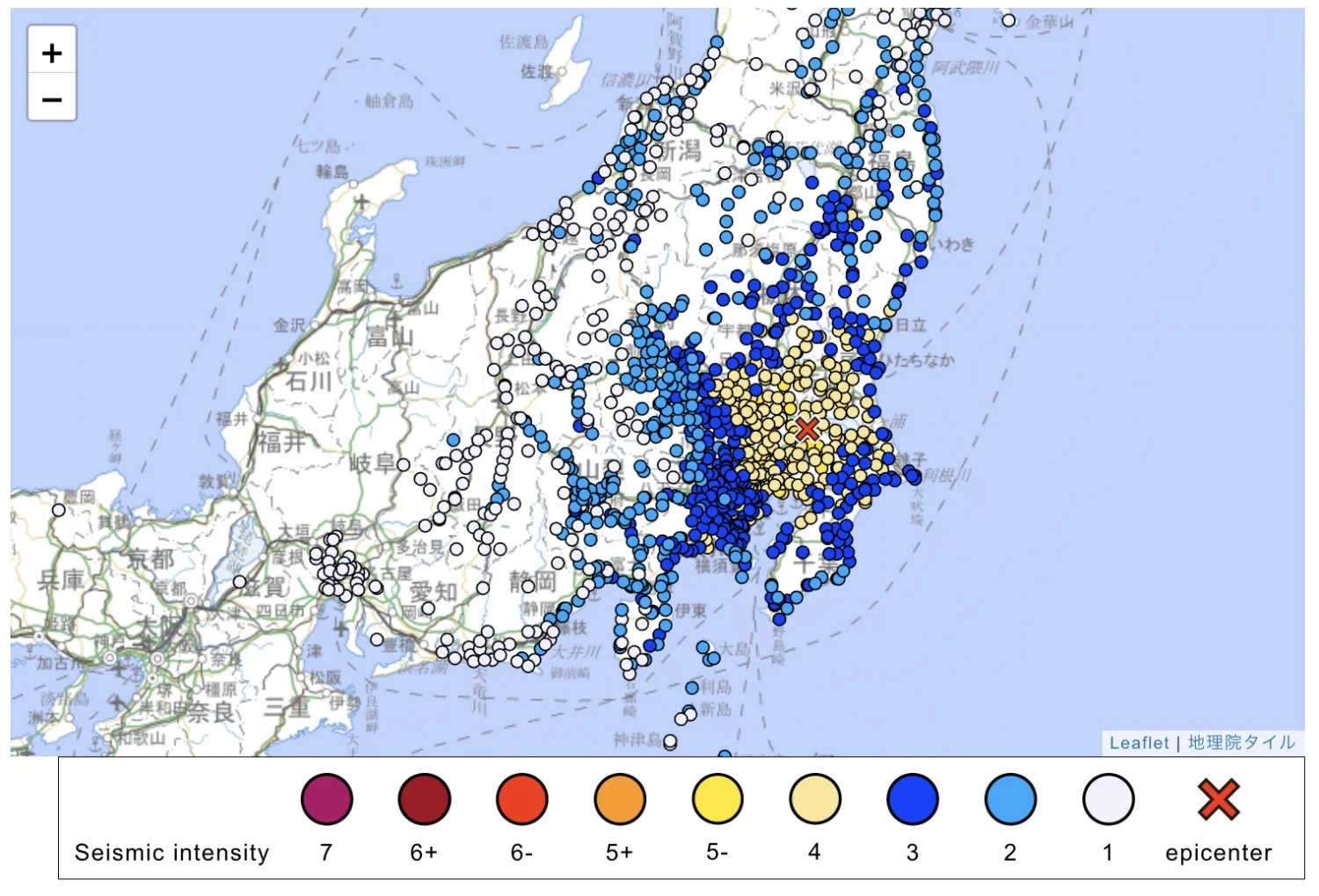
The Japan Meteorological Agency measured the preliminary magnitude at 5.9. The U.S. Geological Survey recorded a preliminary magnitude of 5.8. Differences between early magnitude estimates are common because agencies use different data and analytical methods, and figures may be revised as more seismic information is reviewed.
No tsunami warning was issued. The Japan Meteorological Agency said the quake did not pose a tsunami threat.
At least 23 people were injured across four prefectures, authorities said. Most suffered minor injuries after falling, being struck by objects or losing balance during the shaking.
The quake was felt widely across the densely populated Kanto region, home to the Tokyo metropolitan area and more than 35 million people. It prompted emergency alerts on mobile phones, temporarily affected train services, and led officials to conduct inspections of infrastructure and nuclear facilities.
Strong shaking in Tokyo and Kanto
The strongest shaking was measured at lower 5 on Japan’s seven-level shindo seismic intensity scale in Tokyo’s Adachi Ward and parts of Ibaraki, Saitama and Chiba prefectures.
Japan’s shindo scale measures the intensity of shaking at a particular location, rather than the total energy released at the earthquake’s source. A reading of lower 5 indicates strong shaking that can cause objects to fall from shelves, make walking difficult and prompt people to grab onto stable objects.
Other areas of Tokyo, as well as Tochigi, Gunma and Kanagawa prefectures, recorded level 4 shaking.
The tremor lasted up to a minute in some locations, according to Japanese media reports.
The quake’s relatively deep focus helped spread the shaking across a broad area. Earthquakes at depths of several dozen kilometers can be felt widely because seismic waves travel through rock beneath the surface before reaching cities and towns.
Residents in Tokyo received emergency earthquake alerts on their phones shortly before or as the tremor began. Japan’s warning system is designed to detect the first seismic waves and provide seconds of advance notice before stronger shaking arrives. Even a brief warning can allow people to move away from windows, take cover or stop trains and industrial equipment.
NHK footage showed roads in nearby cities including Mito and Saitama remaining generally calm after the quake, though authorities continued to inspect for damage.
Injuries reported across four prefectures
Authorities reported 23 injuries in Saitama, Kanagawa, Chiba, and Ibaraki prefectures. Most were described as minor.
The Japan Times initially reported two injuries in Kawasaki as local authorities began assessing the impact.
In earthquake events of this size, many injuries occur not from building collapse but from falls, broken glass, unsecured furniture and people reacting suddenly during the shaking. Older adults are particularly vulnerable to falls, especially when earthquakes strike at night or early in the morning.
Japan’s building standards, disaster planning and public-awareness campaigns have reduced risks in many urban areas. But even moderate earthquakes can cause injuries and disruption in a region as densely populated as Tokyo and its surrounding prefectures.
Emergency officials urged residents to stay alert for aftershocks, avoid damaged structures, and check official updates rather than relying on unverified information online.
The number of injured people can change as local governments collect reports from hospitals, fire departments and police agencies. Early disaster figures are often preliminary.
Water pipe rupture in Tokyo
In Tokyo’s Koto Ward, an underground water pipe ruptured in the Kiyosumi area, sending water onto a road. NHK footage showed water flooding part of the street.
Authorities had not immediately confirmed whether the rupture was directly caused by the earthquake. Water mains can break because of ground movement, aging infrastructure, pressure changes, or a combination of factors.
Even limited water-pipe damage can create secondary risks in a major city. Flooded roads can impair traffic, damage pavement and block access for rescue services. Utility crews must inspect nearby lines and determine whether water service has been affected.
The quake also caused a temporary power outage affecting about 460 homes in Tokyo, according to TEPCO Power Grid. Power was restored by Sunday morning.
Tokyo’s infrastructure is designed with earthquakes in mind, but the event illustrates how even a moderate tremor can test systems that support daily life: electricity, water, transportation, communications and public safety.
Trains and transportation checks
Rail operators paused or inspected some services after the earthquake, a standard safety procedure in Japan.
JR East said it was checking whether the tremor had caused damage and would decide whether early trains could operate normally.
The quake delayed some services, including express trains connecting Tokyo and Narita Airport. However, the Shinkansen bullet-train network was reported to be operating normally.
Japan’s rail system uses earthquake-detection technology that can automatically slow or stop trains when seismic waves are detected. Operators then inspect tracks, overhead wires, bridges and other infrastructure before resuming service.
The approach can cause short-term delays, but it is a central part of the country’s disaster-safety system. Rail disruptions after an earthquake are often precautionary rather than evidence of physical damage.
For travelers, the most reliable information comes from rail operators, airport authorities, and government emergency agencies. Officials typically advise passengers not to crowd stations or attempt unnecessary travel until service conditions are confirmed.
Nuclear facilities report no abnormalities
Authorities reported no abnormalities at nuclear power plants and other facilities handling nuclear materials after the earthquake.
The Nuclear Regulation Authority said there were no reports of unusual conditions at approximately a dozen nuclear plants and related facilities.
In Ibaraki Prefecture, the Japan Atomic Power Company said no abnormalities had been found at the Tokai No. 2 nuclear power plant, where shaking reached intensity level 3. The company continued checks at its Tokai plant, which is being decommissioned.
Japan’s nuclear facilities are subject to heightened scrutiny after the 2011 earthquake and tsunami caused the Fukushima Daiichi nuclear disaster. Following that event, Japan strengthened safety requirements and emergency-response systems for nuclear operators.
The absence of reported abnormalities does not mean inspections stop immediately. Operators typically continue monitoring equipment, power systems, cooling systems, and structural conditions after an earthquake, especially at facilities near the affected area.
The current quake was much smaller than the magnitude 9.0 earthquake that struck northeastern Japan in March 2011 and generated a devastating tsunami. Sunday’s event caused no tsunami and did not produce reports of major structural damage.
Still, Japan’s experience with past disasters means even moderate earthquakes prompt careful, immediate checks.
Why Japan experiences frequent earthquakes
Japan sits along the Pacific “Ring of Fire,” a highly active zone where several tectonic plates meet.
The country is affected by the interaction of the Pacific Plate, Philippine Sea Plate, Eurasian Plate and North American Plate. As those plates move, they can build stress in the Earth’s crust. When that stress is released, it produces earthquakes.
Of particular note is the Kanto area, which includes Tokyo, which sits near many tectonic boundaries and has one of the world’s greatest metropolitan populations.
Japan experiences thousands of earthquakes each year, though most are too small to be felt. The country has developed one of the world’s most advanced earthquake-monitoring and warning systems, along with strict building codes and extensive public education.
The shindo scale helps communicate what people may experience locally. Unlike magnitude, which measures the size of the earthquake at its source, intensity tells residents how strongly the ground moved where they were standing.
That distinction explains why a magnitude 5.9 earthquake can feel severe in some neighborhoods and moderate in others. Distance from the epicenter, ground conditions, building height, and local geology all influence shaking.
Long-period ground motion and high-rises
Authorities also reported level 2 long-period ground motion in parts of Tokyo, Saitama and Chiba, including Tokyo’s Koto and Edogawa wards.
Long-period ground motion refers to slow, rolling seismic waves that can cause high-rise buildings to sway for extended periods. The movement may feel different from a sharp jolt. In tall buildings, people on higher floors can experience stronger or longer swaying than those at ground level.
At level 2 persons might have difficulties standing, unsecured objects or furniture might shift or fall.
Tokyo has many high-rise residential and office buildings, and long-period ground motion is a particular concern. Buildings built today are meant to bend and absorb energy in an earthquake, although people may still experience unsettling motion, and elevators may automatically shut down for safety.
People in high-rise buildings are advised to avoid elevators after an earthquake, remain calm, and follow building-management instructions. It may be safer to stay in place until authorities confirm that stairs, exits, and utility systems are secure.
Government response and public guidance
Prime Minister Sanae Takaichi said the government established a liaison office at the Prime Minister’s Office Crisis Management Center to gather information and coordinate the response.
She said officials had been instructed to assess damage and provide timely, accurate information to the public.
That response reflects Japan’s standard disaster-management approach: rapid information gathering, coordination among national and local agencies, infrastructure checks and frequent public communication.
Residents were urged to remain aware of possible aftershocks. Aftershocks are smaller earthquakes that can follow a larger event as the fault system adjusts. They are common, though their timing and strength cannot be predicted precisely.
Emergency officials suggest anchoring furniture, keeping emergency supplies on hand, knowing evacuation routes and being connected to reliable notifications. During an earthquake, the recommended action is generally “Drop, Cover and Hold On”. Get low to the ground, take cover under sturdy furniture if possible and hold on until the shaking stops.
People should avoid windows, shelves, and unsecured objects. They should not rush outdoors during shaking, where falling glass, signs and debris can pose risks.
A reminder of constant preparedness
Sunday’s quake did not produce a tsunami, widespread building collapse or a major nuclear emergency. Most reported injuries were minor, and infrastructure impacts appeared localized.
But the event was still a powerful reminder of the daily reality of life in Japan: earthquakes can strike without warning, including in the country’s largest metropolitan area.
The magnitude 5.9 tremor disrupted sleep, triggered emergency alerts, and sent people into the streets or under tables before dawn. It caused injuries, a water-pipe rupture, and transportation checks. It also activated the systems Japan has spent decades developing, phone alerts, rail inspections, government crisis coordination and nuclear-facility monitoring.
For Tokyo and the Kanto region, the immediate emergency appears to have passed. Yet the response underscores a broader lesson: preparation does not eliminate earthquake risk, but it can reduce the harm when the ground begins to move.