
(PARIS, Oct. 2025) – Police in Paris have instigated a worldwide dragnet for suspects after a brazen robbery at the Louvre Museum on Sunday morning, where thieves executed a perfectly timed, seven-minute dressed as museum-goers raid for jewels that officials have claimed are “of inestimable historical value.” The perpetrators of the robbery using professional-grade tooling and a basket lift made off with a small number of pieces from France’s imperial collection at the museum’s celebrated Galerie d’Apollon, which houses France’s crown jewels.
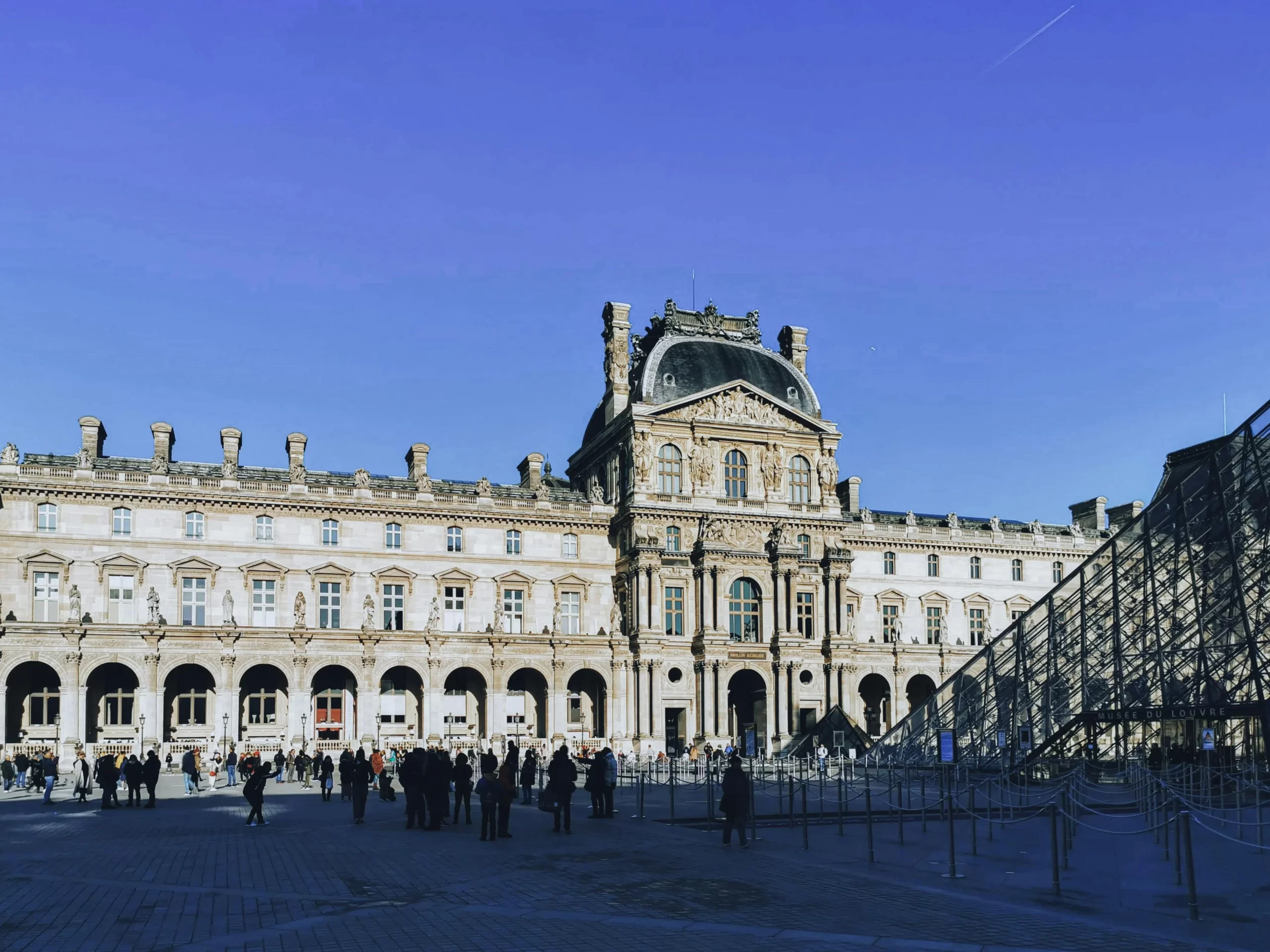
The event occurred around 9:30 AM, while visitors were inside the most visited museum in the world and is considered one of the boldest thefts in Franck’s recent history. The Louvre is temporarily closed to the public by authorities “for exceptional reasons,” while forensic detectives scour the site for evidence.
The Heist: A Perfect Seven-Minute Job
According to France’s Interior Minister, at least three people were involved in the robbery, after entering the Louvre through a window on the riverside of the building, as the thieves used a basket lift placed on an area temporarily under renovation. The intruders are believed to have used small chainsaws and disc cutters to force the window open, smashed several display vitrines, and took jewelry from the Napoleonic and Empress Eugenie collections.
Sieved CCTV footage viewed by police show the theft took only seven minutes. Witnesses heard loud cracking noises just before alarms went off in the gallery, which was then open to the public and staff. Museum guards locked down the gallery, but crew members the still dressed as public departure, out for the nearby Pont du Carrousel bridge, fled on two low, a two high-power TMax motorcycles, heading South toward the A6, highway.
France’s Culture Minister Rachida Dati offered condemnation of the “unforgivable violation of our cultural heritage,” outside of the Louvre shortly after the robbery. The Minister confirmed nine items, including necklaces, brooches, and a tiara worn by Empress Eugenie, wife of Louis Napoleon III, were robbed. Dati said. “These are not just jewels; they are pieces of French history.” One fragment of one of the crowns was identified by authorities, later, a short distance from the museum, leading them to think it was possibly lost during the getaway.
Security Breach at France’s Crown Jewel
The Louvre, an architectural wonder and emblem of French identity, had only just completed renovating some elements of its security measures, such as sensors and digital locks in the gallery of Apollo, at the behest of the French State Audit Office in the previous year. But according to people who know the museum well, renovation work on its western wing, including scaffolding and construction lifts, created ‘temporary vulnerabilities’ to the perimeter of the building.
“Due to the investigation underway we can’t go into specifics of the operation,” said a spokesperson for the Louvre in a statement, “but from the evidence it is clear this was a highly coordinated operation carried out by people with intimate knowledge of our programming and space.”
Investigation is also underway to determine if the thieves may have had inside information on the operation that day. “With the level of precision and timing, this is clearly not spontaneous,” said one police official from the Brigade de Répression du Banditisme, the elite unit specializing in organized crime. “They knew exactly when to hit and which display.”
The Stolen Jewels: Symbols of Empire
The items taken represent the imperial assemblage of ornaments that are rooted in the First and Second French Empires, made for Napoleon Bonaparte, and were later added to by Napoleon III, along with Empress Eugénie. They included the emerald gold brooch, the diamond and pearl tiara, and at least one necklace that was ostentatiously displayed at Versailles before being added to the Louvre national collection following World War II.
Officials have yet to give an official valuation, but based on expert estimates the items are worth more than €20 million ($21.5 million US), however, by their nature and provenance they would not be saleable through legal means. Recovery of the lost properties is the only meaningful resolution.
“These types of objects cannot simply be melted down or privately traded without being traced,” said historian Claire-Marie Dupuy, curator of decorative arts at the Sorbonne. “They are state-owned patrimony; I would imagine whoever took them must realize that there is now going to be a globel search for them.”
A Professional Operation
Interior Minister Laurent Nuñez remarked that to execute this degree of operation signs of “expert reconnaissance and sophisticated execution.” The thieves had to pre-cut some sections of reinforced glass with industrial cutters to reduce noise and shorten their interior time. They even brought an outside lookout and getaway vehicles of the same type used by organized Europin art crime syndicates.
French police have not confirmed any arrests, yet they are working with Interpol and the Art Loss Register to track any existence of jewelry. They reinforced border checks near Belgium and Germany, both known routes for stolen art to be exported, and they are evaluating recent heists that occur in Milan and Geneva where similar methodology was used to take smaller collections of private art earlier this year.
“This achieves a level of nothing on the professional level of doorman toward the actual operation of theft,” said Nuñez. “Every minute was planned.”
Museum Closed, Tourists Shocked
After the episode on Sunday morning, The Louvre, which received 8.7 million visits last year, evacuated all visitors from the museum. Visitors recounted confusion while hearing alarms blaring through the Denon Wing, which is cited as the location for Leonardo da Vinci’s the Mona Lisa.
“I thought they were conducting a fire drill,” said Angela Rossi, a visitor from Italy. “We were told to move away from the glass pyramid; nothing was said as to why.”
Police cordoned off streets surrounding the museum as well as the museum’s entrances located on the Seine. During the process, forensic teams took fingerprints and looked for chemicals in the broken glass cases, while technicians inspected many hours of internal surveillance footage.
The Louvre later announced by its official account on social networking media that it would “remain closed for exceptional reasons,” and the museum “would reopen as soon as the investigation was complete and safety precautions were assured.”
Historical Comparison: The Mona Lisa Robbery
The most recent theft at the Louvre took place remarkably close to the museum’s theft of the Mona Lisa in 1911, when a former employee, Vincenzo Peruggia, carried away the painting under his coat and kept it hidden for two years in Florence until police recovered it. That incident became a scandal after which da Vinci’s portrait was cemented as the world’s most renowned piece of art.
Art analysts noted that art theft, even if not as publicly presented, as in the case of what happened in 2025, could have an impact on the global discussion regarding museum security, “What happened at the Louvre today is not just a French affair – it unambiguously provides institutions worldwide the responsibility to rethink how they protect cultural heritage in real time.” said Alain Bureau, professor of art crime studies at the University of Lyon.
A Cultural and Political Shockwave
The robbery comes amid higher political scrutiny over funding for French cultural institutions. Earlier this year, museums tweeted an appeal for €250 million from the government for basic holdings upgrades and to maintain infrastructure and collections that had run the full lifespan of their maintenance plans. Critics point out that museums – like the very large Louvre, with more than 380,000 objects and 35,000 on display – cannot completely modernize museum security at a scale that large.
“The tragedy confirms the need for continued increased investment into the modernization of museums,” Culture Minister Dati told reporters on Sunday evening. “We cannot protect art on passion alone, we must protect art with precision and resources.”
President Emmanuel Macron has not issued a formal statement, but reportedly is being briefed every hour on the status of the investigation.
Global Reaction and Recovery Efforts
The audacious theft has reverberated throughout Europe’s art establishment. Luxury brands, collectors, and institutions alike— from London’s V&A to New York’s Met—are all rallying to support the French. Audrey Azoulay, the Director-General for UNESCO and a former French Culture Minister, referred to the heist as “an aggression on cultural heritage, which belongs to all humanity.”
Insurance agencies have started looking into claims that may be filed, but a source has confirmed that the Louvre’s jewels, such as the Regent Diamond, which weighs over 140 carats, are safe and completely untouched.
Law enforcement has created a task force named Operation Apollo, a reference to The Apollo Gallery, where the robbery took place. Officials are offering a reward of €2 million to anyone who offers information that leads back to the jewels.
The Mystery Deepens
But key questions remain unanswered; how were the thieves able to neutralize a state-of-the-art alarm? Were there people inside the museum? And will France’s greatest supported museum survive from a symbolic stare that is.
Security experts have suggested that a robbery of this scope takes weeks, if not months to prepare, with possibly some of the construction workers or subcontractors acquainted with the building and its renovation schedule. Some suggest the jewels are already separated or hidden altogether.
“The crucial period is the first 48 hours,” asserted Karl-Heinz Richter, Interpol’s head of its art theft division. If the thieves are a part of a known organized crime syndicate, the artwork in their possession could be lost into a private collection in a matter of days.”
A Crime for the Ages
The Priceless Jewelry Stolen in Bold Daylight Heist at the Louvre is yet another dramatic chapter into the Louvre’s history. Despite law enforcement and the scale of the investigation, experts have affirmed that it could take years to recover the items if at all.
For Parisians, it’s a reminder that the art capital of the world, Paris, is not exempt from a planning process due to the nature of crime. As forensic teams scurry under arching golden ceilings of the Apollo Gallery, the world waits, as we always are, for results from a mystery born in the Louvre.