
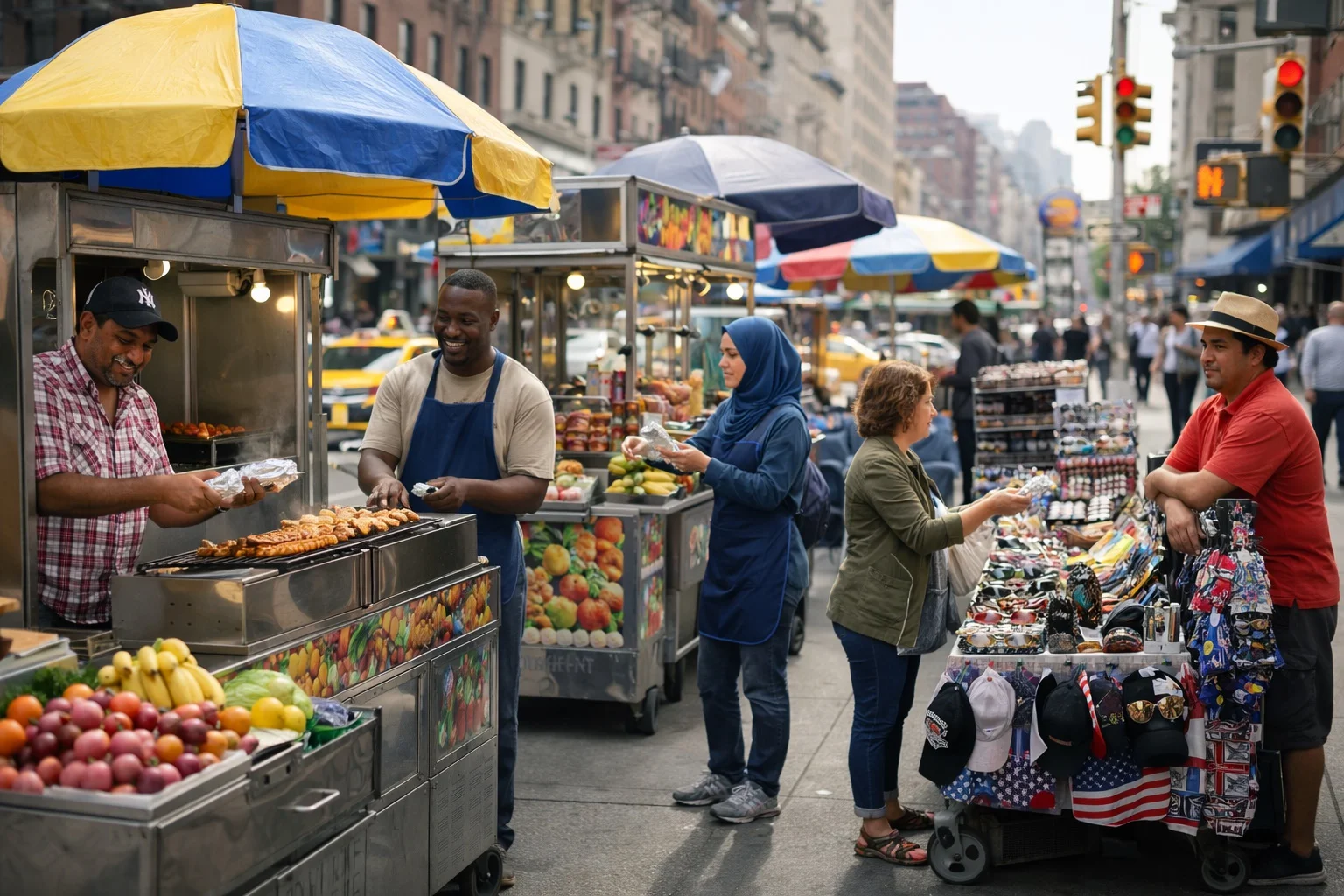
The New York City Council has passed a historic bill that will greatly increase the number of legal street vending permits. This could give thousands more entrepreneurs the chance to sell food, clothes, and crafts on the busy sidewalks of the city without worrying about getting fined or having their goods taken away. Sponsored by Councilmember Alexa Avilés and backed by a coalition of immigrant advocates and small-business groups, the measure addresses decades of restrictive quotas that have fueled an underground economy estimated at $3 billion annually, while easing barriers for low-income vendors from Latin America, South Asia and West Africa who dominate the trade.
Mayor Eric Adams is expected to sign the bill into law by year’s end, marking a rare bipartisan win in a city where street vending has long been a flashpoint between public safety concerns and economic inclusion.
The Bill’s Core Changes
New York’s food vending permits are limited to just 3,000 citywide, a number that hasn’t changed in 40 years, even though the population has grown and the demand for cheap street food like halal carts, tamales, and banh mi has grown. The new law, which was passed unanimously on December 18, 2025, tells the Department of Small Business Services (SBS) to give out 1,500 more food permits over the next three years. It also tells them to give out 2,000 general vending licenses for things that aren’t food, like jewelry, T-shirts, and produce.
Key provisions include:
- Streamlined application process: Digital submissions with reduced fees (from $200,000 black-market bribes to under $1,000 official costs) and multilingual support.
- Priority for underserved neighborhoods: Extra permits will be given to neighborhoods that don’t get enough of them, like the Bronx and Queens, which have a lot of poor people.
- Mobile vending zones are special “super spots” in tourist areas like Times Square and Flushing where there are fewer rules about when and where to set up shop.
- Enforcement grace period: A 12-month period during which unlicensed vendors can follow the rules without facing any penalties.
According to city estimates, the expansion will bring in $500 million in new tax revenue over five years and make the workforce that supports 20,000 families more official.
A Response to Longstanding Inequities
Street vending in New York has operated in a gray zone for generations, with police confiscating $20 million in carts and goods annually from unlicensed sellers, many of whom are immigrants without access to traditional capital. Advocates like the Street Vendor Project, which represents 2,500 members, hailed the bill as “historic reparations” for a system rigged against people of color, who make up 95% of vendors.
Councilmember Avilés, whose district includes Sunset Park’s vibrant vendor scene, framed the push as economic justice: “These are New Yorkers feeding New Yorkers, paying taxes in every other way, why criminalize their hustle?” Data from SBS shows unlicensed vendors already contribute $1.2 billion in sales taxes indirectly, but face average fines of $1,200 per violation, trapping many in debt cycles.
Opponents, including some restaurant owners and sanitation unions, worried about sidewalk clutter and health risks, but concessions like mandatory waste disposal plans and pop-up hygiene stations addressed those concerns.
Economic and Cultural Ripple Effects
Legalization could transform neighborhoods. The bill promises formal markets that will bring more people to brick-and-mortar stores in Jackson Heights, Queens, where 40% of vendors don’t have a license. Economists say that 5,000 new jobs will be created, from permit processors to cart makers, which will help the economy recover after the pandemic.
Culturally, street food is New York’s soul, think the lamb-over-rice carts immortalized in hip-hop lyrics or the elote stands fueling summer block parties. Expanding access preserves that diversity amid gentrification, ensuring pupusas from Salvadoran vendors compete alongside upscale food trucks. One vendor, Maria Gonzalez, told reporters: “I’ve sold empanadas illegally for 15 years. Now my daughters can inherit the business legally.”
| Vendor Type | Current Permits | New Permits Added | Projected Impact |
| Food Carts | 3,000 | +1,500 | $300M annual sales, 3,000 jobs |
| General Merch | 500 | +2,000 | $200M sales, tourism boost |
| Mobile Produce | Limited | +500 | Healthier neighborhoods |
This table illustrates the scale, based on city projections.
Challenges Ahead: Enforcement and Equity
Implementation won’t be seamless. SBS must hire 100 new inspectors and overhaul a backlog of 50,000 applications, a process critics fear could take years. Corruption scandals, vendors paying $50,000 under-the-table for spots, demand robust oversight, with the bill mandating anonymous tip lines and annual audits.
Equity is still something to keep an eye on: Will prime Manhattan locations go to well-connected insiders, or will they really reach people who are trying hard in the outer boroughs? Pilot programs in Brooklyn that gave out 200 emergency permits after COVID showed that they worked but also showed that favoritism could happen.
Health and safety get upgrades too: All new permit holders must complete food handler training, and carts will have GPS trackers so that inspections can be done quickly. These steps are meant to bring street vending up to the same standards as restaurants in light of growing concerns about foodborne illness.
Voices from the Streets and City Hall
Vendors erupted in cheers outside City Hall on passage day, waving placards reading “Licenses, Not Fines!” Fahim, a halal cart owner from Bangladesh, shared: “I came here 20 years ago with $200. Now I support five kids, legality means stability.”
Mayor Adams supported the bill as a “win-win for revenue and humanity,” linking it to his “Fair Fares” equity agenda, even though he was under pressure to cut the budget. Even council members from Manhattan, who used to complain about “sidewalk gridlock,” changed their minds when data showed that vending clusters didn’t cause major delays in foot traffic.
Cities like Los Angeles and Chicago are paying attention to the move because they are also dealing with similar vendor crackdowns. Urban policy experts say it is a model for cities after the pandemic: a way to use immigrant entrepreneurship without too much regulation.
Broader Implications for NYC’s Future
This bill signals a philosophical shift: from viewing street vendors as scofflaws to assets in a $100 billion tourism economy. As remote work reshapes downtowns, vibrant sidewalks could lure visitors seeking authentic eats over sterile chains.
Yet success hinges on execution. If SBS delivers permits swiftly and equitably, New York could pioneer a vending renaissance. Botch it, and resentment festers. For now, the council’s unanimous vote, rare in polarized times, offers hope that pragmatism can prevail.
In a city of dreamers hawking dreams from wheeled kitchens, thousands more may soon cook legally under the skyline, their carts as iconic as yellow taxis.





