
The rescheduled White House Correspondents’ Dinner was less glitzy and more guarded than the version that was derailed by gunfire in April, but it still delivered a clear message: the press corps is determined to keep showing up, even under pressure. The biggest takeaways were a tighter security posture, a visibly more sober tone and a renewed insistence that celebrating the First Amendment still matters, especially when President Donald Trump is in the room.
A dinner shaped by violence
The evening took place after the original April dinner was abruptly cut short when a gunman opened fire outside the event near the Washington Hilton, forcing the evacuation of Trump, journalists, and officials. That incident left an unmistakable imprint on the redo: attendees were routed through controlled entrances, security barriers were visible and Secret Service personnel were stationed outside the normal perimeter.
Because of that backdrop, the event felt less like a glamorous Washington social stop and more like a statement of resilience. WHCA president Weijia Jiang said the association would not allow political violence to take away its annual celebration of the First Amendment, and that sentiment shaped the tone from the start.
The move to the Waldorf Astoria, combined with reduced attendance and heightened screening, made the dinner feel smaller and more deliberate than previous years. The setting itself underscored the theme: a press event trying to keep its footing after an unprecedented security failure.
Trump loomed over the room
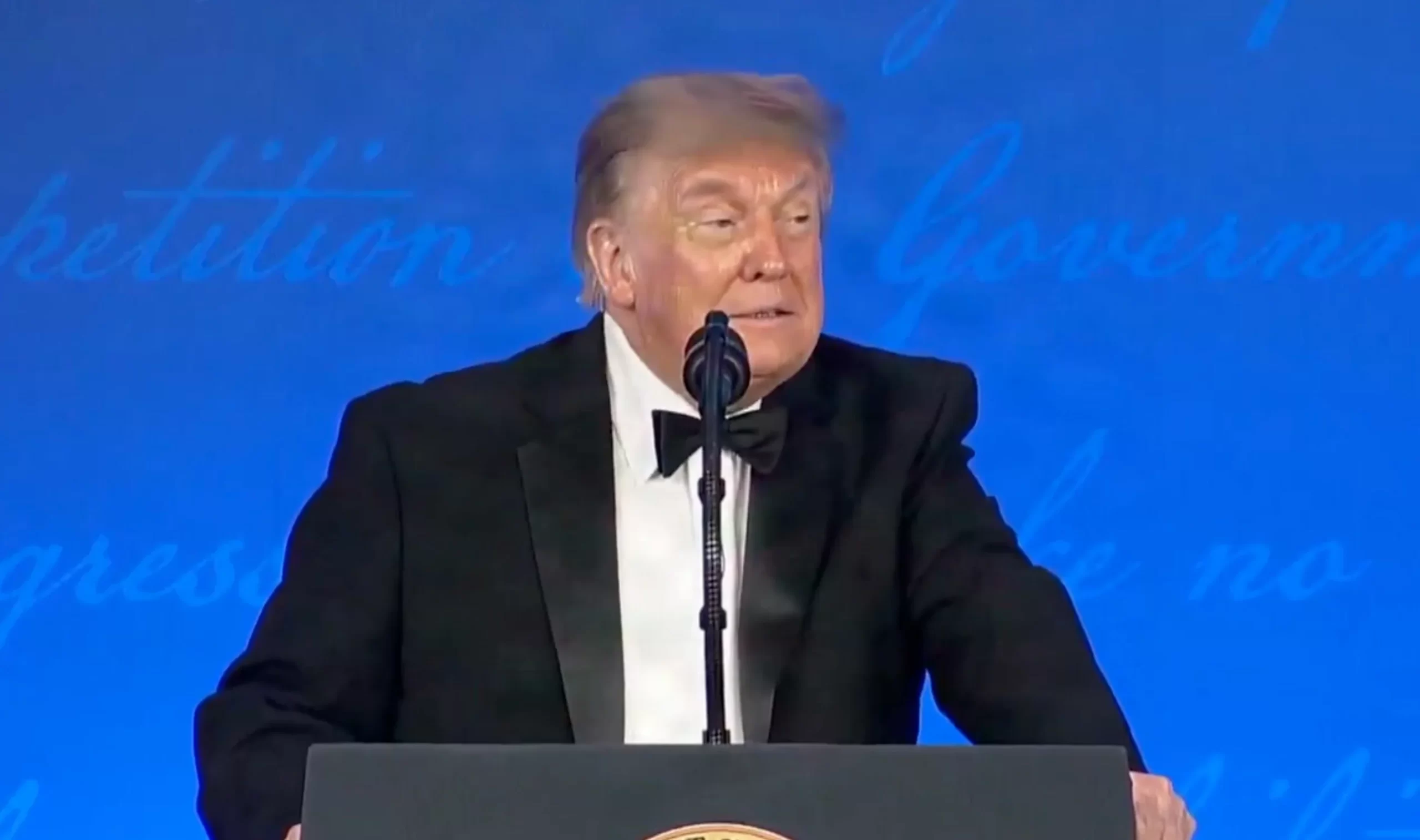
President Trump’s presence ensured the dinner remained politically charged, even if the atmosphere was calmer than in April. White House press secretary Karoline Leavitt had previewed the president’s remarks as “unifying yet vicious,” a line that captured the paradox of the night: part civic ritual, part political test.
Trump told reporters that “a lot was learned” from the April attack and suggested that the second try was better than the first, a remark that mixed self-congratulation with a warning about the dangers surrounding political life. His presence in the room meant the dinner remained one of the few moments each year when the president, the White House press corps and the broader political class occupy the same public space on relatively equal footing.
That dynamic matters because the dinner is never just about jokes or black-tie optics. It is also about whether journalists can preserve a shared civic stage with an administration that has often been openly hostile to the media. This year’s event showed that the answer, at least for now, is yes, but only under heavier security and sharper scrutiny.
Press freedom stayed central
One of the clearest takeaways was the renewed emphasis on the First Amendment and the role of journalism in a polarized era. WHCA leaders framed the dinner not as a vanity event, but as a fundraiser for journalism awards and scholarships, with proceeds supporting the next generation of reporters.
That message carries added weight in a political climate where the administration and its critics frequently clash over truth, access, and accountability. The decision to proceed with the dinner after a violent disruption was itself a symbolic defense of the idea that journalism cannot be intimidated out of public life.
The awards portion of the event reinforced that point. WHCA’s 2026 journalism prizes honored reporting on Medicaid fraud, the exercise of power in the White House, civil service loyalty, Ukraine diplomacy and Jeffrey Epstein, highlighting the kind of accountability work the association wants to protect and promote. In a year dominated by political conflict, those awards served as a quiet but firm reminder of what the dinner is supposed to celebrate.
A smaller, more serious room
The dress code may have stayed formal, but the mood was noticeably more restrained than the traditional “Nerd Prom” image associated with the WHCA dinner. CNN reported that the event would be more modest and sober than the gala disrupted in April, and that prediction largely held up in the final version of the evening.
Notably absent were some of the high-wattage figures who often turn the dinner into a celebrity spectacle, including First Lady Melania Trump, Vice President JD Vance, and Secretary of State Marco Rubio. Their absence helped reduce the sense of a full-state occasion and made the event feel more like a professional gathering of journalists and officials than a full Washington social festival.
The result was a dinner that looked more careful about purpose than pageantry. With tightened security and a pared-down guest list, the WHCA appeared to be signaling that the real priority was continuity, showing that the institution still functions even after being targeted by violence.
What this says about Washington now
The event also revealed how sharply politics and security have fused in the current White House era. What used to be a semi-ironic night of jokes, celebrity cameos and journalistic self-regard now carries the weight of a security operation and a test of institutional confidence.
That does not mean the dinner has lost its relevance. If anything, the rescheduled version showed that the WHCA still sees value in convening presidents and reporters under one roof, even when the relationship is strained. The very act of holding the dinner again was a rebuttal to the idea that political violence or press hostility should end the tradition.
For Trump, the evening offered another stage to project strength after a dangerous episode, while reminding supporters that he remains the dominant presence in Washington’s political theater. For the press corps, the takeaway was simpler: the dinner still matters, but only if it can withstand the political and physical pressures now surrounding it.