
Alysa Liu has ended one of the longest droughts in American figure skating, winning the women’s singles gold medal at the 2026 Winter Olympics in Milan and delivering Team USA’s first Olympic title in the event in 24 years. The 20‑year‑old, who once retired as a teenager before returning to the sport, climbed from third after the short program to the top of the podium with a joyous, technically sharp free skate that brought the crowd in the Milano Ice Skating Arena to its feet.
From third to first: a free skate that “brought down the house”
Liu arrived at the decisive free skate sitting third after a solid short program set to Laufey’s “Promise,” which earned 76.59 points and left her just over two points behind Japan’s Ami Nakai. With the title on the line, she chose to reuse the free program that had carried her to the 2025 world championship, a disco‑inflected routine to Donna Summer’s “MacArthur Park.”
Under intense pressure, Liu produced what USA Today called an “electrifying free skate,” scoring 150.20 points, a season’s best and only a fraction below her personal record of 150.97. That gave her a combined total of 226.79, a mark none of the remaining contenders could match.
Reporters inside the Milano Ice Skating Arena described a performance that was both technically secure and unusually relaxed for an Olympic final:
- Liu hit her jumps with clean landings and strong edges, avoiding the major errors that often decide Olympic nights.
- She maintained speed and expression from the opening seconds, smiling broadly and engaging the crowd instead of tightening up.
“She appeared the least anxious of anyone present,” The Athletic wrote, noting that Liu skated as if “immune to pressure” while other favorites tightened. When her score flashed and she vaulted into first, she clutched her face, then broke into tears before draping herself in the American flag for a victory lap.
Breaking a 24‑year American drought
Liu’s win ends a long, painful gap for U.S. women in an event the country once dominated.
- The last American to win Olympic women’s singles gold was Sarah Hughes at the 2002 Salt Lake City Games.
- In the years since, U.S. women watched as skaters from Japan, Russia and South Korea took over the sport’s biggest prize.
ESPN called Liu’s medal “elusive” and “rare,” emphasizing that her victory restores the U.S. to the top of a podium that had begun to feel out of reach. Fox News framed it as “breaking Team USA’s 24‑year Olympic gold medal drought in women’s figure skating.”
That history was not lost on Liu. “I literally can’t process this,” she told USA Today in the mixed zone, admitting she had not allowed herself to believe she could actually win Olympic gold after everything it had taken just to get back to this stage.
A comeback story: from teenage prodigy to early retirement and back
Part of what makes Liu’s gold so resonant is the winding path that led her to Milan.
- She won her first U.S. national title at 13, landing triple Axels and quads that made her one of the most talked‑about prodigies in the sport.
- By 16, burned out and dealing with injuries and the strain of elite sport, she stepped away from competition entirely, saying she needed to reclaim a sense of normal life.
- She returned in 2024, slowly rebuilding her technical arsenal and confidence.
- In 2025, she completed her comeback by winning the world championship, skating a version of the same “MacArthur Park” program she used in Milan.
The New York Times/The Athletic notes that Liu’s time away from the sport appears to have reshaped her relationship to it; she now speaks about skating less as an all‑consuming identity and more as something she chooses to do. Slate argued that her loose, visibly joyful style in Milan, laughing and singing along before she took the ice — “changed figure skating forever” by showing that an Olympic champion can look like she is having fun, not just surviving the pressure.
The competition: a deep Japanese field and an American teammate
Liu’s path to gold ran through a field stacked with Japanese talent and a resurgent American teammate.
According to ESPN, the final standings in Milan were:
- Gold: Alysa Liu (USA) — 226.79
- Silver: Kaori Sakamoto (Japan) — approximately 224 points
- Bronze: Ami Nakai (Japan) — about 219 points
Nakai had led after the short program and landed her triple Axel in the free, but a handful of smaller errors and lower component scores left her total just short of Liu’s. When Nakai realized she had done enough for bronze at 17, she burst into tears; Liu was the first to reach her, and the two leaped together in celebration in the kiss‑and‑cry.
World No. 1 Kaori Sakamoto delivered a strong, characteristically powerful free skate, but her score could not eclipse Liu’s total, leaving her with silver. The result underscored how narrow the margins were between the top three, and how much Liu’s clean content and performance quality counted.
Another storyline belonged to American skater Amber Glenn. After a devastating short program left her outside medal position, Glenn produced an “inspired” free skate that briefly put her in the lead with 147.52 points in the long and 214.91 overall, then watched from rinkside as subsequent skaters, including Sakamoto and Liu bumped her down to fifth. Liu paused her own warm‑up to head to the mixed zone and praise Glenn’s performance, a show of team solidarity on a night when only one American could medal.
A champion’s joy, and a sport’s new face
More than her elements or scores, what may linger from Liu’s Olympic night is the tone she set.
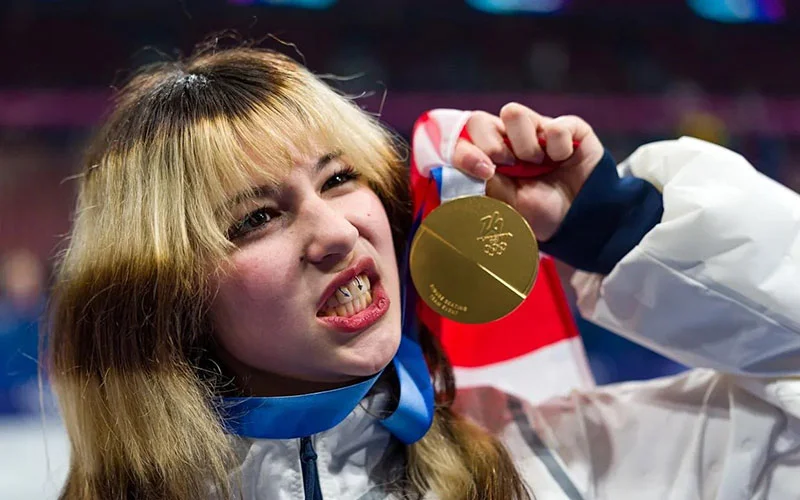
NBC and USA Today reporters noted that she smiled and sang softly to herself before her name was called, cracked jokes with coaches and skated her program with what looked like unforced joy. Afterward, she looped the rink with her gold medal and U.S. flag, biting the medal for photographers and at one point flashing her now‑signature smiley frenulum piercing, a small piece of self‑expression that has made her instantly recognizable.
Slate argued that in a sport often defined by visible stress and exacting standards, Liu’s demeanor, relaxed, slightly quirky, but razor‑sharp in performance, “proved it doesn’t have to be that way,” suggesting a model of elite competition that leaves more room for personality.
For American skating officials, the hope is that her victory will do more than end a drought. By combining world‑class difficulty with a style that feels modern and accessible, Liu could help pull a new generation of girls, and boys, into rinks in the U.S., just as Tara Lipinski, Michelle Kwan and Sarah Hughes did for earlier cohorts.
As she left the arena in Milan, Liu admitted she still hadn’t fully absorbed the scale of what she had done. “All I know is I did my best and I did it my way,” she told reporters. For a skater who walked away at 16 and came back on her own terms, that might be the most important gold medal of all.