
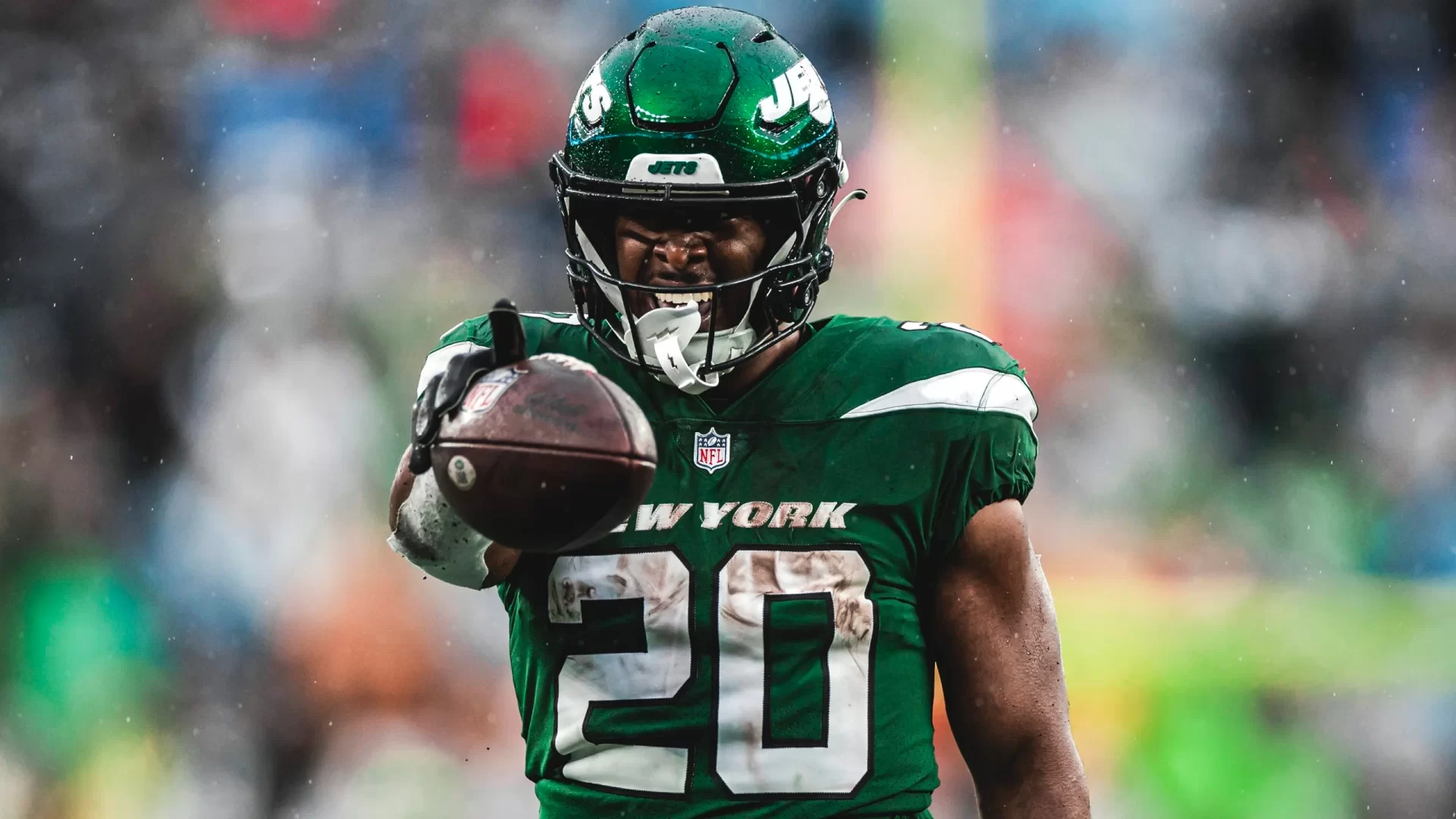
Running back Breece Hall will remain the focal point of the New York Jets’ offense for the foreseeable future after agreeing to a three‑year contract extension worth up to 45.75 million dollars, a deal that instantly makes him one of the highest‑paid players at his position and signals the franchise’s commitment to building around its young star. The agreement, reached Friday after weeks of negotiations under the franchise tag, includes 29 million dollars in guarantees and will keep Hall in green and white through the 2028 season.
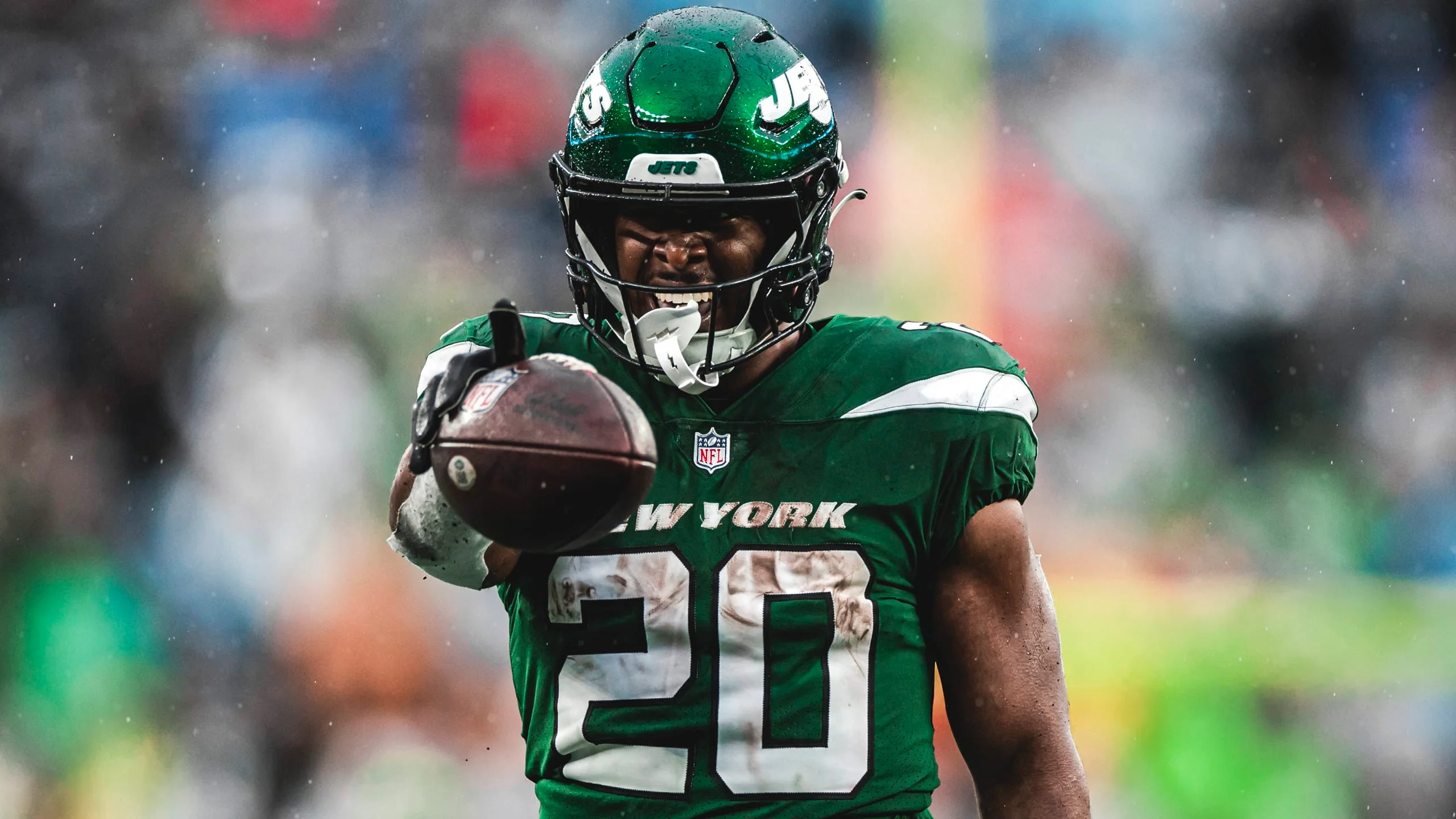
Contract terms put Hall near the top of the RB market
ESPN reports that the extension is formally a three‑year, 43.5-million-dollar contract with escalators that can push the total to 45.75 million dollars, according to agent Nicole Lynn of Klutch Sports. The deal includes 29 million dollars guaranteed, giving Hall significant security at a position where long‑term money has become increasingly scarce.
In terms of average annual value, the numbers place Hall among the elite at his position. ESPN and NFL Network differ slightly in their calculations, but both note that his yearly average slots him inside the top five of NFL running backs. ESPN’s initial breakdown pegs the APY at 14.5 million dollars, fourth behind Saquon Barkley, Christian McCaffrey and Derrick Henry; NFL Network’s report, using the full incentive package, cites 15.25 million dollars, ranking Hall third.
The Jets had used the franchise tag on Hall in early March, locking him into a one‑year, 14.3-million-dollar tender for 2026 while the two sides negotiated. Under league rules, they had until July 15 to work out a long‑term agreement; otherwise, Hall would have been required to play the season on the tag.
Instead, New York opted to extend one of its few proven offensive centerpieces. Connor Hughes of SNY reported that from the Jets’ perspective, the contract is “really a two‑year, fully guaranteed 29-million-dollar deal,” with no guarantees in the third year, giving the team flexibility if the market or Hall’s performance shifts after 2027.
Reward for a breakout season — and a swift comeback
The extension caps a career‑defining year for Hall.
After missing much of his rookie campaign with a torn ACL in 2022 and working his way back through 2023 and 2024, Hall delivered his first 1,000‑yard rushing season in 2025.
He carried the ball 243 times for 1,065 yards and four rushing touchdowns, leading the Jets in attempts and yards.
He added 36 receptions, a dip from his early‑career receiving volume but still a significant part of the passing game.
NFL.com calls Hall “one of the few bright spots” in a Jets offense that has struggled through injuries and inconsistency at quarterback and along the offensive line. Despite the team’s broader issues, Hall’s ability to break big plays and handle a heavy workload made him a rare constant.
The Jets’ decision to pay a premium at running back, a position many teams have de‑emphasized, reflects how they view Hall’s role not just as a ball‑carrier but as the engine of their offense, a player whose presence, they hope, can ease pressure on their passing game and help control tempo in a division loaded with high‑powered attacks.
Strategic move in a changing running back market
Hall’s deal arrives amid ongoing debate about the value of veteran running backs in a pass‑first league. Over the past several off‑seasons, marquee players at the position have struggled to secure multi‑year contracts, with some being tagged, released, or forced into short‑term, incentive‑heavy deals.
Against that backdrop, the Jets’ commitment stands out.
Buffalo Bills site BuffaLowDown notes that Hall’s extension makes division rival James Cook’s contract “look like a steal,” highlighting how aggressively New York has chosen to price its backfield.
Yahoo Sports emphasizes that Hall’s APY now trails only a small handful of stars, underlining the Jets’ belief that he belongs in the conversation with the league’s most impactful backs.
New York’s approach is also about roster clarity. After a turbulent stretch that saw the team trade away several prominent players, including former first‑round cornerback Sauce Gardner, as NFL.com points out, securing Hall removes one major question mark from the offense.
In a division where offensive identities are well established, from Miami’s speed‑based passing attack to Buffalo’s Josh Allen‑centric offense, the Jets are signaling that theirs will run through No. 20.
Cap implications and roster building
From a cap standpoint, the structure of Hall’s extension gives the Jets both short‑term clarity and long‑term options.
The guaranteed 29 million dollars effectively covers the first two years, aligning closely with the franchise‑tag figure while smoothing cap hits over multiple seasons.
With no guarantees in the third year, the Jets retain the ability to restructure, extend again or move on in 2028 without prohibitive dead money if performance or health deteriorate.
For Hall, the deal offers immediate security at a position where injury risk is high. USA Today notes that locking in multi‑year guarantees now is particularly significant for a player who has already come back from a major knee injury and carries a heavy workload.
The extension also shapes how the Jets allocate resources elsewhere. With their backfield solved, attention can turn fully to fortifying the offensive line, adding depth at receiver, and solidifying the quarterback position, all areas that have contributed to recent inconsistency.
What it means for the Jets and the AFC East
In football terms, the deal is both a reward and a bet.
A reward for a player who has emerged as the Jets’ most reliable offensive weapon, shouldering 243 carries, and finally crossing the 1,000‑yard mark behind a line that was rarely fully healthy.
A bet that Hall can sustain that production, and perhaps expand his receiving role, as the Jets chase relevance in a division dominated in recent years by other quarterbacks and offenses.
For now, the numbers and structure suggest that both sides found a workable middle ground: Hall secures top‑tier money and guarantees in a tough market, and the Jets lock in a foundational piece without the long horizons that have made other running back contracts burdensome.
As the Jets move into the heart of the off‑season, one thing is clear: whatever else changes on their depth chart, Breece Hall will be at the center of their plans, and their payroll, for at least the next two years, and likely well beyond.