
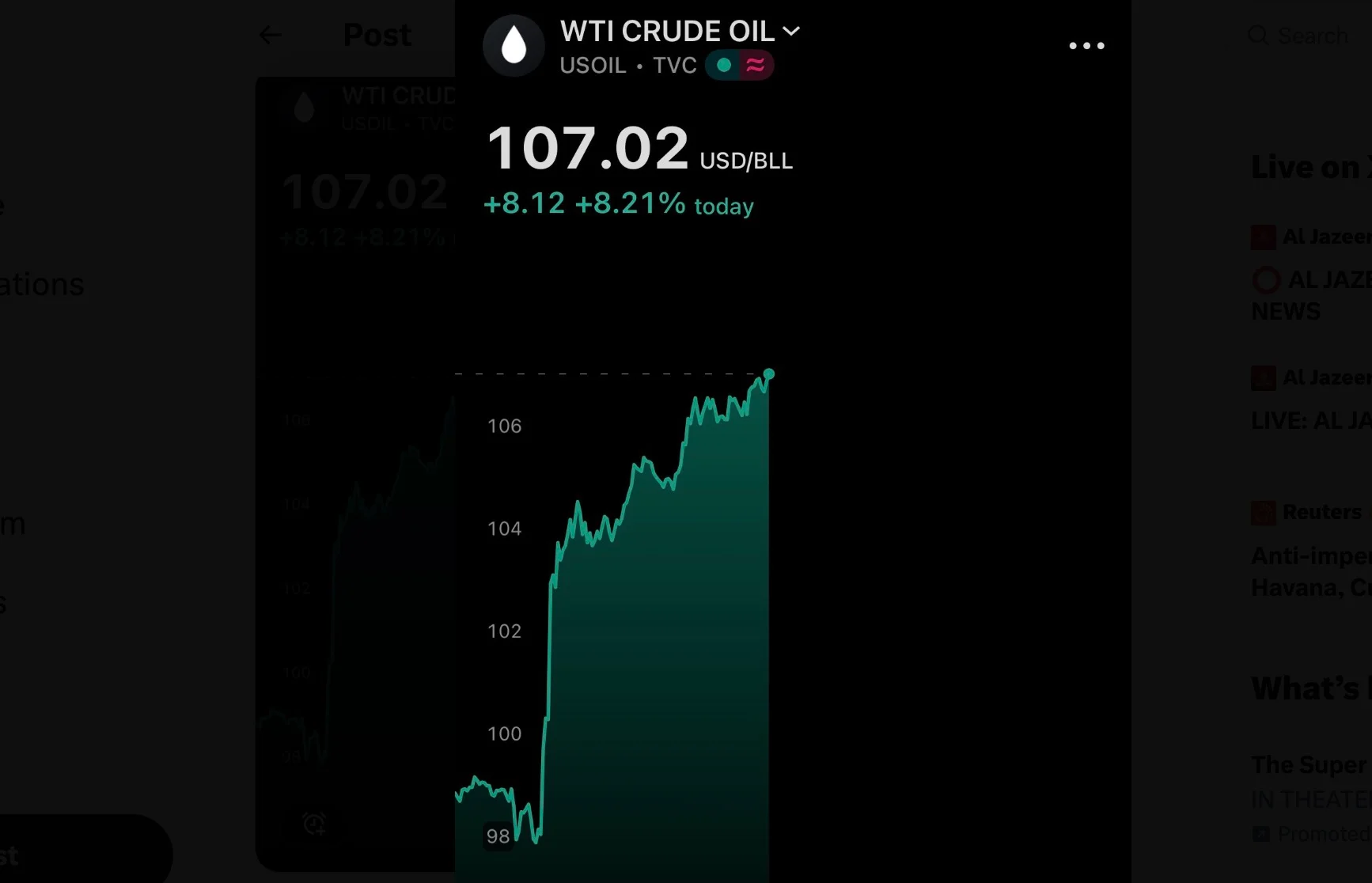
Oil prices leapt more than 7% in less than a day after President Donald Trump’s televised address on the Iran war upended hopes for a quick de‑escalation and raised the specter of deeper, longer‑lasting supply shocks from the Gulf. Traders had been betting that Trump would sketch out a clear off‑ramp; instead, he promised to keep hitting Iran “extremely hard” for the next two to three weeks and again dangled the possibility of strikes on the country’s power grid and oil sector if no deal emerges.
A speech that killed the “quick truce” trade
In the hours before Trump spoke from the White House, oil had actually been drifting lower as traders positioned for a possible cease‑fire timeline or at least a clearer commitment to ending major U.S. operations in Iran. Brent crude, the global benchmark, hovered around 100 dollars a barrel, while U.S. West Texas Intermediate (WTI) was near the low‑100s.
Instead, the president doubled down. He told Americans the war was “nearing completion” but said Iran would be hit “extremely hard” for the next two or three weeks and again refused to provide a concrete plan for reopening the Strait of Hormuz, the narrow chokepoint through which roughly a fifth of the world’s seaborne oil flows. BBC, CNN and other outlets described the reaction as a “reality check” on earlier optimism that a diplomatic off‑ramp was just days away.
By Thursday morning in Europe and Asia, the recalibration was visible on trading screens. Brent futures jumped by roughly 6.5–8%, climbing into the 108–109 dollar range; several reports put the intraday move at 7.3% or more. WTI contracts for nearby delivery rose around 7% to about 107 dollars a barrel, reversing a chunk of the previous session’s pullback.
Escalation risk: power plants, oil fields and Kharg Island
Beyond the absence of a clear exit, traders focused on what Trump did promise: a willingness to expand the target set to some of Iran’s most critical civilian and energy infrastructure.
In recent days, the president has repeatedly threatened to “blow up” Iran’s electric generating plants and to destroy its oil wells, export terminals and Kharg Island, a hub that handles the vast majority of Iran’s crude shipments. MarketWatch reported that Brent was already up nearly 60% for the month and “firmly in alarm bell territory” after Trump warned that, failing a deal, he would “completely obliterate” power plants, oil wells and Kharg Island, as well as possibly desalination facilities.
Energy analysts noted that knocking Kharg offline could cut Iran’s exports sharply, with JPMorgan warning it might wipe out roughly half of the country’s crude output, at least temporarily. Even short of that worst‑case scenario, strikes on oil infrastructure or sustained risk to Hormuz shipping lanes would tighten supplies in a market that had already been pushed to multi‑year highs by the conflict.
Trump’s speech revived those fears, with several commentators highlighting his talk of hitting Iran “extremely hard” while still insisting he had not yet touched the “easiest target of all”, the country’s oil sector. For traders, that sounded less like de‑escalation and more like a fresh list of red lines that could soon be crossed.
Hormuz still constrained, timeline still fuzzy
Another key driver of the 7% spike was what Trump did not say about the Strait of Hormuz. After weeks of missile strikes, mining incidents and naval skirmishes, traffic through the waterway remains constrained and insurers continue to price in a higher risk of disruption.
Ahead of the address, some investors hoped the president would lay out specific steps or a timeline for restoring safe passage, for example, a phased cease‑fire linked to inspections or international patrols. Instead, he spoke in broad terms about “finishing the job” and suggested the war could be over “very shortly,” without committing to concrete benchmarks or an end‑date for major operations.
BBC quoted one analyst, Alberto Bellorin of InterCapital Energy, saying the market was “correcting its own wishful thinking,” concluding that a return to normal shipping conditions is “months away rather than weeks.” MarketWatch similarly noted that with routes beyond Hormuz also facing some risk, crude remains in “alarm bell territory” and is on track for one of its biggest monthly gains on record.
That mismatch between the political rhetoric, “very shortly”, and the operational reality on the water forced traders to adjust their timelines, pushing up the risk premium baked into each barrel of oil.
Positioning whiplash in futures markets
The speed and scale of the move also reflected positioning. In the days before the speech, some hedge funds and commodity traders had shifted into what one analyst described as a “peace premium” trade, trimming long positions and betting on a near‑term pullback in prices as cease‑fire talk picked up.
When Trump’s address signaled that heavy bombing could continue for two to three more weeks and left open the option of hitting oil and power facilities, those bets suddenly looked risky. Reuters and CNBC reported a scramble to cover short positions and rebuild hedges, amplifying the upward move in both Brent and WTI.
The jump was large even by recent standards. CNN Business said Brent rose about 7.4% in early trading Thursday, topping 108 dollars, while WTI climbed 7% to roughly 107 dollars. Reuters put the gains at “nearly 7%” for both benchmarks, to around 108.8 dollars for Brent and 107.2 dollars for WTI. That move unwound much of the relief rally that had briefly taken prices back toward the 100‑dollar line earlier in the week.
Spillover: stocks slip, inflation fears resurface
As crude spiked, global equities stumbled. AP and other outlets reported that world shares turned lower on Thursday, with Asian and European markets in the red, as investors digested the prospect of higher‑for‑longer energy costs and a more drawn‑out conflict.
The New York Times noted that oil’s jump and the speech’s lack of a clear exit plan “tilted investors away from risk,” erasing some of the gains that had followed Trump’s earlier hints that the war might be over within weeks. CNN Business framed the move as a sign that inflation concerns are returning just as central banks had begun to contemplate rate cuts, with higher fuel and transportation costs feeding into broader price pressures.
In bond markets, traders nudged up expectations that policymakers, particularly in Europe and parts of Asia, may have less room to ease policy if energy‑driven inflation proves more persistent. For emerging markets that import most of their fuel, a prolonged period of triple‑digit oil prices raises the risk of wider current‑account deficits and weaker currencies.
Bottom line: pricing in a longer, riskier war
Oil’s 7% jump after Trump’s address was less about any single line in the speech than about the overall message markets heard: core war aims are “nearing completion,” but heavy bombing will likely continue for weeks, Hormuz remains only partially secure, and some of Iran’s most critical energy infrastructure is still on the table as potential targets.
That combination shattered the notion that the conflict was on the verge of a neat, negotiated end that would quickly normalize flows through the Gulf. Instead, traders are now pricing in a scenario where supply risk persists, diplomatic timelines stretch and even a “successful” operation could leave Middle Eastern energy infrastructure more fragile and contested than before.
For consumers, that means the pain at the pump, with U.S. gasoline already above 4 dollars a gallon in many areas, may last longer than hoped. For policymakers, it raises the stakes of every missile launch and every word from Washington or Tehran. And for oil traders, it confirms that, at least for now, the war premium in crude is back, and it is being set more in the presidential speechwriting office than in the OPEC conference room.