
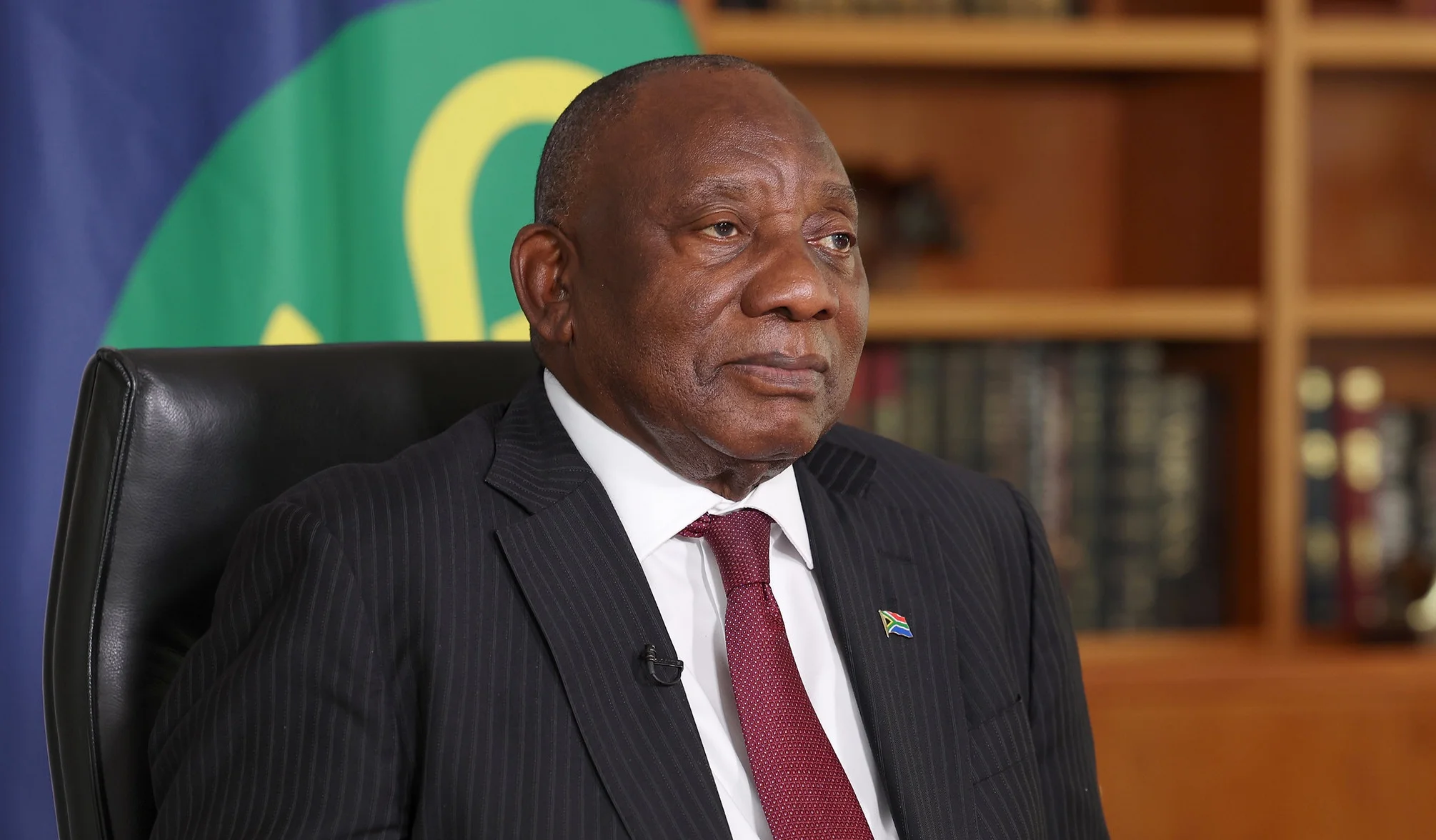
South African President Cyril Ramaphosa is facing the most serious threat yet to his political survival after the country’s top court revived an impeachment process over the so‑called “Farmgate” cash scandal and opposition parties renewed calls for him to step down. Ramaphosa has responded with defiance, vowing to challenge parts of the process in court and insisting he will not resign, setting up a high‑stakes confrontation in a hung parliament and a fragile coalition government.
Court ruling reopens ‘Farmgate’ and impeachment path
The latest crisis stems from a landmark judgment by South Africa’s Constitutional Court, which last week found that parliament acted unlawfully and unconstitutionally when it blocked an impeachment inquiry into Ramaphosa in 2022.
The case was brought by opposition parties, including Julius Malema’s Economic Freedom Fighters (EFF) and the African Transformation Movement (ATM), which argued that lawmakers improperly voted down an independent panel’s recommendation to establish an impeachment committee over the “Farmgate” allegations.
Chief Justice Mandisa Maya said the National Assembly’s 2022 vote to halt the inquiry was “invalid” and ordered that the panel’s report be referred to a multi‑party impeachment committee for further consideration. That committee, which parliament has now agreed to set up, will examine evidence and decide whether to recommend formal charges against the president.
Under South Africa’s constitution, removing a sitting president requires a two‑thirds majority of the 400‑member National Assembly, a high bar in a chamber where Ramaphosa’s African National Congress (ANC) still holds the largest bloc of seats within a broad coalition.
What is ‘Farmgate’?
The impeachment push centers on a murky 2020 incident at Ramaphosa’s Phala Phala game farm, in the northern Limpopo province, that has come to be known as “Farmgate.”
A 2022 parliamentary panel and earlier media reports alleged that large amounts of foreign currency, stashed in furniture on the president’s property, were stolen by burglars, raising questions about undeclared cash, failure to report a crime and potential abuse of state resources in the subsequent handling of the case.
- Ramaphosa acknowledges that there was a theft at Phala Phala but insists the, $580,000, according to his account, came from the legitimate sale of buffalo through his private game‑farming business.
- A former intelligence official, Arthur Fraser, alleged in a criminal complaint that the real sum was closer to $4 million in undeclared foreign currency, hidden in a sofa and never properly disclosed to authorities.
The independent panel concluded in 2022 that the president may have violated the constitution and anti‑corruption laws and recommended that parliament establish an impeachment inquiry. Instead, ANC MPs used their majority at the time to vote down that recommendation, the decision now overturned by the Constitutional Court.
Ramaphosa has consistently denied wrongdoing and, in past public statements, argued that he was the victim of a politically motivated attempt to derail his anti‑corruption agenda inside the ANC.
Calls for impeachment, and Ramaphosa’s refusal to resign
The court’s ruling has emboldened Ramaphosa’s critics and triggered fresh calls for his resignation and impeachment.
Outside the court and in subsequent rallies, EFF leader Julius Malema told supporters that the president should “do the honorable thing” and step down, arguing that Ramaphosa cannot effectively govern while under the cloud of an impeachment inquiry. Malema said ANC MPs would ultimately have no choice but to back removal once “the evidence will be undeniable in front of them.”
Jacob Zuma’s new party, uMkhonto weSizwe (MK), has gone further, formally writing to the speaker of the National Assembly to request a no‑confidence vote in the president. The speaker has yet to respond publicly, and analysts say such a motion, which would require only a simple majority, is unlikely to pass given the current coalition arithmetic.
Despite the pressure, Ramaphosa has drawn a clear line. In a national address and remarks carried by local and international media, he declared: “I remain here and am not resigning”, insisting that the Constitutional Court ruling “does not compel the president to vacate office.”
He has also signaled an aggressive legal strategy, saying he intends to seek judicial review of the independent panel’s original 2022 report, which he claims relied on hearsay and flawed reasoning.
Parliament’s next move: Impeachment committee and coalition calculus
The lower house of parliament has said it will establish a multi‑party impeachment committee to consider the panel’s findings, as ordered by the Constitutional Court.
The committee’s task is to:
- Examine evidence around the Farmgate allegations, including the origin and handling of the foreign cash and the response to the 2020 theft.
- Decide whether there is a prima facie case that the president violated the constitution or broke the law.
- Report back to the National Assembly with a recommendation on whether to proceed to a full impeachment vote.
No firm timeline has been set, and Deutsche Welle notes that the committee’s work could stretch over months, extending political uncertainty.
Since 2024, Ramaphosa has governed at the head of a Government of National Unity, after the ANC lost its outright majority for the first time since the end of apartheid. The ANC remains the largest party, but it now relies on a coalition with several smaller parties, including the centrist Democratic Alliance (DA), to pass legislation.
Analysts quoted by Reuters and Al Jazeera argue that while the impeachment process is politically damaging, Ramaphosa still appears likely to survive a final removal vote if it ever happens, provided he maintains support from most ANC MPs and key coalition partners.
DA leader Geordin Hill‑Lewis said the impeachment committee must now do its work “properly, rationally, fairly and constitutionally,” underscoring that the process, not the outcome, will be watched as a test of South Africa’s institutions.
Governance, corruption, and the stakes for South Africa
Ramaphosa came to power in 2018 promising to clean up endemic corruption that flourished under his predecessor Jacob Zuma, and he has often framed his presidency as a project to rebuild trust in state institutions.
He has appointed commissions of inquiry, suspended senior officials, including his police minister last year, and backed investigations into graft networks, moves that won him support among some voters and business leaders. The Farmgate scandal, critics say, cuts directly against that anti‑corruption image and has eroded his moral authority.
Beyond the fate of one president, the revived impeachment process carries larger implications:
- Rule of law and separation of powers: The Constitutional Court’s intervention is being seen as an assertion of judicial independence and a reminder that parliament cannot simply close down politically inconvenient inquiries.
- Coalition stability: The Government of National Unity was already fragile; a drawn‑out impeachment fight could sharpen tensions within the ANC and between coalition partners, potentially affecting policy on everything from energy reform to crime.
- Public trust: For many South Africans facing unemployment, rolling power cuts and rising crime, another high‑profile corruption case at the top of government risks deepening cynicism about politics.
Opposition parties will likely seek to use the impeachment process to portray Ramaphosa as part of a broader culture of impunity, while his allies argue that submitting to the inquiry, and defending himself within it, proves that “no person is above the law,” as his office said in response to the court ruling.
A long road ahead
For now, Ramaphosa remains in office, insisting he will both govern and fight the allegations in the appropriate forums. The impeachment committee must still be formed, gather evidence, and decide whether to recommend a vote, and even then, removal would require a two‑thirds supermajority that currently looks improbable.
Yet the Constitutional Court’s decision has ensured that the Farmgate scandal, once thought to be politically contained, is back at the center of South Africa’s national debate. How Ramaphosa manages the twin pressures of governing in a coalition and defending himself against an impeachment inquiry will shape both his legacy and the trajectory of Africa’s most industrialized economy in the months ahead.