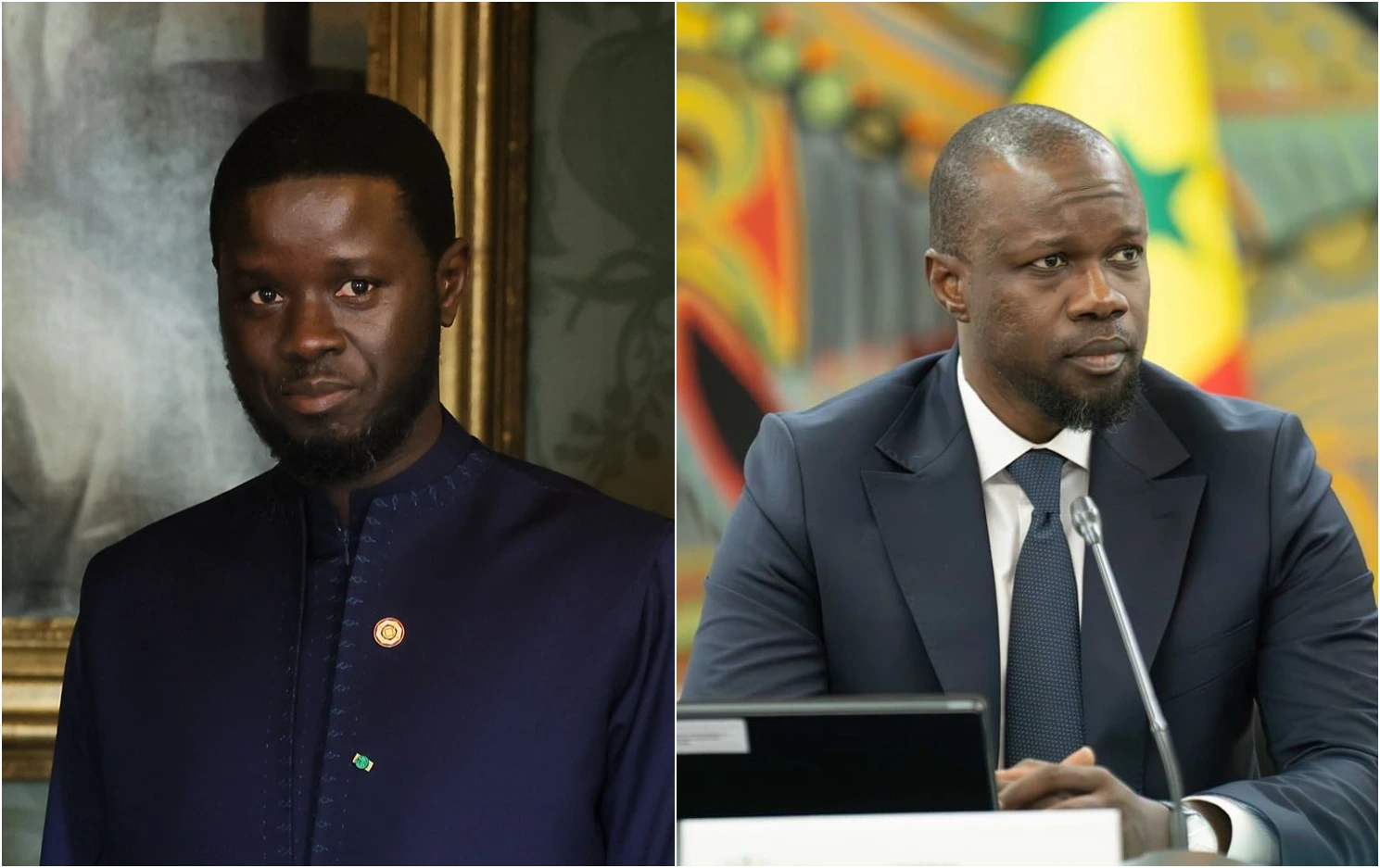
Senegal’s reformist experiment was jolted late Friday when President Bassirou Diomaye Faye abruptly fired Prime Minister Ousmane Sonko, his former mentor and the firebrand opposition leader who helped propel him to power just two years ago. The dismissal, announced in a terse late‑night broadcast on state television, dissolved the entire government and thrust one of West Africa’s rare democratic bright spots into a new phase of uncertainty.
A late‑night decree that stunned Dakar
The announcement came not from the president himself but from Oumar Samba Ba, secretary general of the government, reading a presidential decree on national television late Friday.
“President Bassirou Diomaye Faye has put an end to the functions of Prime Minister Ousmane Sonko,” Ba said in the broadcast, adding that the dismissal automatically terminated the appointments of all ministers and secretaries of state and dissolved the government.
Africanews and Associated Press copy describe the message as a “shock announcement” that surprised much of the country. Many Senegalese learned of the decision via state TV flashes and viral social‑media posts, with pages such as PTV Gambia and “Africa is home” framing it as the culmination of “growing tensions within the ruling coalition.”
Ba said outgoing ministers would remain in place only to manage “current affairs” until a new cabinet is appointed. As of Saturday morning, Faye had not named a replacement prime minister, leaving a vacuum at the top of government.
From comrades to rivals: the Faye–Sonko split
The firing caps years of evolving tension between two men who built their political careers together within the Pastef movement (Patriotes Africains du Sénégal pour le Travail, l’Éthique et la Fraternité).
Sonko, a former tax inspector turned anti‑corruption crusader, founded Pastef and became the face of a youthful, anti‑establishment opposition to former president Macky Sall. But a defamation conviction, upheld by Senegal’s Supreme Court, led the Constitutional Council to bar Sonko from running in the 2024 presidential election.
Faye, a quieter figure and longtime Sonko ally, ran in his stead and won the presidency in March 2024 on a promise of rupture with the old order, pledging to fight corruption, renegotiate natural‑resource contracts and rebalance relations with the IMF and France. Once in office, Faye appointed Sonko as prime minister, an unusual arrangement that formalized their partnership at the summit of the executive.
That partnership began to fray in public this year. Earlier this month, Faye signaled his frustration in an interview on state television, saying Sonko would “remain in his post as long as he keeps doing his job properly,” and expressing concern about internal rifts within Pastef. Sonko, for his part, criticized aspects of economic policy and the handling of protests, turning private disagreements into open conflict.
According to the Washington Post and AP, their disputes extended to “crucial issues such as the negotiation of a loan with the International Monetary Fund,” with Faye pushing for pragmatic engagement on Senegal’s mounting debt and Sonko favoring a more confrontational line.
Friday night’s decree suggests the president concluded that cohabitation at the top of the state was no longer tenable.
Sonko’s response: “I will sleep with a light heart”
If the dismissal was intended to humiliate Sonko, his first reaction suggested he saw opportunity rather than defeat.
“Praise be to Allah. Tonight, I will sleep with a light heart in the Keur Gorgui neighborhood,” he wrote in a brief post on X (formerly Twitter) shortly after the announcement, referring to the Dakar district where he lives.
On the streets, some of his supporters echoed that sentiment. In footage broadcast by African and international channels, crowds in Dakar could be seen cheering and waving flags in front of Sonko’s residence. “To them, his dismissal was not a defeat but an opportunity for Sonko to separate himself from President Bassirou Diomaye Faye,” a correspondent noted in a YouTube report, adding that many believe he will now be freer to criticize the government and rebuild an opposition base.
At the same time, the move risks reigniting the kind of unrest that rocked Senegal in recent years, when Sonko’s legal battles and Sall’s attempt to delay elections triggered protests that left dozens dead. Civil‑society groups fear that if Sonko’s supporters interpret the sacking as a betrayal, demonstrations could return to the streets of Dakar and other cities.
Government dissolved, political temperature rising
By firing Sonko and dissolving the government in one stroke, Faye has taken a bold gamble with Senegal’s political stability.
Reuters reports that the decision “may reignite political turmoil” in a country already grappling with a debt crisis and popular frustration over living costs. AP copy carried by multiple outlets repeats that the firing comes after “years of simmering tension” and notes that the sacking “led to the resignation of all the members of the government and its dissolution,” as set out in Ba’s televised statement.
Facebook posts from regional media such as PTV Gambia and Africa‑focused pages framed the development in stark terms: “Senegal plunged into political tension after President Bassirou Diomaye Faye fired Prime Minister Ousmane Sonko over reported disagreements on key policies.”
For now, outgoing ministers have been told to handle day‑to‑day matters, but key questions remain unanswered:
Will Faye appoint a technocratic prime minister to reassure markets and donors, or seek to consolidate power in his own hands?
- How will Pastef, already stretched by internal divisions and the burden of governing, absorb the shock of its two most prominent figures breaking publicly?
- Can Senegal’s institutions—Parliament, courts, security forces—manage the transition without sliding into the kind of instability seen elsewhere in the Sahel?
- The coming days are likely to offer initial answers, but analysts warn that once political alliances fracture at the top, putting them back together is rare.
Economic backdrop: debt, IMF, and public frustration
The political drama unfolds against a challenging economic backdrop. Senegal is facing a rising debt burden and delicate talks with the International Monetary Fund, even as it prepares to become an oil and gas producer.
In his recent interview marking two years in office, Faye acknowledged “challenges linked to IMF debt and the fallout from Middle East tensions,” but insisted he remained confident in Senegal’s growth prospects.
Sonko campaigned for years against what he saw as unfair contracts and external constraints on Senegal’s sovereignty. His supporters expected a sharp break with past economic orthodoxy. When faced with the realities of governing, Faye took a more cautious line, seeking to renegotiate terms but not defaulting on obligations, a position that reportedly fueled the rift.
If the dismissal triggers instability or scares investors, the cost of borrowing for Senegal could rise just as it needs financing for infrastructure and social programmes. Conversely, some in Dakar’s business community may quietly welcome a clearer chain of command, hoping that a single executive centre will speed decision‑making.
What it means for Senegal’s democracy
Senegal has long stood out in a region scarred by coups and contested elections, maintaining multi‑party competition and peaceful transfers of power since independence. That reputation came under strain during the Sall years; Faye’s election, with Sonko at his side, was widely seen as a democratic course correction.
The new rupture tests that narrative. On paper, Faye’s move is constitutional: presidents in Senegal have the power to appoint and dismiss prime ministers and cabinets. But the political optics are heavy. A president elevated in part by Sonko’s movement has now sidelined its figurehead, raising fears of personal power struggles overshadowing institutional reform.
AP’s dispatch notes that the firing “caps a period of open confrontation” between two men who had ousted the former ruling party, turning yesterday’s alliance into today’s fault line. Whether Senegal emerges with a reconfigured but functional government, or slides into prolonged deadlock, will shape how neighbors and partners see its democratic resilience.
The road ahead
In the short term, all eyes in Dakar are on two people: Bassirou Diomaye Faye, who must now assemble a credible new government, and Ousmane Sonko, who must decide whether to position himself as an internal critic, an external opposition leader or something in between.
For ordinary Senegalese, the question is more basic: will this latest bout of elite infighting deliver better governance, or just more instability in a country that, until recently, was praised as a democratic anchor in West Africa?
The answer, as ever, will depend less on a single late‑night decree than on what follows: whether institutions hold, whether the streets stay calm, and whether those who promised a break with the past can resist letting personal rivalries pull Senegal backwards.