
A catastrophic early-morning fire tore through the Viva Wyndham Dominicus Beach resort in Bayahibe, Dominican Republic, on Friday, June 19, killing one tourist, injuring at least nine others, forcing the emergency evacuation of nearly 1,700 guests and staff, and reducing large sections of the popular Caribbean resort to charred ruins, in a blaze that investigators say spread with terrifying speed through the hotel’s thatched palm-roof structures in wind-driven conditions that overwhelmed initial fire suppression efforts.
Dawn at Bayahibe: A Paradise Engulfed
The Caribbean sun had barely risen over Bayahibe, the postcard-perfect resort town on the southeastern coast of the Dominican Republic, when the first alarm sounded at the Viva Wyndham Dominicus Beach Hotel on the morning of Friday, June 19.
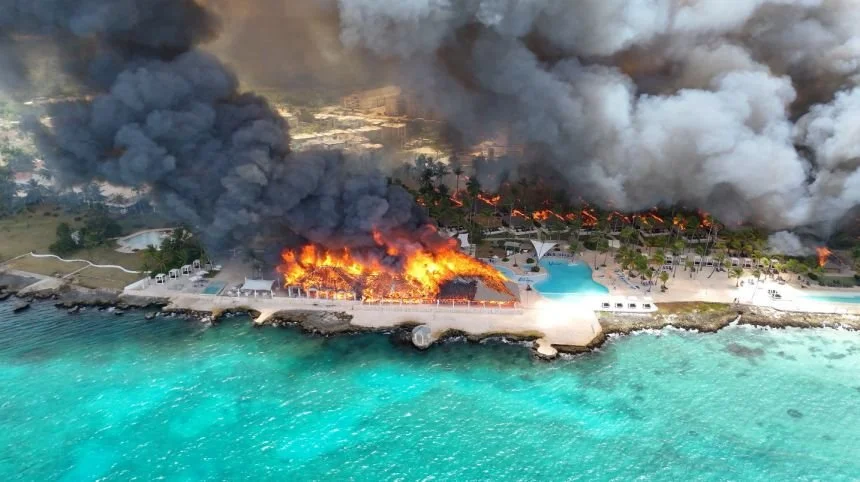
What followed unfolded with a speed that survivors would later describe as terrifying: within what witnesses said was less than 30 minutes from the first signs of fire, thick black smoke was billowing high above the Caribbean coastline, visible from miles away. Drone footage captured by CNN and broadcast by local media showed flames engulfing entire resort structures, the thatched palm roofs catching and burning with an intensity that fire specialists would later attribute to the combination of the material’s extreme flammability and wind conditions pushing the blaze from building to building.
The resort, Viva Wyndham Dominicus Beach, situated on the coast between Punta Cana and Santo Domingo in La Altagracia province, with nearly 700 rooms and an all-inclusive operation that accommodates hundreds of families, couples and groups at full capacity, was that morning at or near full occupancy. Nearly 1,700 people, guests, day visitors and staff, were present on the property when the fire took hold.
All 1,700 were evacuated.
One did not survive.
Francesca Valentino: The Victim Identified
The Dominican Republic’s DAEH emergency services confirmed the identity of the sole fatality on Friday: Francesca Valentino, a 46-year-old Italian woman who had been at the resort, was killed in the blaze.
The Straits Times, which was among the first international outlets to name the victim, reported that Valentino was identified by DAEH in its official statement, confirming her as the Italian tourist whose death was announced by the Dominican Republic Foreign Ministry when it first briefed international media as firefighters were still battling the blaze. Three additional people were transported to medical facilities for treatment. Six others were treated on-site for injuries including smoke inhalation, minor burns and injuries sustained during the evacuation.
BBC News reported Friday that the Italian embassy in the Dominican Republic moved immediately to provide consular support, meeting with Valentino’s husband at the hospital where she was taken, and mobilizing to assist approximately 285 Italian tourists who were either staying at the resort or in the surrounding area of Bayahibe when the fire erupted. Among the consular services being provided: emergency passport issuance for Italian nationals whose travel documents were destroyed in the fire, passports, identification papers and travel vouchers all consumed by the blaze, and the coordination of emergency return flights to Italy for those wishing to leave immediately.
The Fire Response: Fifteen Firefighting Units
The scale of the fire response was commensurate with what responders found when the first units arrived.
ABC News, which contacted the Dominican Republic Foreign Ministry directly as the blaze was still active, reported that fifteen firefighting units were deployed to the Viva Dominicus Beach resort, a mobilization indicating that local responders recognized early that this was not a contained, single-structure fire but a rapidly spreading conflagration across a multi-building resort complex.
The resort’s thatched roofing, constructed from dried palm leaves in the traditional Caribbean coastal style that is both aesthetically distinctive and among the most combustible forms of roofing in common use, became the fire’s primary vector of spread. The country’s Emergency Operations Center stated in its preliminary assessment: “Observations indicate that the fire spread rapidly due to the flammable nature of parts of the roof structures made of palm, as well as wind conditions.”
The combination of palm thatch and wind is, in fire science terms, close to a worst-case scenario: palm thatch, once ignited, burns at temperatures that overwhelm most hand-held suppression equipment, and the fibrous material fragments in wind and carries embers to adjacent structures, producing the kind of multi-source, multi-direction fire spread that aerial drone footage of Bayahibe on Friday vividly illustrated.
The Dominican Republic’s Emergency Operations Center confirmed by Friday afternoon that the fire had been brought under control. The resort itself, or significant sections of it, had been structurally compromised by the time suppression was achieved.
The Evacuation: 1,700 People in an Emergency
The evacuation of 1,700 guests and staff from an all-inclusive Caribbean resort in the hours before dawn is, by any operational standard, an extraordinary logistical event, one that the Dominican Republic’s DAEH emergency services and resort staff carried out with a dispatch that almost certainly prevented the death toll from being substantially higher.
Guests described scenes of sudden, organized alarm, resort staff directing them out of rooms and toward muster points on the beach or in the resort’s outer grounds, away from the burning structures. Many guests evacuated with only the clothes they were sleeping in, losing luggage, passports, medications, and personal belongings to the fire.
The COE confirmed that evacuated guests were transferred to alternative hotels in Bayahibe and the surrounding area, a logistical achievement that required rapid coordination with competing properties to identify available rooms for nearly 1,700 displaced individuals in a popular tourist zone during peak Caribbean travel season.
The Viva Wyndham Dominicus Palace, a separate property that is part of the same Viva-Wyndham branded hotel family but situated adjacent to rather than within the Dominicus Beach complex, was confirmed to have sustained no damage from the fire. Guests at the Palace were not evacuated.
Wyndham Hotels and the Property
The Viva Wyndham Dominicus Beach is operated in partnership with Wyndham Hotels & Resorts, one of the world’s largest hotel companies, with a portfolio of more than 9,000 properties across 95 countries.
ABC News reported Friday that it had reached out to Wyndham Hotels & Resorts for comment as the fire was being controlled and had not received a response by the time of publication. The Dominican Republic Foreign Ministry’s communications to the international media focused on emergency response coordination and the status of affected tourists rather than on the hotel chain’s immediate public positioning.
Wyndham has not, as of Saturday morning, issued a public statement on the fire on any of its primary communications channels. The hotel’s pre-fire marketing describes the Viva Wyndham Dominicus Beach as a 700-room “award-winning, all-inclusive” property on a private beach, with a range of room categories including swim-up suites, beachfront units, and standard garden rooms.
The Safety Question: Caribbean Resort Construction
The fire’s preliminary findings, that thatched palm roofing contributed materially to the speed and scale of the blaze, immediately revived a long-standing debate in the Caribbean hospitality industry about the tension between traditional aesthetic appeal and modern fire safety standards.
Thatched roofing remains one of the most commonly used decorative and functional roofing materials at Caribbean beach resorts, valued for its tropical aesthetic, its ventilation properties and its alignment with the environmental and cultural character that resort marketers use to attract international tourists. It is also, as Bayahibe demonstrated Friday morning, one of the most dangerous.
International fire safety standards, including the NFPA (National Fire Protection Association) codes applied in the United States and the EN codes applied in the European Union, recommend flame retardant treatment or structural replacement of organic thatched materials in commercial hospitality settings as minimum safety requirements. Whether Viva Wyndham Dominicus Beach was compliant with applicable Dominican Republic fire safety regulations, and whether those regulations require flame retardant treatment of palm thatch, was not confirmed by Dominican authorities in Friday’s briefings.
The COE’s statement that “tourist activities in Bayahibe and the surrounding area remain unaffected and continue to take place safely and as normal”, issued Friday afternoon as the fire was being contained, was clearly aimed at limiting economic damage to the Dominican Republic’s tourism sector, the country’s single largest foreign exchange earner, responsible for approximately 10% of GDP.
Italy Activates Consular Response
Italy’s response to the death of Francesca Valentino and the endangerment of 285 of its nationals at Bayahibe was immediate and diplomatically assertive.
The Italian Embassy in Santo Domingo dispatched a consular officer to meet with Valentino’s husband at the hospital on Friday and activated emergency consular protocols for the full group of Italian nationals affected by the fire. BBC News confirmed the embassy was issuing emergency travel documents, temporary passports that Italian nationals require to board international flights when their regular documents are lost, and coordinating with airlines to arrange priority return flights for those wishing to leave the Dominican Republic immediately.
The Italian Foreign Ministry was briefed on the incident and is monitoring the situation, BBC News reported. Italy’s Civil Protection agency, which operates a 24-hour international crisis desk for Italian nationals in emergency situations abroad, was also coordinating with the embassy in Santo Domingo.
A Resort Town That Will Continue
Despite the severity of the fire, one fatality, nearly a dozen injuries, 1,700 evacuations and the partial or total destruction of one of Bayahibe’s largest resort properties, Dominican authorities were emphatic that the town’s broader tourist economy should continue operating.
“Tourist activities in Bayahibe and the surrounding area remain unaffected and continue to take place safely and as normal,” the COE statement read, noting that the fire had been fully contained and that alternative accommodation had been secured for all displaced guests.
The Dominican Republic welcomed approximately 7.8 million tourists in 2025, with the all-inclusive coastal resort corridor between Punta Cana and the La Altagracia coast, which includes Bayahibe, representing the country’s most economically significant tourism zone. The government’s rapid statement on the continued safety of tourism operations reflected both administrative reassurance and economic calculation: a lingering cloud over Bayahibe’s safety reputation carries financial consequences that extend well beyond one hotel.
For the 1,700 guests who stood on Bayahibe’s beach before dawn Friday, watching an all-inclusive resort burn, the calculation was more immediate. For Francesca Valentino’s family, making their way home from the Dominican Republic this weekend, there is no calculation that matters at all.