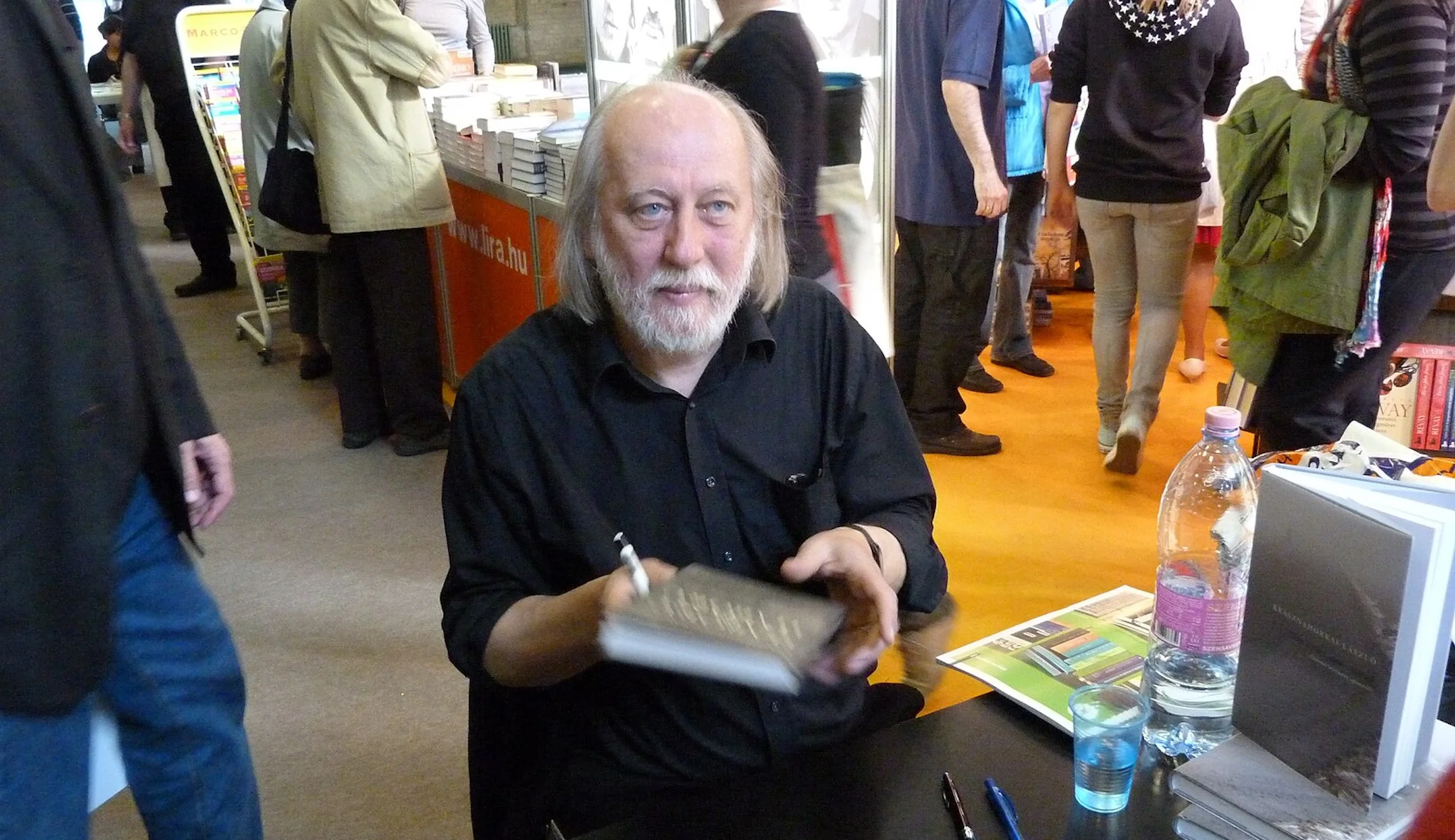
(STOCKHOLM, Oct. 2025) – Hungarian novelist László Krasznahorkai has received the 2025 Nobel Prize in Literature, literature’s highest honor, for a “thoughtful and visionary oeuvre that reaffirmed, even in the presence of apocalyptic horror, the power of art.” As a world has continued to be uncertain globally and fight for wider literary experimentation, the Swedish Academy has reached for a master whose profound and demanding novels have inspired readers and critics alike across continents.
A Nobel for the “Master of the Apocalypse”
Krasznahorkai, age 71, is one of Central Europe’s most demanding and visionary writers. He was born in Gyula, Hungary, in 1954, and rose to international prominence with his 1985 debut, Sátántangó, a psychological and darkly beautiful depiction of rural existence on a collapsing collective farm with Hungary’s Communist regime. His other novels, including The Melancholy of Resistance, War & War, and Baron Wenckheim’s Homecoming, have established him as a writer whose complex, oftentimes labyrinthine sentences contemplate spiritual, moral, and societal collapse with extraordinary intensity.
Susan Sontag once recognized Krasznahorkai as the “master of the apocalypse” for contemporary writers. His prose often occurs in and receives recognition for its imposition of the overwhelming, the dizzying, and the transcendentally beautiful in the contours of despair. Critics have long argued that Krasznahorkai’s novels can never carry the nihilism they seem to promote, but all, all are deeply invested in the endurance of the art and compassion when societies fail.
The Nobel Committee’s Rationale
The Swedish Academy, which oversees the prize, noted in its citation that Krasznahorkai’s literary work, “in the midst of apocalyptic fear, reaffirms the strength of the imagination.” Anders Olsson, chair of the prize committee, highlighted the laureate’s “masterful prose”, the ability to depict “the brutal struggle between order and disorder”, as elements that distinguished him in modern world literature.
Context and Recent Laureates
With this year’s decision, the Nobel Committee continues their recent pattern of awarding writers whose work grapples with a crisis of existence and vulnerability of the human spirit, and the fragility of our social bonds. Last year, the award went to South Korean novelist Han Kang for her poetic explorations of vulnerability and trauma. Other notable laureates, in recent years, are Abdulrazak Gurnah for examination of colonialism and migration, and Annie Ernaux, for her autobiographical examination of nostalgia and society.
The Artistry and Influence of Krasznahorkai
Krasznahorkai’s novels are notorious for their dense, flowing paragraphs, often with pages-long sentences, and philosophical inquiry. He is influenced by Kafka and Thomas Bernhard, and he asserts a unique Hungarian voice in the disquiet of modernity, while expanding acknowledgement of a shared aesthetic experience of struggle. He has collaborated on multiple occasions with filmmaker Béla Tarr, producing cinematic interpretations of Krasznahorkai’s longer novels into film, such as the seven hour also-titled film on his Sátántangó.
A fundamental inquiry of Krasznahorkai’s writing is a continual searching for meaning within a society headed towards apocalypse. In The Melancholy of Resistance, the arrival of a traveling circus into a provincial town provides an allegorical examination of mass hysteria and authoritarianism. War & War follows the journey of a low-level archivist as he travels across each corner of Europe, through time, and back again, a deep exploration of chaos, order, and transcendent, creative artistic work.
Personal Journey and Literary Legacy
Krasznahorkai, from a Jewish family in southeastern Hungary, became immersed in the cultural realities of the aftermath of the failed 1956 Hungarian Revolution and what he referred to as the moral compromises of living under Communism in his youth. This sense of historical and existential pressure can be felt in his writing, where personal and collective destinies erupt in haunted ways.
Translation notwithstanding, Krasznahorkai’s novels have navigated a wide reach of readership – thanks in part to translator George Szirtes, and his successor, Ottilie Mulzet. The recognition he received on an international level certainly took a turn when he was also awarded the prestigious Man Booker International Prize, and the America Award for literature.
Krasznahorkai has the ability to generate, evoke, even inspire, wholly different ways to think, but not just to think about, what literature is today, not only in a freshly minted Hungarian letters idea, but a whole host of readers and writers across Europe, Asia, and Americas.
Reactions Within Hungary and Beyond
The news is cause for celebration within the Hungarian literary community and regionally from Central Europe. Congratulated in a public statement, Hungarian President Katalin Novák commented on the Nobel recognition Krasznahorkai received saying his body of work “brilliant work ever attests to the inventive spirit and vibrant global presence of Hungarian letters. Significant writers, literary critics, and readers were indeed celebrating the news of a writer whose reputation is mostly well known and often an ineffable complexity to his existence, world famous yet simple and humble with to the heart of reclusiveness.
The Nobel Prize: Honors and Implications
The Nobel Prize for Literature comes with the distinction of a personal gold medal, diploma, and award money of near $1.2 million. As far as distinctions can have a purpose, this will ensure that the laureate body of writings will be read even more vigourosly than it or perhaps even vitally judging by the award acquisition.
Krasznahorkai’s naming generated oodles of congratulatory acknowledgments. Sad to say, one notion of authorial reception not only for the author, but even for the literature sensitivity that the author embodies; a sensibility that significantly engage, does not simply escape, in the concerns of world’s all her anxieties, forms of formulaic, stale mass market fiction, would encourage trust in the resiliency of art- particularly expressional survival in the vitally ridiculous, and abysmally uncertain future.
Looking to an Art Future Past Endtime
Now partly becomes part of the future of writing in the conversation of retrospective, what the tragedy will become in acquisition of the Nobel citation in December (as the official award presentation for the 2025 Prize will occur on December 10 in Stockholm). For readers and admirers, it privileges not what is simply a fine writer of an instant, but perhaps, most of all, for the confrontation of a dark, difficult, yet poignantly human body of prose that i needed now, at a time, and amid, a troubled world then.
Krasznahorkai Awarded Nobel Prize in Literature 2025 locker is the seed to the time when it will not be just a headline, but also a celebration of the able intuitive power of art, against, in sword like examples, cinnamon and rose petals; positive in producing decisive beauty, ways to affect, and process in comprehension, or against a world so often inundated by hopelessness. Ultimately, the author’s imagined the death of the literal, but offers us whispers that to speak from darkness persists darkness, forms from and recalls, and perhaps shines alone.