
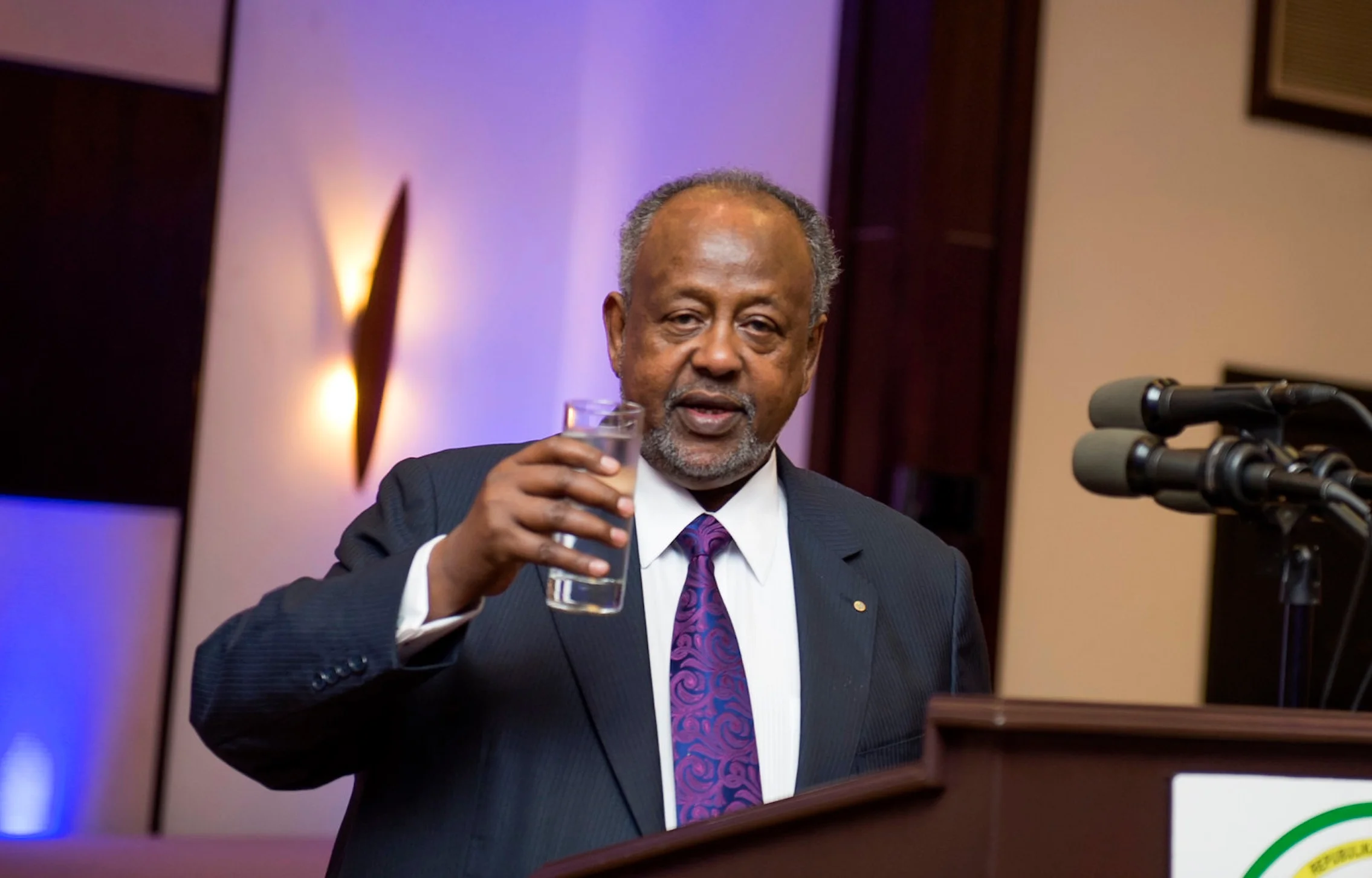
Djibouti’s long‑time president Ismail Omar Guelleh is set to extend his 27‑year rule after winning a landslide 97.8% of the vote in a presidential election widely seen as lacking genuine competition, according to official results announced on Saturday. The 78‑year‑old, in power since 1999, defeated his only challenger, little‑known opposition figure Mohamed Farah Samatar, who secured just around 2.2%, in a poll boycotted by most major opposition parties after constitutional changes last year cleared the way for Guelleh to run for a sixth term.
Official results: a familiar landslide
The interior ministry said Guelleh had won 97.8% of ballots cast in Friday’s vote, with turnout officially above 80% of the roughly 256,000 registered electorate. His sole challenger, Mohamed Farah Samatar of the Unified Democratic Centre, a small party with no seats in parliament, received just over 2%, according to state media and news agencies citing preliminary tallies.
Guelleh, who is only Djibouti’s second president since independence from France in 1977, declared victory even before final figures were read out, posting “Re‑elected” on his social media accounts as early results showed an overwhelming lead. He later celebrated at his residence, calling the outcome “a triumph for the entire nation” and thanking supporters for “once again placing their trust” in him.
The results must still be validated by Djibouti’s Constitutional Council before Guelleh is formally sworn in for another five‑year term, but no serious legal challenges are expected.
Constitutional changes cleared the way
Guelleh’s latest run was made possible by a constitutional amendment passed in November, which removed the upper age limit of 75 for presidential candidates. Previously, a 2010 revision had abolished term limits while shortening the presidential mandate from six years to five and setting the age cap at 75, a compromise that allowed Guelleh to stand again in 2011 and 2016.
He had signaled in earlier interviews that he might step down at the end of his current term, but allies in the ruling People’s Rally for Progress (RPP) pushed through the age‑limit repeal, arguing that continuity was needed amid regional instability and economic headwinds. The move opened the door for him to seek a sixth term, a step critics say entrenched one‑man rule in a country that has never seen a competitive transfer of presidential power.
In the last presidential election in 2021, also boycotted by most opposition parties, Guelleh officially took over 97% of the vote. Friday’s result almost exactly replicates that margin.
An election without real competition
Although voting proceeded peacefully, independent observers and opposition figures described the contest as non‑competitive.
Major opposition parties once again boycotted the vote, arguing that years of restrictions on media, civil society and political organizing had made it impossible to mount a viable campaign. Many of their leaders are in exile, have been jailed in the past, or complain of harassment and administrative hurdles at home.
Africanews and the BBC note that Guelleh dominated the campaign, plastering the capital with posters and drawing large crowds to rallies, while Samatar “struggled to gain support” and remained little known to the wider public. Local critics quoted by regional broadcasters said a race with only one low‑profile challenger and boycotts by other parties “cannot be considered a fair election.”
State media nonetheless hailed a “massive turnout” and “broad popular mobilization,” citing the official figure above 80%. Independent estimates are hard to verify in the absence of robust domestic monitoring or foreign observer missions.
A tiny state with outsized strategic weight
Despite its population of around one million, Djibouti occupies a pivotal position at the Bab el‑Mandeb Strait, the gateway to the Red Sea and the Suez Canal, one of the world’s busiest maritime chokepoints. That strategic geography has turned the country into a hub for foreign military bases.
France, the former colonial power, maintains forces there; the United States operates its only permanent African base, Camp Lemonnier; China opened its first overseas military base in Djibouti in 2017; and Japan and other nations have smaller facilities. The Japan Times notes that Djibouti is host to Tokyo’s only overseas base, underscoring its importance to global anti‑piracy and security operations in the Gulf of Aden and Indian Ocean.
Djibouti has used this position to bring in billions of dollars in international investment in ports, free trade zones, and infrastructure, especially from China under the Belt and Road Initiative. But that strategy has also left the country in a lot of debt and open to shocks from outside, with rising unemployment and complaints about how benefits are not fairly distributed.
Stability vs. democracy
Supporters at home and abroad argue that Guelleh has provided stability in a volatile region, sandwiched between war‑torn Yemen across the water and troubled neighbors like Somalia and Ethiopia. They credit him with keeping foreign powers engaged, maintaining relative internal calm, and pushing through infrastructure projects that have turned Djibouti into a regional logistics hub.
Critics, however, see the election as another step toward entrenched authoritarianism. Human rights groups have long accused the government of cracking down on dissent, restricting independent media and harassing opposition figures. Repeated boycotts, they argue, reflect not apathy but a calculation that participation would only lend legitimacy to a foregone conclusion.
In comments to regional media, opposition voices framed the 97.8% figure as symbolic, placing Djibouti in the company of other states where ruling parties routinely post near‑total victories. “The people of Djibouti deserve true freedom and a genuine democratic process,” one widely shared post read. “What took place cannot be considered a fair election.”
What Guelleh’s sixth term could bring
With another five years at the helm, Guelleh is expected to continue balancing Djibouti’s relationships with major powers while seeking to manage domestic economic pressures.
Key challenges include:
- Debt and dependence: Managing heavy external debt, much of it owed to Chinese entities, while preserving sovereignty over strategic assets like ports and railways.
- Jobs and inequality: Addressing unemployment and perceptions that foreign investment benefits a narrow elite more than the wider population.
- Security spillovers: Containing the impact of conflicts in neighboring states and maritime insecurity in surrounding waters.
The latest election also pushes questions of succession further into the future. At 78, Guelleh has now secured a mandate that would take him beyond three decades in power if he serves it in full. With term limits gone and age caps lifted, there is no clear institutional timetable for a transition; attention is likely to focus on whether he signals a preferred heir within the ruling party or family.
For now, official messaging emphasizes continuity. State TV framed the result as a renewed “pledge of confidence” in Guelleh’s leadership at a time of international uncertainty, while foreign partners are expected to issue carefully worded congratulations that balance praise for stability with generic nods to democratic principles.
In a small but strategically pivotal corner of Africa, the headline is straightforward: a familiar leader has tightened his grip through an election that left little doubt about the outcome, and many questions about the state of democracy behind the numbers.