
Key Facts
- The Federal Aviation Administration said an equipment failure at the Philadelphia Terminal Radar Approach Control facility, or TRACON, triggered ground stops and delays affecting major Northeast airports on Monday.
- FAA Administrator Bryan Bedford said a primary communications circuit serving Philadelphia TRACON failed; officials then found that the backup fiber line in New Jersey had also been cut.
- The disruption affected Newark Liberty, Philadelphia International, John F. Kennedy International, LaGuardia and Teterboro airports, with knock-on effects across the U.S. aviation network.
- Transportation Secretary Sean Duffy said telecom lines had been repaired, and airport operations were resuming by Monday evening but warned that airlines would need time to clear accumulated delays.
- NJ Transit said a construction crew working near New Brunswick and North Brunswick, New Jersey, accidentally severed a fiber-optic cable at about 9:45 a.m.; an investigation is underway into the circumstances.
- More than 1,000 flights were canceled nationwide and thousands more delayed at the height of the disruption, according to reports citing airline-tracking data.
NEWARK, N.J. — A Federal Aviation Administration equipment outage disrupted air travel across the Northeast on Monday after a primary communications circuit failed at a Philadelphia air traffic facility and a backup fiber-optic line in New Jersey was found to have been cut.
The failure prompted ground stops, ground delays and cancellations at some of the region’s most important airports, including Newark Liberty International Airport, Philadelphia International Airport, John F. Kennedy International Airport, LaGuardia Airport and Teterboro Airport. The disruption spread well beyond the Northeast, delaying flights at airports across the country as airlines held planes at their departure points or diverted aircraft already in the air.
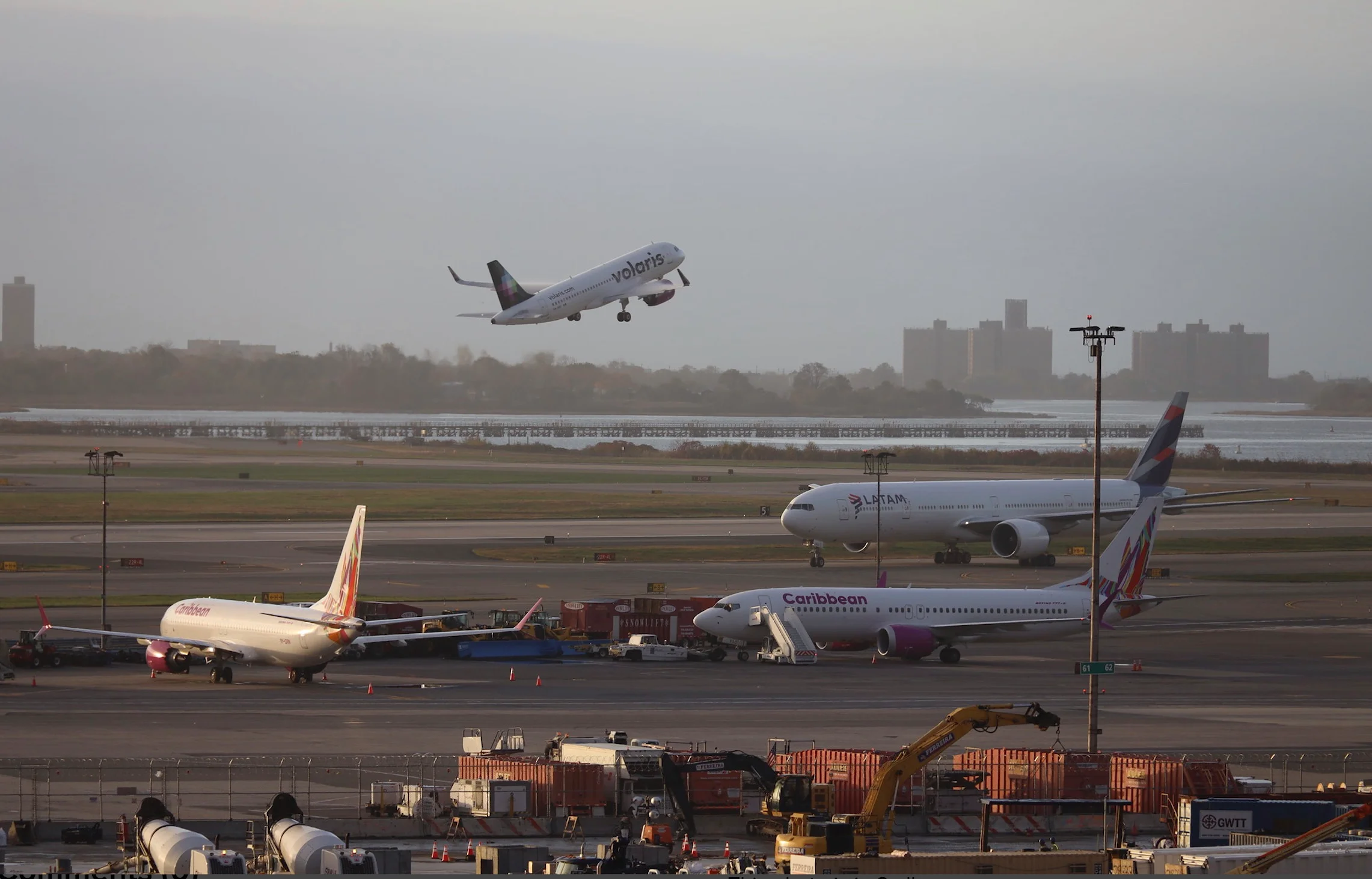
By Monday evening, the FAA said the equipment problem had been resolved and flight operations were beginning to resume. But the end of the technical failure did not mean an immediate end to the travel disruption. Airlines faced the difficult task of repositioning aircraft, crews and passengers after hours of constrained operations in one of the country’s most congested air corridors.
Transportation Secretary Sean Duffy said telecommunications lines had been repaired, while warning that delays would continue as airports and airlines worked through the backlog.
The episode underscored how a single communications failure, compounded by a damaged backup connection, can cascade through the national aviation system, especially in the heavily trafficked Northeast corridor.
What happened
The immediate problem centered on Philadelphia TRACON, a Terminal Radar Approach Control facility responsible for managing aircraft arriving and departing from several major Northeast airports.
FAA Administrator Bryan Bedford said the facility’s primary communications circuit failed Monday morning. When the backup system was needed, officials discovered that the backup fiber line also had a break.
The FAA initially described the disruption as an issue with “some frequencies” at Philadelphia TRACON. Those radio and telecommunications capabilities are essential for air traffic controllers to communicate with aircraft and coordinate aircraft movements safely.
The outage prompted the FAA to pause flights into Philadelphia International, Newark Liberty and Teterboro. Ground stops and delays were subsequently expanded to other airports, including JFK and LaGuardia, as officials worked to replace the failed circuit and restore operations.
A ground stop is among the FAA’s most consequential traffic-management tools. It prevents affected flights from taking off toward an airport or region. The measure can be disruptive, but it is intended to prevent more serious problems when airport capacity, weather, runway conditions, staffing or communications systems cannot safely handle normal traffic levels.
In this case, flights already airborne faced different restrictions. Some were diverted to alternate airports, while others were placed in holding patterns or managed through revised arrival schedules. Boston Logan Airport said it was receiving a significant number of diversions from airports affected by the outage.
The outage began during a busy travel period and ahead of the United Nations General Assembly in New York, an event that brings large numbers of foreign delegations, government officials and security-related aviation activity to the region.
The cut fiber line
The communications failure was compounded by damage to a Verizon fiber-optic cable in New Jersey.
NJ Transit said a construction crew working on the Delco Lead project between New Brunswick and North Brunswick accidentally severed a fiber-optic cable at approximately 9:45 a.m. Monday. The cable served as a backup to the primary circuit that had failed, according to the agency.
The transit agency said preliminary information indicated that the crew had been working about 10 feet from utility markings. It said personnel were investigating whether Verizon or a contractor had made the markings and were examining the circumstances of the damage.
Verizon said contractors working near an Amtrak line cut a fiber cable and that the company and its partners were working to restore service.
Duffy initially said an Amtrak construction crew had cut the fiber line. Amtrak later said the incident occurred on NJ Transit property, while NJ Transit identified the work as part of its Delco Lead project.
That distinction matters because responsibility for the cut line remains under review. The available information establishes that a construction-related fiber break affected a backup system. It does not, by itself, settle which organization or contractor bears legal or operational responsibility.
The location of the break was described as somewhere between New Brunswick and Newark.
The incident illustrates a basic but consequential infrastructure risk: Even when critical systems have backup connections, the resilience of those backups depends on physical protection, accurate utility markings, redundancy in routing and coordination among agencies, telecom companies and construction crews.
Airports affected
The largest immediate impact fell on Newark and Philadelphia, whose operations are closely linked to the Philadelphia TRACON facility.
But the effects quickly widened.
| Airport | Impact reported Monday |
|---|---|
| Newark Liberty International | Ground stops, severe delays and a large share of cancellations; operations began resuming in the evening. |
| Philadelphia International | Ground stops and major delays; limited arrivals resumed before broader operations recovered. |
| John F. Kennedy International | Ground delays and flight disruption as FAA constraints expanded across the region. |
| LaGuardia Airport | Ground delays; flights began returning as repairs progressed. |
| Teterboro Airport | Ground-stop and delay impacts tied to Philadelphia TRACON communications problems. |
| Boston Logan and other U.S. airports | Received diversions or experienced network-related delays as aircraft and crews fell out of position. |
The FAA’s traffic-management decisions had nationwide consequences because Newark, JFK, LaGuardia and Philadelphia are major hubs in an interconnected U.S. air network.
A delay at Newark can prevent an aircraft from reaching Chicago, Atlanta, Houston, Denver or Los Angeles on time. That delayed aircraft may then be scheduled to operate other flights, carrying passengers whose trips have no direct connection to the Northeast.
Crew scheduling adds another layer. Pilots and flight attendants operate under strict duty-time rules. If delays push a crew beyond its legal working limits, an airline may cancel a later flight even after the original technical problem is resolved.
That is why disruptions in the New York-Philadelphia corridor often produce a national ripple effect.
Cancellations and delays mount
At the height of the disruption, more than 1,000 flights were canceled nationwide and thousands more were delayed, according to reports citing flight-tracking data.
Newark was hit particularly hard. One afternoon estimate reported that 21% of the airport’s scheduled flights had been canceled and another 20% delayed. Philadelphia had a smaller cancellation percentage but a much higher share of delays, with roughly 36% of scheduled flights delayed at one point.
United Airlines, Newark’s dominant carrier, faced especially broad disruption. The airline said the FAA technology outage affected all carriers operating in the Northeast, including its Newark hub.
United canceled the remainder of its domestic mainline and United Express flights to and from Newark on Monday in an effort to support an orderly restart, according to local reporting.
The cancellations were not merely a response to flights being unable to depart. Airlines also had to make operational choices about where to position planes, how to preserve crews for the next day and whether continuing to attempt scheduled service would create further disorder.
For passengers, the disruption meant missed connections, long airport waits, diversions, rebookings and uncertainty. Travelers heading to the Northeast from cities including Chicago, Atlanta, Boston, Cleveland, Miami, Toronto and Montreal were affected by ground stops or arrival restrictions during the day.
Some passengers found their flights held at distant airports before departure. Others boarded, pushed back and waited. In the most difficult cases, travelers reached the Northeast only to be diverted to another airport because their intended destination could not receive them.
Why Philadelphia TRACON matters
Philadelphia TRACON is part of a broader air traffic control system that manages aircraft in terminal airspace, the complex area surrounding airports where planes are climbing after departure, descending for arrival, changing altitude and being sequenced for landing.
A TRACON facility typically manages radar approach control across a broad metropolitan region. Its controllers coordinate with airport towers, en route air traffic centers and adjacent terminal facilities.
Philadelphia TRACON has an especially important role because it manages traffic associated with Philadelphia and Newark, among the busiest and most operationally challenging airports in the country.
Newark’s role is particularly significant. It is one of the three primary commercial airports serving the New York metropolitan area, alongside JFK and LaGuardia. Its schedules are tightly packed, and minor disruptions can escalate quickly.
The failure of a primary communications circuit might ordinarily be mitigated by a backup line. But the simultaneous unavailability of the backup fiber cable sharply reduced the facility’s ability to sustain operations.
The FAA’s decision to restrict traffic reflected the aviation industry’s core safety principle: When essential communication or surveillance capability is compromised, capacity must be reduced or flights must be paused until safe procedures are restored.
The safety system worked in one critical respect. Flights were stopped or restricted rather than permitted to operate normally under uncertain communication conditions.
But the incident also exposed the costs of limited resilience in infrastructure supporting one of the nation’s busiest airspace regions.
A wider infrastructure warning
Duffy said the incident showed why the United States needs more investment to modernize aging aviation infrastructure.
The equipment failure comes after other recent concerns involving Philadelphia TRACON. CNN reported that the facility experienced a brief radio outage in May, days after a separate incident had caused a ground stop for flights bound for Newark.
The FAA had previously said upgrades to the facility and a new fiber-optic connection between Philadelphia and New York would help reduce the risk of future outages.
Monday’s incident demonstrates that resilience is not created by a single upgrade.
A robust system requires several layers of redundancy:
- Primary and backup circuits that do not share the same physical vulnerability.
- Diverse cable routes rather than closely located paths.
- Current and verified utility maps for construction crews.
- Effective marking and “call before you dig” procedures.
- Backup radio and data capabilities.
- Clear communication between transit agencies, telecom companies and aviation authorities.
- Rapid repair capacity.
- Regular testing of failover systems under realistic conditions.
The question for policymakers will be whether the primary and backup systems were sufficiently separated, monitored and protected.
A backup line is most valuable when it is unlikely to fail for the same reason as the primary line. In this case, the primary circuit failure and the construction damage were different events, but their timing created the same practical result: a critical aviation facility lost both normal and backup communications capability.
Business fallout
The disruption will create costs for airlines, airports, travelers and businesses.
Airlines face expenses from canceled flights, crew accommodation, passenger rebooking, fuel consumed during holding or diversion, aircraft repositioning and schedule recovery. They also risk customer dissatisfaction, particularly when disruptions occur at hubs where passengers connect to other flights.
Airports may face congested terminals, overloaded customer-service areas and complications in handling diverted aircraft. Ground transportation providers, hotels and restaurants can see sudden surges in demand when passengers are stranded.
For business travelers, delays can mean missed meetings, canceled events and disrupted supply-chain travel. For cargo operators, an air-traffic disruption can delay time-sensitive shipments, including medical products, industrial components and high-value goods.
The broader economic impact of a single-day incident is difficult to quantify immediately. Much depends on whether delays carry into Tuesday, how many flights are ultimately canceled and whether aircraft and crews can be returned to planned schedules overnight.
Duffy said flight operations were resuming, but delayed operations can continue long after the underlying problem is fixed.
An aircraft that misses several rotations in one afternoon can take a day or longer to return to its intended schedule, particularly if crews time out or aircraft are left in the wrong city.
What travelers should do
Passengers flying through the Northeast on Monday night or Tuesday should assume that conditions remain fluid.
Airlines and airports generally advise travelers to:
- Check flight status directly with the airline before leaving for the airport.
- Monitor airline apps for rebooking options.
- Allow additional time for security, check-in and gate changes.
- Consider alternate airports where practical.
- Avoid canceling a reservation before reviewing airline rebooking options.
- Keep essential items, medications and chargers in carry-on baggage.
- Ask about hotel, meal or travel-credit policies if a flight is canceled.
- Confirm connections, especially for international itineraries.
The reason to check directly with an airline is simple: A flight may be listed as operating even if the aircraft, crew or inbound equipment is delayed. Airline systems update throughout the day as operational decisions change.
Travelers with critical appointments should consider whether a backup rail, rental-car or alternate-airport plan is feasible. But they should weigh those options against cancellation fees, limited availability and the possibility that a delayed flight may still operate later.
What comes next
By Monday evening, officials said telecom lines had been repaired and operations were beginning to normalize across the affected Northeast airports.
The immediate operational priority is restoring a stable traffic flow without creating further congestion. That means airport towers, terminal controllers, airline operations centers and FAA traffic managers must gradually increase capacity while accounting for aircraft, crews and passengers that are out of position.
The investigation will likely focus on two questions.
First, why did the primary communications circuit at Philadelphia TRACON fail?
Second, why was the backup fiber line vulnerable to accidental construction damage, and were utility markings, routing, oversight and contingency procedures adequate?
Those are separate but interconnected questions.
The primary failure created the need for backup communications. The damaged backup line turned a manageable technical fault into a regional aviation disruption.
The FAA’s response demonstrated the system’s safety-first discipline: stop or limit flights when essential communications are compromised. But the scale of the disruption shows how much of the country’s aviation system depends on reliable, resilient infrastructure behind the scenes.
For travelers, Monday’s event was an airport ordeal. For airlines, it was an operational crisis. For policymakers, it is likely to become another argument for modernizing the networks that keep the nation’s air traffic moving safely.





