Nicolás Maduro’s first appearance in a U.S. courtroom on Monday will be a tightly choreographed but globally watched moment: part legal formality, part geopolitical theatre. He and his wife, Cilia Flores, are to be arraigned at noon in Manhattan federal court on a four‑count superseding indictment accusing them of leading a 25‑year narco‑terrorism conspiracy that allegedly moved “thousands of tons” of cocaine toward the United States and financed armed groups Washington designates as terrorists.
The hearing will unfold as the U.N. Security Council meets in New York to scrutinize the legality of the U.S. raid that seized the deposed Venezuelan president, ensuring that every procedural step in Courtroom 15D lands with outsized political weight.
The basics: when, where, and on what charges?
According to court notices and U.S. media, Maduro’s first appearance is scheduled for noon Monday at the Daniel Patrick Moynihan U.S. Courthouse in lower Manhattan, before U.S. District Judge Alvin K. Hellerstein of the Southern District of New York. Flores, who was captured alongside him in the U.S. military operation in Caracas, is listed as a co‑defendant in the same case and is also expected to be arraigned.
The superseding indictment, unsealed over the weekend, builds on charges first filed in 2020. It alleges that:
- Maduro led a 25‑year narco‑terrorism conspiracy that used Venezuela as a platform to ship “thousands of tons” of cocaine to the U.S.
- He and co‑conspirators funneled drug profits to Colombian guerrilla groups and gangs, including organizations the U.S. lists as terrorists.
- The Maduro government functioned as a “corrupt, illegitimate regime” sustained by trafficking operations that “flooded the United States with cocaine,” in the words of the Justice Department.
Attorney General Pam Bondi has promised that Maduro and Flores will face “the full wrath of American justice on American soil in American courts,” framing the prosecution as both a criminal case and a moral reckoning with a foreign ruler Washington never recognized as legitimate.
What will actually happen in the courtroom?
Monday’s hearing is formally an arraignment, not a trial. Court procedure and prior high‑profile cases suggest a predictable sequence.
You can expect:
- Verification of identity and rights. Judge Hellerstein will confirm on the record that Maduro is Nicolás Maduro Moros, that he understands the nature of the proceedings, and that he has been advised of his rights, including the right to counsel and to remain silent.
- Reading of the charges. The four counts, centered on narco‑terrorism and cocaine importation conspiracies, will either be read aloud or waived by defense counsel, but their substance will be summarized in open court.
- Entry of a plea. Maduro is expected to plead not guilty. His public narrative for years has been that U.S. indictments are politically motivated tools of “imperialism,” and there is no sign he will reverse that stance in his first appearance.
- Counsel questions. The judge will confirm who is representing Maduro and Flores. Given the speed of events, there may be initial court‑appointed counsel while governments and families arrange longer‑term legal teams, likely blending U.S. criminal defense specialists with international law experts.
- Detention or bail arguments. Prosecutors are almost certain to ask that Maduro be detained without bail, citing flight risk, the severity of the charges and the extraordinary nature of his capture. It is highly unlikely that a judge would release a deposed foreign leader charged with narco‑terrorism, especially one whom the U.S. spent years trying to bring into custody.
The hearing will also set a schedule: deadlines for pre‑trial motions, discovery, and the next status conference. But given the complexity and diplomatic sensitivities, this case will almost certainly move slowly rather than racing toward a quick trial date.
The security and political stagecraft around the hearing
Though the legal script is conventional, the staging is not. New York outlets report heightened security around the courthouse, with roads and sidewalks subject to closures, additional metal detectors and a visible federal presence in and around lower Manhattan. Officials in Washington say there is no specific threat to the capital but have nonetheless stepped-up monitoring around Venezuelan diplomatic and diaspora sites amid fears of protests or lone‑actor attacks.
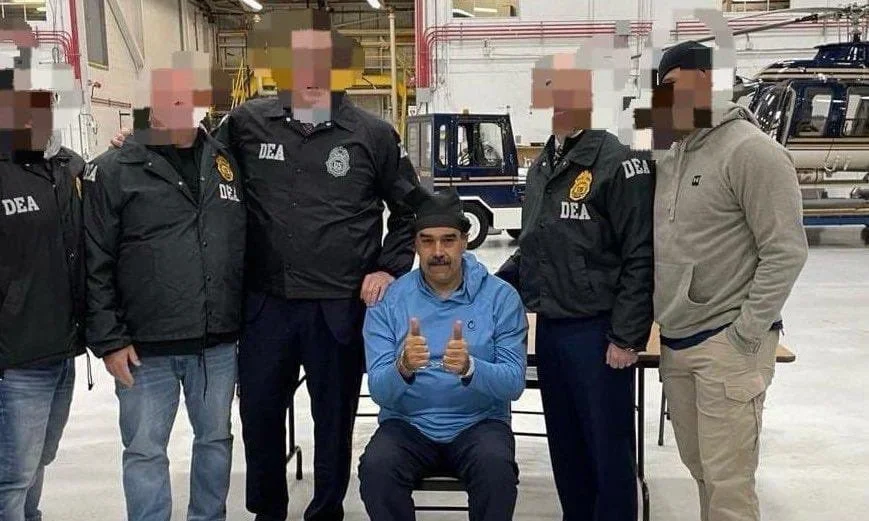
The images that have already emerged underscore the theatre: photos released by Trump and leaked to ABC News show Maduro blindfolded in a sweatsuit aboard the USS Iwo Jima, then later at a Manhattan helipad en route to Drug Enforcement Administration processing, while Flores appears in an olive‑green hoodie with a bandaged head. Sources told ABC that Maduro appeared calm, at times joking with agents.
Across town, the U.N. Security Council will be meeting Monday morning at Colombia’s request to discuss the legality of the U.S. raid and its implications for international law. That rare convergence a sitting or recently deposed head of state in a federal dock while diplomats debate whether his capture was lawful, will magnify scrutiny of every word spoken by the judge, prosecutors and defense.
Trump has already used the lead‑up to the hearing to threaten “further strikes” in Venezuela and to rattle sabers at Colombia and Mexico, saying the U.S. has “dominance over Venezuela” and warning other governments to “get [their] act together.” His rhetoric guarantees that whatever happens inside Courtroom 15D will be read not only as a legal milestone but as an extension of a broader, muscular foreign‑policy posture.
How prosecutors may frame the case on day one
While Monday’s hearing is not a trial, prosecutors from the Southern District of New York will use even brief remarks to begin framing the narrative for the judge, for the media and for audiences abroad.
Expect several themes:
- Continuity with the 2020 indictment. Prosecutors will likely emphasize that this is not a new political grudge case, but an extension of charges filed six years ago, based on years of investigation, cooperating witnesses and prior guilty pleas from co‑conspirators.
- Maduro as criminal, not head of state. The Justice Department has already described his regime as a “corrupt, illegitimate government” and insists the U.S. never recognized him as Venezuela’s leader, undercutting any claim to head‑of‑state immunity. That argument is likely to surface early.
- Trafficking as “weaponization.” The indictment accuses Maduro of using cocaine “as a weapon” against the United States by partnering with FARC‑linked networks to inundate U.S. communities with drugs. Framing the alleged crimes as national‑security threats rather than routine trafficking is meant to justify both the gravity of the charges and, implicitly, the extraordinary steps taken to arrest him.
Commentary from former SDNY prosecutors suggests the government may also preview its position that the manner of Maduro’s apprehension—via a controversial foreign raid—does not affect the court’s jurisdiction, citing the long‑standing Ker–Frisbie doctrine that U.S. courts generally will not inquire into how a defendant was brought before them.
What Maduro’s defense is likely to signal
Maduro’s lawyers will be constrained on day one: they need time to review discovery, consult their client and coordinate any strategy with political allies if they can. But they may begin sketching out the lines of a defense that blends legal argument and political framing.
Watch for:
- Challenges to jurisdiction and capture. Expect early hints that the defense will argue the U.S. raid violated international law and Venezuelan sovereignty, and that any prosecution is tainted by how Maduro was seized. Even if such arguments face long odds under U.S. precedent, raising them now builds a record for domestic and international audiences.
- Re‑assertion of political persecution narrative. Maduro has long insisted that U.S. charges are part of a campaign to topple his government. His lawyers may reference Trump’s public boasts about “running” Venezuela and tapping its oil as evidence that the prosecution is inseparable from regime‑change motives.
- Emphasis on status and risk. On detention, the defense could argue that Maduro, as a high‑profile detainee under tight federal control, poses no realistic flight risk and should be held in conditions reflecting his former office, even if outright bail is out of reach.
Analysts note that, over time, the defense may try to draw parallels with Manuel Noriega, the Panamanian leader seized by U.S. forces in 1989 and later tried on drug charges in Miami—inviting comparisons, and contrasts, in how Washington handles such cases across eras.
Why Monday matters beyond the legal script
In strict legal terms, Monday’s arraignment is a starting line: a reading of charges, a plea, a detention decision. But it will also function as a kind of live‑action referendum on three larger questions:
- Can the U.S. present this as law enforcement rather than naked regime change? The more the courtroom feels like normal process, calm judge, clear rights, measured prosecutors, the more Washington can argue it is applying the rule of law even to a deposed adversary.
- How does the world respond to a leader on trial whose government still claims power at home? As the Security Council meets and Caracas denounces the hearing as illegitimate, allies and critics alike will be parsing every image for signs of humiliation or fairness.
- What signal does this send to Venezuela’s fractured elites and opposition? A credible process could open space for a negotiated transition in Caracas; a hearing that looks overtly vindictive or politicized could harden positions and complicate any future bargains.
The legal calendar will stretch far beyond Monday. But for now, one thing is certain: when Nicolás Maduro steps into Judge Hellerstein’s courtroom, the case caption will read “United States v. Maduro”, and the way that first encounter is handled will shape not only the fate of one man, but the narrative of American power, Venezuelan sovereignty and where justice ends and politics begins.