OpenAI’s ChatGPT has quietly evolved into one of the most versatile translation tools on the market, moving from a general‑purpose chatbot to a context‑aware “ChatGPT translator” that can handle text, voice and documents across more than 50 languages. With this week’s launch of the standalone ChatGPT Translate product, the company is now explicitly challenging incumbents like Google Translate by promising more natural phrasing, customizable tone, and tighter integration into everyday workflows.
What the ChatGPT translator actually is
At the core is ChatGPT’s large language model, which has been trained on massive multilingual datasets and tuned to generate fluent, human‑like text in dozens of languages. Unlike classic machine‑translation engines that rely purely on parallel sentence pairs, GPT‑based systems infer meaning and style from broader context, then generate translations token by token.
By the middle of 2025, technical tests showed that ChatGPT could accurately process and translate more than 50 languages through chat, audio, and file uploads. It could also automatically detect the source language and adjust to tone, formality, and regional differences when asked. Business user guides now call it a useful multilingual assistant that can translate chat threads, emails, knowledge base articles, and even long documents all at once.
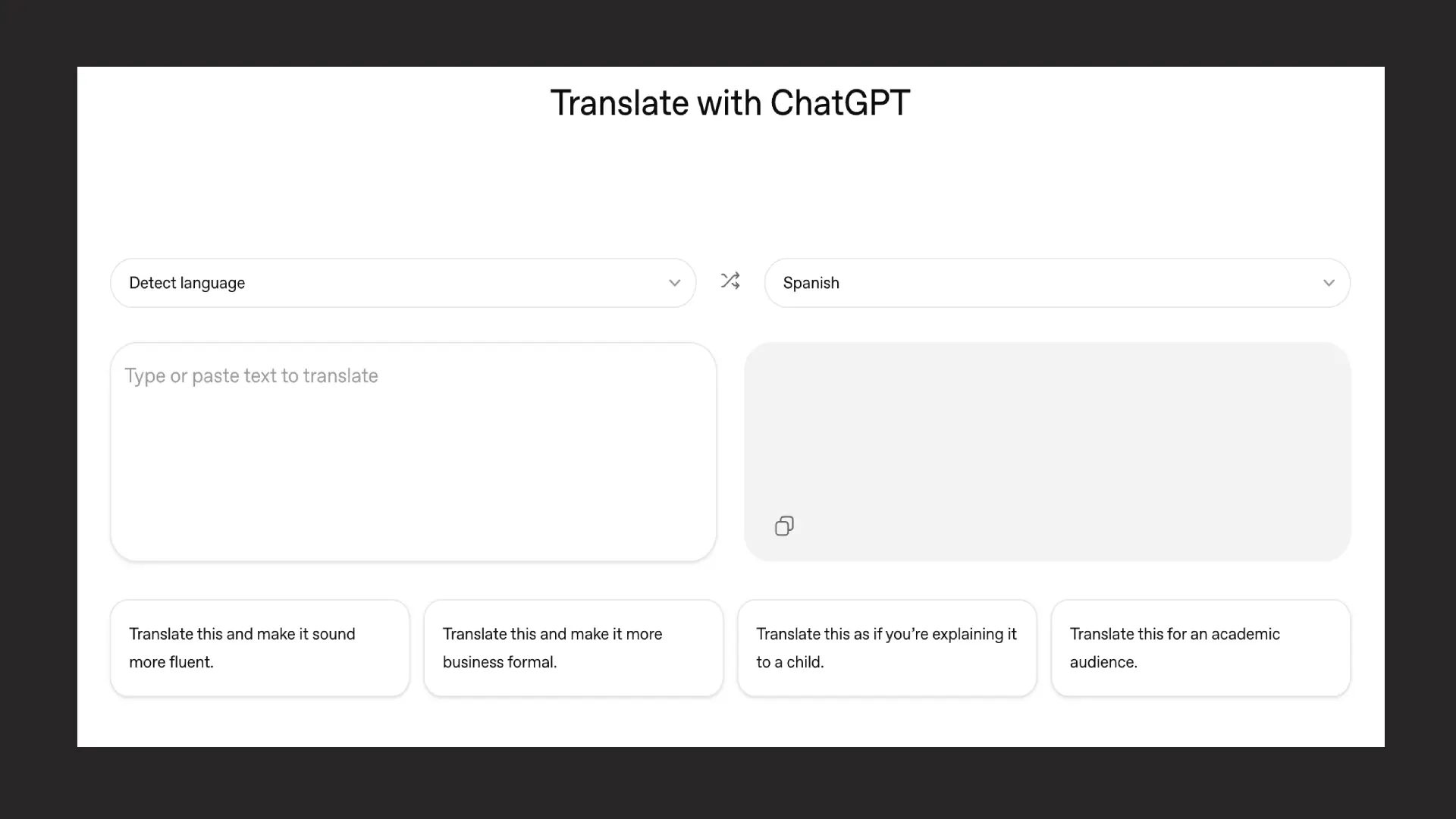
OpenAI’s new ChatGPT Translate, which came out in January 2026, combines these features into a separate interface made just for translation work. It supports more than 50 languages and is more flexible and context-aware than other translation tools.
Key features: beyond copy‑and‑paste translation
Recent documentation and independent guides highlight several capabilities that distinguish the ChatGPT translator from older-generation tools.
- Context‑aware text translation
ChatGPT can incorporate instructions about target audience, tone, register and terminology directly into the prompt, producing less literal and more natural‑sounding translations. For example, users can ask it to sound formal for a legal document, casual for social media, or to keep specific brand terms unchanged.
- Multilingual and multi‑target output
Unlike many consumer tools that require you to change languages one by one, ChatGPT can output multiple languages at once from a single source text, useful for international product pages, app strings or global announcements.
- Voice and live speech translation
OpenAI’s Advanced Voice Mode, powered by multimodal GPT‑4o, allows paid subscribers to run real‑time speech translation: users talk in one language and hear translations in another, with the model “hearing” and “speaking” directly rather than passing audio through multiple systems. Release notes indicate the feature supports interactive voice conversations in major languages such as English, Spanish, French, Portuguese, German, Japanese, Korean, Chinese, and Hindi.
- Document, audio, and video workflows
Translation guides show that users can upload documents or media files, have ChatGPT transcribe the text, and then translate it into more than 50–59 languages, depending on the workflow. For video, this often means a three‑step pipeline: extract audio, transcribe, then translate the transcript.
- On‑screen text and OCR
Desktop tools built on GPT‑4o Vision enable OCR plus translation for screenshots or photos: users can highlight text or capture an image of a sign or slide deck and get instant translations. Keyboard shortcuts in some desktop apps trigger “instant translation” of selected text within other software.
- Roadmap extras for 2026
Planned features include terminology‑glossary APIs (to lock in company‑specific word choices), bilingual toggles inside threads and offline mobile translation packs for key language pairs like English–French and English–Spanish. These are aimed at enterprise translation teams and travellers who need access without a permanent connection.
How to get good translations from ChatGPT
Specialist guides stress that simply pasting text and typing “translate this” is rarely enough for high‑stakes work. Instead, they recommend structured prompting that looks more like a mini translation brief than a one‑line command.
Common best practices include:
- Define the text type and purpose: e.g., legal contract, marketing email, product manual, academic abstract.
- Specify source and target languages, including regional variants such as Brazilian Portuguese or Canadian French.
- State the target audience and tone: corporate versus youth‑oriented, formal versus conversational.
- Set terminology rules: list brand names, technical terms or acronyms that must stay in the original language.
- Allow restructuring for naturalness, telling the model it may reorder sentences or break long phrases.
Some practitioners also use “pivot prompting”, first translating into English, then into the final language, plus back‑translation (asking ChatGPT to translate its own output back into the original language) to catch subtle errors. Others ask ChatGPT to highlight uncertain phrases or to propose two or three alternatives for tricky idioms.
Strengths and limits compared with classic machine translation
Language‑technology firms that have benchmarked ChatGPT against engines like Google Translate and DeepL say the picture is nuanced.
Strengths noted in independent tests include:
- More natural, fluent sentences, especially in creative or marketing‑style copy.
- Better handling of informal language, slang, and mixed‑register chat messages.
- Flexibility to adapt style mid‑conversation and to accept corrective feedback from the user.
Limitations and risks include:
- Occasional “hallucinations,” where the model inserts or omits details that are not in the original text, which is unacceptable in legal or medical contexts.
- Uneven quality for long or highly technical documents without very clear instructions and sometimes the need for human review or specialized engines underneath.
- Data‑privacy concerns in enterprise settings if sensitive content is fed directly into a consumer model without contractual safeguards.
Vendors caution that, while ChatGPT is more than capable of handling everyday translation tasks, mission‑critical customer support, regulated industries and brand‑sensitive content may still require dedicated translation stacks that combine multiple engines, glossaries, and human linguists.
What this means for users, companies, and translators
For ordinary users, from students to travellers, the ChatGPT translator essentially merges several tools into one: a dictionary, a phrasebook, a grammar coach, and a cultural adviser that can explain why a literal translation sounds “off” and suggest something more idiomatic. People can ask not only “what does this mean?” but also “how would a native speaker say this politely?” or “make this sound like a relaxed Instagram caption.”
For businesses, analyses by translation‑platform providers argue that ChatGPT can significantly speed up localization workflows, especially when used for first drafts that are later refined, or for low‑risk content like internal documentation and knowledge bases. Its ability to handle multiple formats, chat, email, documents, subtitles, makes it attractive for global teams and customer support operations, provided it is integrated with guardrails and glossaries.
For professional translators, industry commentary is clear: ChatGPT is less an outright replacement and more a powerful co‑pilot. It can pre-translate, suggest other options, fill in gaps in terminology, and deal with parts that are the same over and over again. Humans can then focus on nuance, brand voice, and legal correctness. Agencies are already trying out workflows where GPT-based systems work with traditional engines. Routing logic decides which model handles each segment based on its domain and level of risk.
As OpenAI rolls out ChatGPT Translate and deepens live voice and document features, the translator space is shifting from simple word‑for‑word output to fully interactive, context‑rich language assistance. For EU, US, and global users alike, discovering the ChatGPT translator now means not just asking “how do you say this?”, but also “how do I say this well to the people I want to reach?”.