
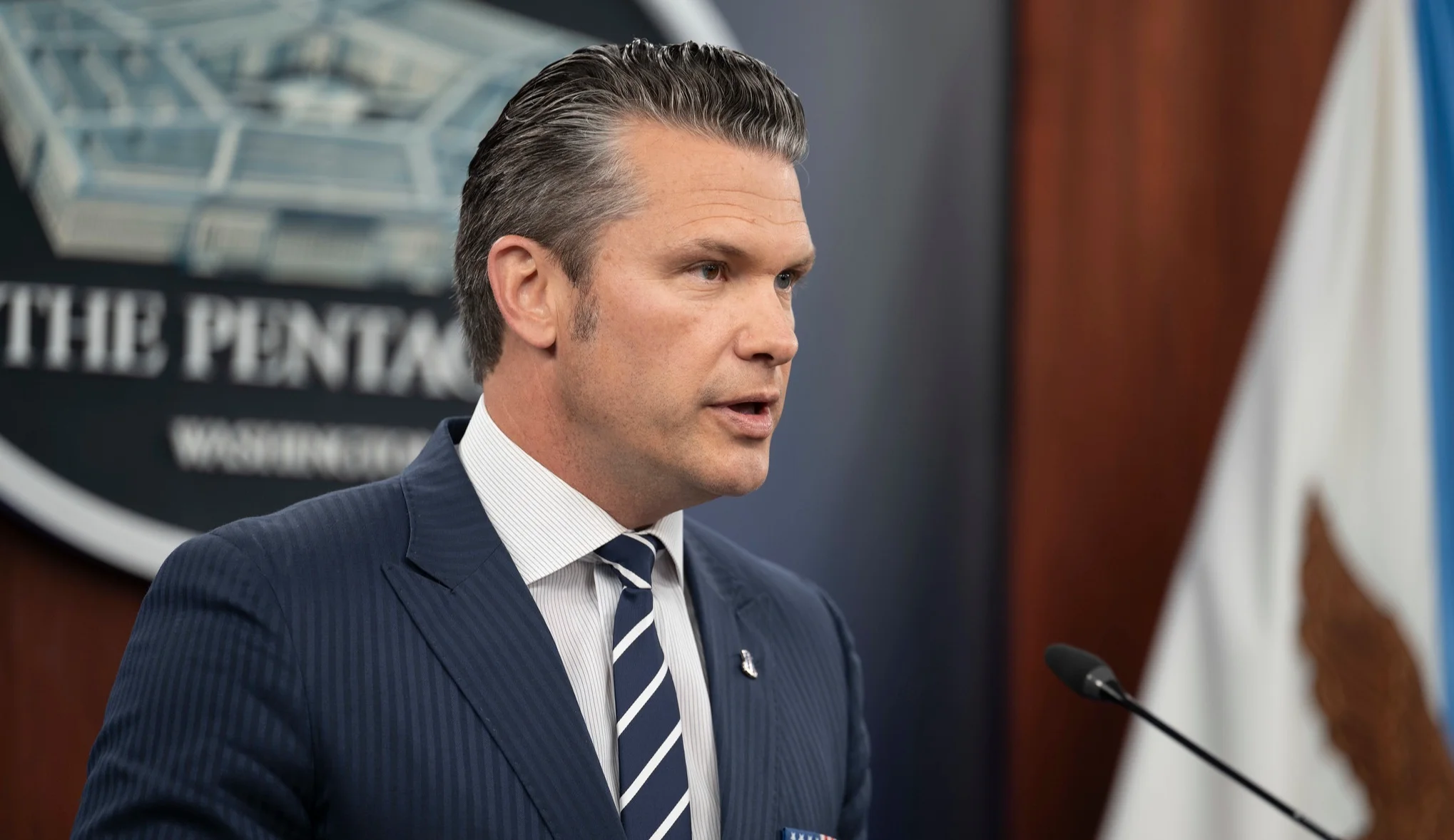
United States Defense Secretary Pete Hegseth delivered his most explosive and consequential speech to NATO in Brussels on Thursday, calling the alliance a “paper tiger and a one-way street,” announcing a six-month Pentagon review of all American military forces and bases in Europe, threatening to tie future US NATO dues to allied spending compliance and condemning European allies for blocking US access to their bases and overflight rights during the Iran war, a sweeping reform ultimatum that is already reshaping how allies plan for the continent’s defense.
A Speech That Shook Brussels
When Pete Hegseth walked into NATO headquarters in Brussels on Thursday morning, every defense minister in the room knew they were about to hear something unprecedented in the alliance’s modern history.
They were not disappointed. In a speech broadcast live, shared across platforms and immediately dissected by governments from Warsaw to Paris to Ankara, the United States Secretary of Defense declared that “for too long NATO has been a paper tiger and a one-way street. No more.” The words, spoken with the deliberate cadence of someone who had weighed their impact, landed in that conference room like a concussion grenade.
What followed was not merely rhetoric. Hegseth unveiled a series of concrete, immediate policy actions, a six-month Pentagon review of US military forces and basing across Europe, a formal linkage between future US NATO dues and allied defense spending compliance, a sharp rebuke of European allies over the Iran war, and the outline of a new doctrine he called “NATO 3.0” — that, taken together, represent the most structurally significant challenge to the alliance’s foundational architecture since its creation in 1949.
The Six-Month Review: What It Means
The centerpiece announcement of Hegseth’s Brussels address was the launch of what he described as a comprehensive six-month Pentagon review of “America’s force posture and basing in Europe.”
“This will be a real review,” Hegseth told defense ministers, “designed to ensure that NATO is moving swiftly and irrevocably toward Europe taking the lead and taking primary responsibility for its own defense.” He added with unusual bluntness: “This is a review where some nations will not measure up, while others will excel.”
CNN and the Wall Street Journal report the review will include consultations with Congress, which has mandated a minimum floor of US troop presence in Europe under existing federal law, a constraint that limits how aggressively the Pentagon can unilaterally draw down forces even if the review recommends doing so. The review is expected to cover all American military assets committed to NATO’s force structures, including prepositioning arrangements, command headquarters, air bases and naval facilities.
The announcement came days after NATO Secretary-General Mark Rutte confirmed the US had already reduced its contributions to the alliance’s crisis response force structures, the military units pledged by members for rapid deployment during emergencies, effective immediately. Reuters sources indicate those cuts include the reduction of US F-15 and F-15E fighter jets available to NATO by one-third, to 99 aircraft, and the halving of MQ-9 Reaper drone availability from 24 to 12. The Pentagon is also separately implementing a drawdown of approximately 5,000 US troops from Germany over the next 12 months.
Dues Contingency: The Financial Ultimatum
Perhaps the most structurally consequential element of Hegseth’s Brussels speech was the announcement that the United States would formally tie its annual NATO dues contributions to whether allied nations meet their defense spending targets.
“Going forward, our annual NATO dues will be contingent on other countries meeting their defense spending targets,” Hegseth stated. “Where other allies do not spend with urgency, our dues contributions will go down.”
The threshold in question is the 5% of GDP defense spending target that NATO allies agreed at last year’s Hague Summit, a figure the Trump administration, according to Breaking Defense, pushed as the new global standard, with all member nations committing to the benchmark. Hegseth’s announcement transforms that commitment from a political obligation into a financial one: miss the target, lose the American contribution.
The Wall Street Journal notes that the legal mechanics of reducing US NATO dues would require Congressional authorization, given that appropriations and treaty-based financial commitments are subject to legislative oversight. But the political signal, delivered in person, at NATO headquarters, to all 32 allied defense ministers, was unmistakable in its intent.
The Iran War Rebuke: ‘Shameful’ Base Restrictions
Alongside the structural reform announcements, Hegseth delivered a sharp bilateral rebuke directed at European allies who refused to provide US forces with access to their military bases and overflight rights during the Iran war that began February 28.
“European nations that restricted US forces’ access to their bases and overflight rights during the Iran war, behavior I can only describe as shameful, put American service members at risk,” Hegseth said, according to Al Jazeera and Yeni Safak. He said the six-month review would include a specific mandate to “secure US rights for basing and overflights” as a non-negotiable baseline for future alliance commitments.
The Iran war reference electrified the Brussels meeting, as several European NATO members — including Germany, France, and Spain — had declined to offer their territory as staging or transit points for US operations against Iranian targets, citing their own political constraints and fears of escalation. Hegseth’s decision to name that refusal publicly, at an allied ministers’ table, set up what European officials described as an uncomfortable exchange in the closed-door sessions that followed.
‘NATO 3.0’: The Doctrine Behind the Speech
Hegseth’s Brussels address was not merely a grievance list, it contained the outline of a coherent strategic doctrine that he labeled “NATO 3.0,” a term that frames the alliance’s future in explicitly comparative terms.
“NATO 3.0 recognizes that post-Cold War, we need to revert to a robust military alliance with genuine capabilities to deter threats right here on the continent and lead the conventional defense of Europe,” he said. The formulation draws a contrast with what he characterized as “NATO 2.0,” the post-1991 era of “distraction, deindustrialization and demilitarization” — the period during which European defense spending declined and reliance on US forces deepened.
The vision described by Hegseth involves a transformed architecture in which European allies and Canada carry the primary burden for the continent’s conventional ground defense, while the United States retains its nuclear umbrella commitment, supports allied arms purchases through the Foreign Military Sales program and “superpowers” its own defense industrial base toward a $1.5 trillion investment target by 2027. “We are creating an arsenal of freedom,” Hegseth said of the US defense build-up, “which primarily protects America and its interests while also strengthening NATO and our allies.”
The European Union Institute for Security Studies, in a June paper published ahead of the Brussels meeting, identified NATO 3.0 as the architecture likely to govern the July 7-8 Ankara summit, noting that Hegseth’s February 2025 statement — “strategic realities prevent the US from taking primary responsibility for European conventional deterrence” — had already signaled the trajectory.
NATO Secretary-General Rutte: Damage Limitation
NATO Secretary-General Mark Rutte spent much of Thursday in what observers described as a high-wire act: acknowledging the reality of Hegseth’s announcements while maintaining that the alliance’s fundamental commitments remained intact.
“We have looked at the division of responsibilities when it comes to conventional forces, and we see that European allies and Canada are ready, willing and able to do more. So, the United States has adjusted its contributions to the NATO force model,” Rutte said, framing what the US describes as a reduction as a natural evolution of European capability. He reaffirmed that the United States, “under its nuclear umbrella,” remains “committed” to the alliance.
But Rutte also acknowledged the gap created by the already-implemented US force structure reductions, confirming that European members were urgently working to “fill” the battlefield assets the US had withdrawn, including refueling aircraft, fighter jets, drones, and naval vessels, with “most of it done, some of it nearly, and some requiring more debates and discussions.”
Europe’s Response: Urgency and Anxiety
European NATO members left Thursday’s Brussels meeting facing a dual imperative: accelerate defense spending and procurement to demonstrate readiness for the Ankara summit while managing the domestic political implications of doing so at the scale Hegseth now formally demands.
The Financial Times notes that European NATO countries spent 50% of their military equipment investment on purchases from the US in the 2022–24 period, up from 28% previously, a metric that, paradoxically, Hegseth cited as evidence that the alliance was producing results even as he demanded more.
The July 7-8 Ankara summit now looms as the first major reckoning with the six-month review timeline Hegseth set Thursday. Whether European allies’ spending trajectories and willingness to extend basing rights satisfy the Pentagon’s new benchmarks will determine whether “NATO 3.0” becomes a strengthened alliance, or the accelerant for its most serious internal fracture since Suez.





