
Samsung’s first triple-folding smartphone, the Galaxy Z TriFold, has sold out in Korea in minutes every time it has gone on sale, underscoring both strong early demand and a deliberate scarcity strategy as the company tests the next frontier of foldable phones. With global shipments reportedly capped at tens of thousands of units and further launches scheduled for 2026, the device is less a mass‑market product than a high‑stakes signal of where Samsung thinks the premium smartphone market is headed.
A Triple‑Fold Phone That Few Can Buy
Samsung launched the Galaxy Z TriFold in South Korea on 12 December, initially making the triple‑folding phone available at just 20 of its major retail stores and via its domestic online shop. Priced at 3.59 million won, about 2,430 to 2,470 dollars, for a 512‑gigabyte configuration, it is the most expensive smartphone Samsung has ever sold to consumers.
Despite that price, the first batch sold out within minutes at all participating stores, with local media describing queues of “dozens of people” outside multiple locations before doors opened. Samsung did not disclose exact unit volumes, but Korean industry estimates suggest the initial domestic batch numbered around 1,000 units.
A subsequent online restock, opened a few days later, also vanished in roughly two minutes, while in‑store allocations again sold through almost immediately. As of late December, the phone is effectively unavailable in Korea until at least January, with Samsung inviting customers to sign up for restock notifications.
Inside the Galaxy Z TriFold: Design and Purpose
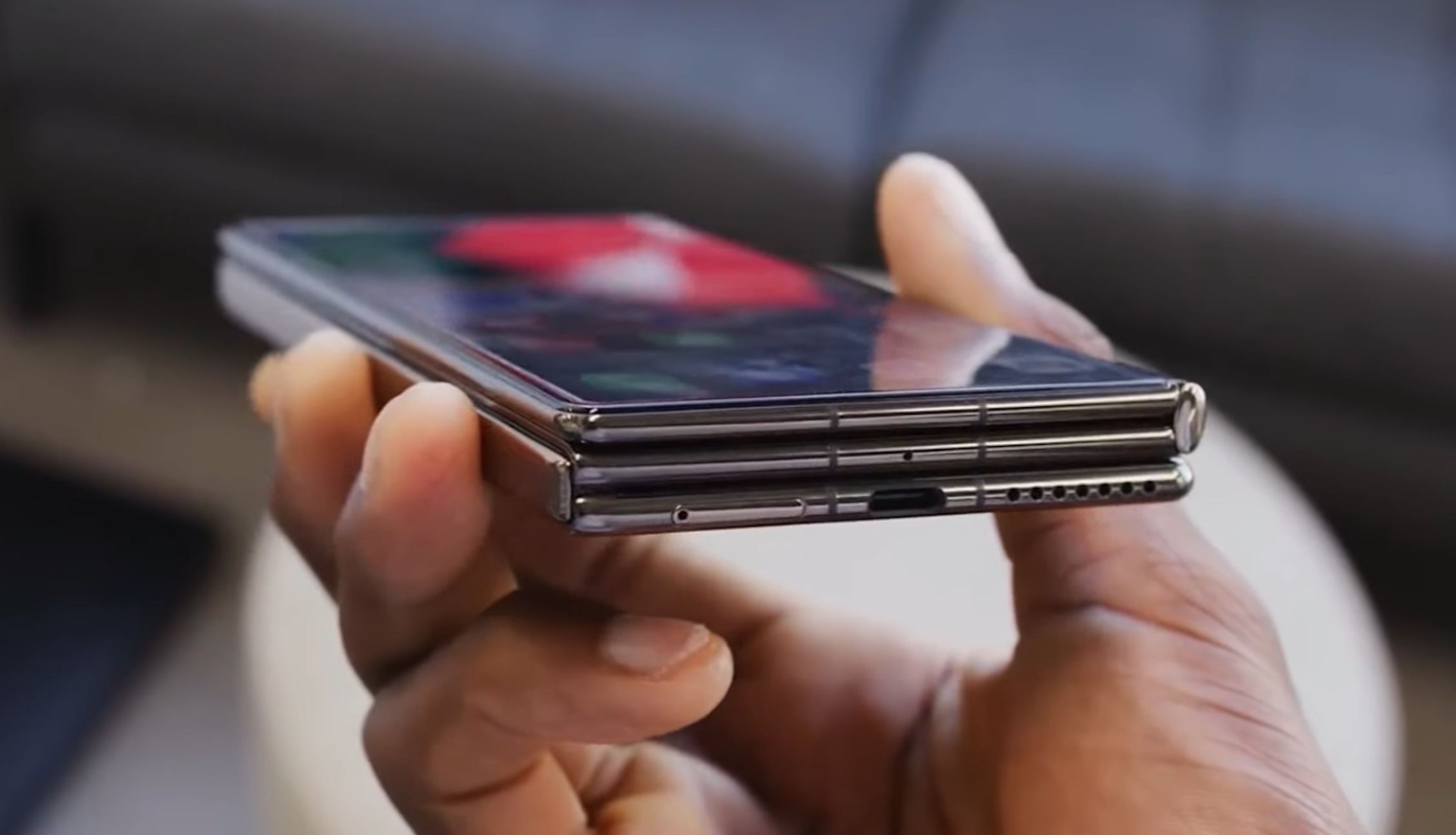
The Galaxy Z TriFold is Samsung’s first commercial tri‑fold smartphone, featuring two hinges and three segments that fold into a compact bar‑style form and open out into a tablet‑sized display. Demonstrations at events such as the APEC Summit in Gyeongju showed the device folding from around 6.5 inches in its phone configuration to roughly 10 inches when fully unfolded, using a dual infolding design that keeps its flexible screens protected when closed.
This dual infolding approach contrasts with rival concepts, such as Huawei’s Mate XT Ultimate, which leaves one display exposed when folded and therefore more vulnerable to damage. On the rear, the Galaxy Z TriFold carries a triple‑camera setup and punch‑hole displays that echo the design language of Samsung’s mainstream Galaxy Z Fold line, signaling continuity rather than a complete break with its existing foldable identity.
Samsung has framed the device as a halo product: a showcase for what its display technology and hinge engineering can do after more than half a decade of work on foldables, starting with the original Galaxy Fold in 2019. The larger screen area is designed to enable advanced multitasking, split‑screen productivity and an experience that straddles the line between phone, mini‑tablet and, in some use cases, laptop replacement.
Deliberate Scarcity: Strategy, Not Just Demand
The repeated sell‑outs have generated headlines about “hot‑cake” demand, but analysts and Korean media emphasize that scarcity is at least partly by design.
According to The Korea Herald, Samsung plans to ship only about 20,000 to 30,000 Galaxy Z TriFold units globally, with domestic sales estimated at just 3,000 to 4,000 units so far. That is negligible compared with Samsung’s mainstream foldables: the company’s Galaxy Z Fold7 and Z Flip7 reportedly drew more than 1.04 million pre‑orders combined in their home market earlier this year.
Limiting volume serves several purposes:
- It reduces financial risk on an expensive, first‑generation form factor whose long‑term reliability and consumer appeal are still untested at scale.
- It helps Samsung control manufacturing yields for a complex hinge and display system, giving engineers time to monitor failure modes and refine processes.
- It amplifies the device’s visibility: a product “almost no one can buy” becomes a status symbol and talking point, reinforcing Samsung’s image as a foldable pioneer.
As one analysis noted, both a 1,000‑unit and a 10,000‑unit run can sell out quickly; without hard sales data, “sold out in minutes” says as much about supply strategy as about demand.
Positioning Ahead of a New Foldable War
The timing of the TriFold’s launch is not accidental. Market research firm IDC forecasts that global foldable shipments will grow by nearly 30 percent year‑on‑year in 2026, with much of the anticipated momentum tied to Apple’s long‑rumored entry into the category with a device expected to cost around 2,400 dollars.
“Samsung will kick‑start 2026 with the Galaxy Z TriFold, introducing tri‑fold innovation to mainstream global consumers,” IDC senior research director Nabila Popal said, framing the device as a pre‑emptive move in what she described as the “next phase” of the smartphone wars. Samsung has already said the TriFold will reach additional markets in the “coming weeks,” including the United States, United Arab Emirates, Singapore, China, and Taiwan, with a broader push envisioned for next year.
The strategy appears designed to secure three advantages:
- First‑mover credibility: By commercializing a triple‑folding phone ahead of Apple and most Android rivals, Samsung seeks to cement its reputation as the company that defines what a foldable can be, not just one more participant in a mature category.
- Ecosystem leverage: A tri‑fold form factor puts new demands on Android and app developers, from window management to aspect ratios. Samsung’s early experiments, layered atop its One UI software, could shape developer expectations and optimizations before any competing implementation arrives.
- Portfolio segmentation: With mainstream foldables already moving toward mass‑market price points, the TriFold establishes a higher tier: an ultra‑premium, limited‑run device for early adopters, technophiles, and professionals willing to pay for novelty and productivity.
Questions Around Software, Durability and Value
For all the engineering theatre, the Galaxy Z TriFold also surfaces unresolved questions for Samsung and the wider industry.
First, there is software. Reviewers and analysts who saw the device behind glass at APEC and in early demonstrations note that One UI must adapt to a display that transitions between unusual aspect ratios and multiple “postures.” Existing foldable‑optimized Android apps are largely built around single‑hinge devices that open from phone to tablet; a tri‑fold screen could reveal gaps where apps letterbox, clip or fail to use the additional space effectively.
Second, there is durability. While Samsung’s dual infolding design protects the flexible panels when closed, it also introduces more mechanical complexity in the form of two hinges and additional moving parts. The company’s experience with improving hinge life and crease visibility on the Z Fold and Z Flip lines will help, but long‑term reliability data on tri‑folds does not yet exist in the wild.
Third, there is the value proposition. At roughly 2,400 dollars, the Galaxy Z TriFold costs significantly more than high‑end slabs and even than Samsung’s own premium foldables. For early adopters, that premium may be acceptable; for enterprise buyers or mainstream consumers, the return on investment will depend on whether the extra screen real estate translates into measurable productivity or entertainment gains.
These uncertainties explain why Samsung appears content, for now, to keep the device rare: the TriFold can influence the conversation about the future of phones without yet bearing the burden of mass adoption.
Implications for Consumers and Competitors
For consumers, the TriFold’s rapid sell‑outs are a reminder that the smartphone market still has room for radical hardware experimentation at the top end. Even if most people never buy a triple‑folding phone, technologies pioneered in halo devices stronger ultra‑thin glass, smarter multi‑window software, more efficient hinges, often trickle down into more affordable models over time.
For competitors, Samsung’s move raises the bar. Chinese manufacturers have already been pushing on form factors, from book‑style foldables to rollable concepts. Apple, which tends to wait until technologies mature before entering new categories, now faces a market in which consumers may come to see multi‑panel devices as the logical next step in mobile computing.
And for Samsung itself, the Galaxy Z TriFold is both a test and a message: a test of what its foldable supply chain and software stack can support, and a message to investors and customers that it intends to lead, not follow, as the smartphone approaches its third decade.
Whether triple‑folding phones ultimately remain niche curiosities or evolve into a mainstream segment will depend on price, durability, and software far more than on the spectacle of launch‑day sell‑outs. For now, though, Samsung has succeeded in making a device that, at least in one market, is more desirable than obtainable, and in positioning its brand at the centre of the next chapter in the global foldable phone race.