
A dangerous, multi‑day heat wave is forecast to grip a large swath of the United States next week, with major cities from the South and Midwest to the Northeast expected to see temperatures near or above 100 degrees and “feels‑like” heat indices over 105–110 degrees, putting tens of millions at risk of heat‑related illness. Meteorologists warn that the dome of high pressure driving the event will keep hot, humid air parked over densely populated corridors, delivering record‑challenging highs and unusually warm nights that offer little relief.
Where and when the heat will hit hardest
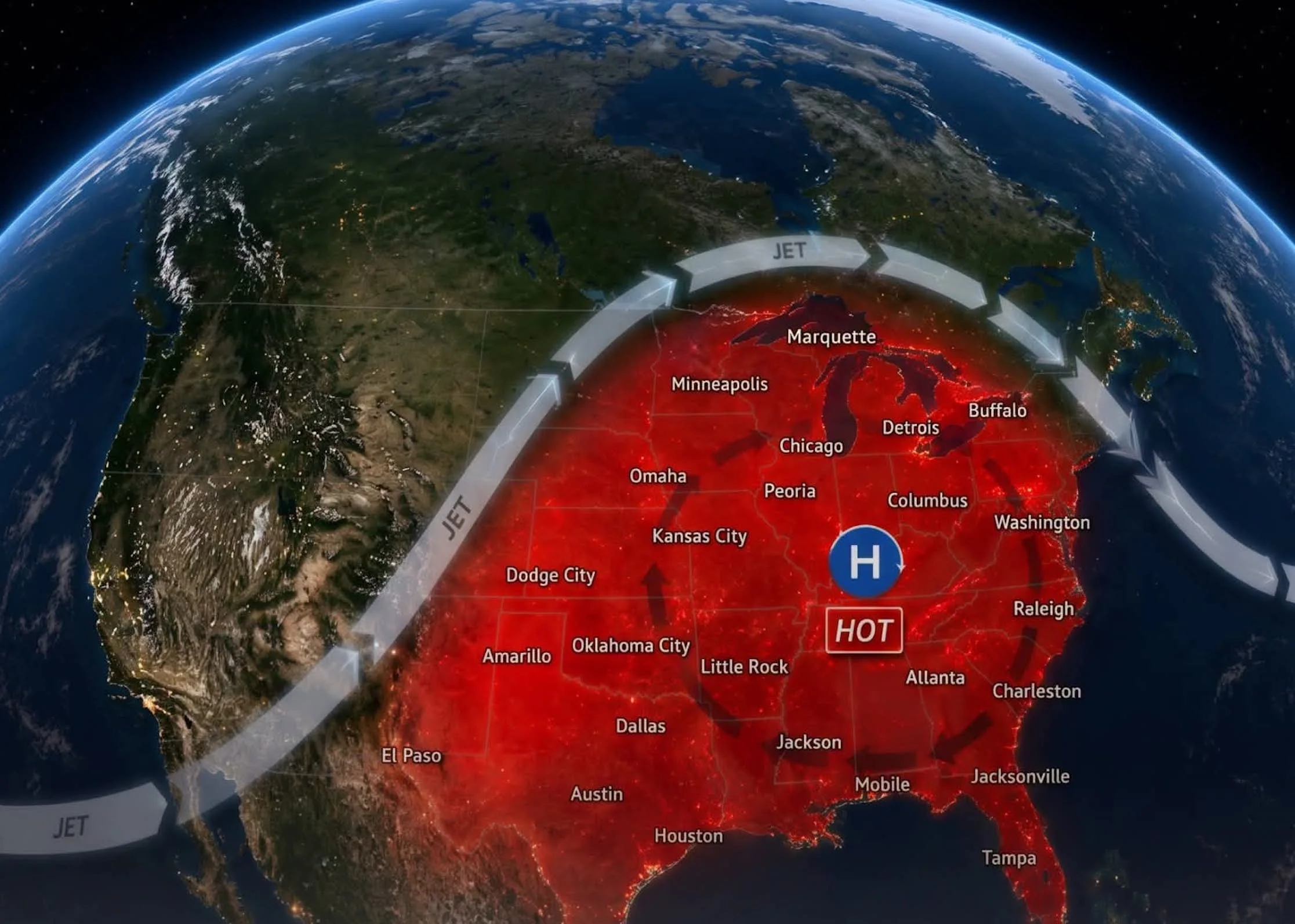
Forecasts from network meteorologists and private services point to a broad zone of extreme heat building across the central and eastern United States before shifting toward the East Coast early next week.
AccuWeather says a “large bubble of heat” will drift slowly across the country, with sweltering 90–100°F heat expanding to affect around 170 million people. ABC News reports that more than 100 million people from the Midwest to the Northeast are on alert for “life‑threatening temperatures,” with heat indices, the “feels‑like” combination of heat and humidity, reaching 110°F in some areas.
CNN explains that a heat dome trapping hot, humid air will make next week “the hottest time of the year” for many locations, with Level 3 (“major”) and Level 4 (“extreme”) heat‑risk categories covering territory from the Gulf Coast up to Vermont. USA Today’s heat‑index maps show large swaths of the central and eastern U.S. shaded in “Danger” (over 103°F) and “Extreme Danger” bands through the coming seven days.
The timing varies slightly by region, but models broadly agree on a multi‑day event that peaks over the Midwest and Ohio Valley, then pushes east into the I‑95 corridor.
Major cities in the crosshairs
Specific city‑level forecasts illustrate how widespread the heat will be.
ABC News says central U.S. cities like Denver and Minneapolis could shatter heat records, with heat indices in some locations hitting 110°F on Friday and Saturday. In the Chicago area, the “feels‑like” temperature could reach 105°F from Saturday through Monday, with highs in the upper 90s.
The South and Ohio Valley will see similarly punishing conditions. Nashville and Louisville are forecast to feel like around 104°F on Sunday and Tuesday. CNN notes that cities such as St. Louis and Memphis may record their hottest day of the year, with highs in the upper 90s and heat indices well over 100°F.
By early next week, the worst of the heat shifts into the Northeast and Mid‑Atlantic. ABC News reports that in New York City the heat index is expected to soar to 103°F, 107°F and 105°F across three days, while in Washington, D.C., the “feels‑like” temperature could reach 103°F, 107°F and 108°F. Boston could feel like 102°F on Tuesday, with similarly high indices expected in Detroit, Cleveland, Pittsburgh and Philadelphia, up to 107°F in some cases.
Interactive tools from The Washington Post and the New York Times, based on National Weather Service data, show hazard‑level heat index values in dozens of major cities, including New York, Chicago, Houston, Phoenix, Philadelphia, Washington, Atlanta, and Dallas, on one or more days of the week. In some urban centers, the heat index is forecast to exceed 105°F for multiple consecutive days.
Nighttime offers little relief
One factor worrying forecasters is how high temperatures will remain after sunset.
CNN notes that high humidity will “hinder significant temperature drops overnight,” with lows staying near 80°F in cities like St. Louis and Chicago, roughly 10 degrees above typical July lows. AccuWeather and USA Today’s maps likewise highlight elevated nighttime heat indices, which keep bodies from cooling and raise risks of heat exhaustion and heat stroke.
In parts of the Southeast and South, forecasts call for lows in the 70s to low 80s throughout the week, meaning round‑the‑clock heat stress, especially for people in poorly insulated homes or without air conditioning. The National Weather Service warns that “little relief overnight” is a hallmark of dangerous heat waves, contributing to cumulative strain on vulnerable populations.
Health risks and safety guidance
Public‑health officials and meteorologists are urging residents to treat the upcoming heat as a serious hazard, not just uncomfortable weather.
The National Weather Service categorizes heat indices above 103°F as “Danger” and above 125°F as “Extreme Danger,” with risks of heat cramps, exhaustion and heat stroke rising sharply. ABC News warns that “life‑threatening temperatures” will put more than 100 million people under heat alerts.
NWS safety guidance includes:
- Drink plenty of water, even if you do not feel thirsty, to avoid dehydration.
- Avoid strenuous activity during the hottest parts of the day; reschedule outdoor work or exercise to early morning or late evening.
- Check on elderly neighbors, people with chronic illnesses, and those without reliable cooling.
- Never leave children or pets in parked cars, where temperatures can become deadly within minutes.
Health departments stress that heat risk is highest for older adults, very young children, outdoor workers, people with heart or respiratory conditions, and residents of dense urban neighborhoods with limited shade and green space, the so‑called “urban heat island” effect.
Infrastructure and economic impacts
Extreme heat has implications beyond health. Prolonged high temperatures can strain electric grids as air‑conditioning use spikes, stress road and rail infrastructure, and disrupt day‑to‑day operations for businesses and city services.
Utilities in large metro areas typically prepare for heat waves by bringing additional generation online and asking for conservation during peak demand. Transit agencies may slow trains or monitor tracks and overhead lines for heat‑related damage, particularly in systems where rails can buckle.
Employers face safety decisions for outdoor and non‑air‑conditioned workplaces. OSHA and local regulators often encourage or require adjustments during extreme heat, more frequent breaks, shaded rest areas, hydration plans and altered shift schedules. For hourly workers, these adjustments can mean lost hours or pay if work is curtailed; for companies, they are part of maintaining operations without jeopardizing staff health.
Climate context: heat waves becoming more likely
Climate scientists say that while individual heat waves are driven by short‑term weather patterns, human‑driven climate change is making such events more frequent, more intense, and more likely to break records.
CNN cites an analysis by Climate Central showing that a recent similar heat wave was “three times more likely” for nearly 160 million Americans under today’s climate than it would have been without fossil‑fuel emissions. Long‑term data show that average summer temperatures and the number of days with dangerous heat indices have risen across much of the country.
For major U.S. cities, that means heat waves like the one forecast next week are no longer rare, once‑a‑decade events, but recurring features of summer that urban planners, health systems and employers must plan for. From cooling‑center networks and tree‑planting campaigns to building codes and workplace rules, cities are gradually adapting, but the scale of next week’s heat will test those measures.
For residents, the immediate takeaway is more practical: check forecasts for your city, understand the heat risk categories, and prepare to treat the coming days as a serious weather emergency, not just uncomfortable conditions.





