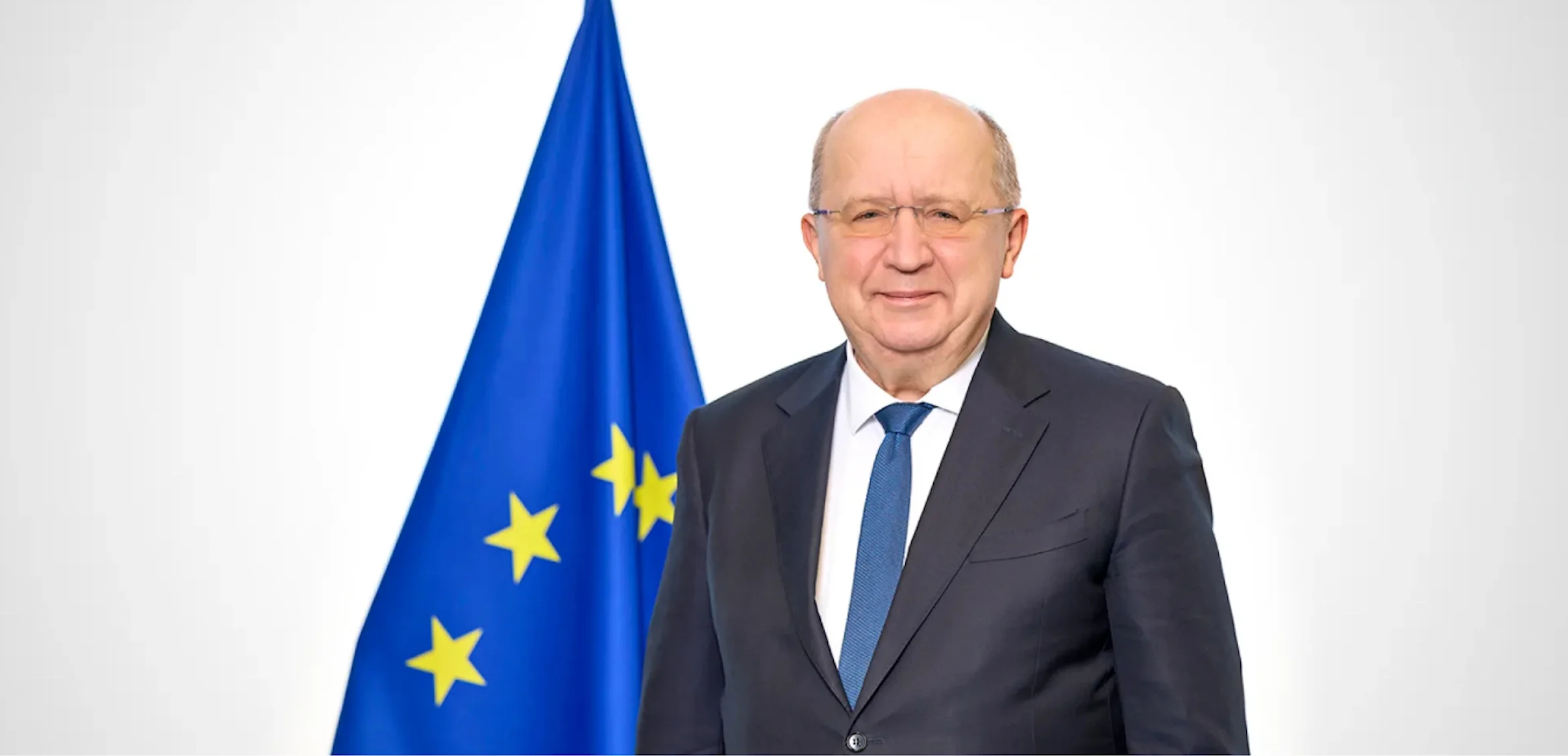
A senior European Union official has warned that any U.S. military move to seize Greenland would “simply mean the end of NATO,” escalating a transatlantic row over President Donald Trump’s renewed insistence that Washington must “own” the vast Arctic territory. EU commissioner for defense and space Andrius Kubilius said Europe would be obliged to treat an armed takeover as aggression against Denmark, a NATO ally, and raised the prospect of EU military support for Greenland if Copenhagen requested it.
What the EU commissioner said
Speaking at a security conference in Sweden, Kubilius said the EU could “help provide security for Greenland” if Denmark asked, and explicitly linked any forced U.S. move to NATO’s survival. “I agree with the Danish prime minister that it will be the end of NATO, but also among people it will be very, very negative,” he told Reuters, warning of a “very deep negative impact” on public opinion and transatlantic relations.
Kubilius stressed he does not believe a U.S. invasion is imminent, but pointed to Article 42.7 of the EU treaty, which obliges member states to assist any EU country facing “armed aggression” on its territory. That clause, he said, could come into play if Denmark, which controls Greenland, were attacked, even by the United States.
The commissioner questioned who would recognize a forcible occupation and how it would affect trade, warning of “painful negative consequences” for U.S.–EU ties.
Trump’s Greenland talk returns
The warning follows a new round of combative rhetoric from Trump, who has revived talk of bringing Greenland under U.S. control after years of fitful interest in the island’s strategic location and mineral wealth. The U.S. already operates Thule Air Base in northwestern Greenland, a key radar and missile‑warning site, but Trump has argued that is no longer enough to counter Russia and China in the Arctic.
In recent days, the White House has described acquiring Greenland as a “national security priority” and has pointedly refused to rule out military options, saying the president, as commander‑in‑chief, “keeps all options on the table.” Trump told supporters he would “take action regarding Greenland, regardless of their feelings,” claiming that if Washington does not move, the territory could fall under rival influence.
On Truth Social, he again cast himself as NATO’s savior, writing, “I’m the one who SAVED NATO!!!” while also expressing doubt the alliance would be there for the U.S. “if we really needed them.”
Denmark’s “everything stops” warning
Danish Prime Minister Mette Frederiksen, whose country is responsible for defense and foreign policy for Greenland, has been equally blunt. Any U.S. armed action against Greenland, she told broadcaster TV2, would mean that “everything halts”, including NATO and “80 years of close transatlantic security links.”
Frederiksen and Greenland’s own leadership have repeatedly stressed the island is “not for sale” and not available for transfer and have condemned talk of taking it by force as unacceptable. Denmark and the United States, both NATO members, are due to meet this week to discuss the situation, even as Trump has appointed Louisiana Governor Jeff Landry, a vocal advocate of annexation, as a special envoy to the Arctic Island.
European leaders have publicly backed Copenhagen. A Bruegel think‑tank analysis noted that “annexation of Greenland is unrealistic for numerous reasons,” but highlighted that EU capitals view any military option as a red line that would mean the “de‑facto end of NATO.”
U.S. debate: “end of NATO” warnings at home
Concern is not limited to Europe. On NBC’s “Meet the Press,” Democratic Senator Chris Murphy said that if the U.S. annexed Greenland by force, “it would be the end of NATO,” echoing Frederiksen’s language. Other Democrats, including Senator Mark Warner, have warned that an attempted takeover would “entirely dismantle NATO” and rank among the biggest geopolitical mistakes in U.S. history.
The Biden‑era U.S. foreign policy consensus around NATO has been frayed by Trump’s repeated criticisms of allies’ defense spending and suggestions he would “encourage” Russia to attack members that “don’t pay their bills.” Talk of using force against Greenland, technically part of an ally’s territory, has deepened doubts in Europe about Washington’s long‑term reliability.
Why Greenland matters
Greenland, home to about 56,000 people and governed as an autonomous territory within the Kingdom of Denmark, has become a focal point in great‑power competition as Arctic Sea ice melts and unlocks shipping routes and resource access. The island sits astride North Atlantic and Arctic Sea lanes and hosts U.S. missile‑warning and space‑tracking systems.
Trump and his advisers argue that formal U.S. control would prevent Russia or China from gaining a foothold, citing interest from Chinese firms in airports and mining projects. European officials counter that existing U.S. basing rights and close NATO cooperation already secure the island, and that aggressive moves would do more to empower Moscow and Beijing by fracturing the Western alliance.
Kubilius said the EU could bolster Greenland’s security with warships, anti‑drone systems, or troops if Denmark requested it, but stressed such decisions would rest with “military people” and political leaders in Copenhagen.
What it could mean for NATO and Europe
At the core of the dispute is a question NATO has never had to confront what happens if the United States, the alliance’s dominant member, uses force against another member’s territory. European officials say such a move would effectively gut the mutual‑defense principle at NATO’s heart, even if the alliance’s formal structures remained on paper.
Kubilius argued that Europe must build the capacity to defend itself “being without the United States,” warning that any U.S. withdrawal or self‑exclusion from NATO would pose a “very big challenge.” He floated the idea of repurposing NATO’s machinery into a more European‑led pillar if Washington stepped back, though he acknowledged that “NATO such as it is now definitely will not exist anymore.” For EU readers, the Greenland crisis underscores calls for “strategic autonomy”: more investment in defense, greater Arctic coordination and a contingency plan for an alliance that may no longer be anchored unambiguously in Washington. For U.S. and global audiences, it is a reminder that decisions about a sparsely populated Arctic Island could reshape the most important military alliance of the post‑war era.