At least 39 people have been confirmed dead and 152 injured after two high‑speed trains collided in southern Spain, in what officials say is the country’s worst rail disaster in decades and one that has severed a key artery between Madrid and Andalucía. The crash occurred on Sunday evening when a Málaga–Madrid service derailed near the town of Adamuz in Córdoba province and ploughed into an oncoming train, sending several carriages from both services tumbling off the tracks.
What happened near Adamuz
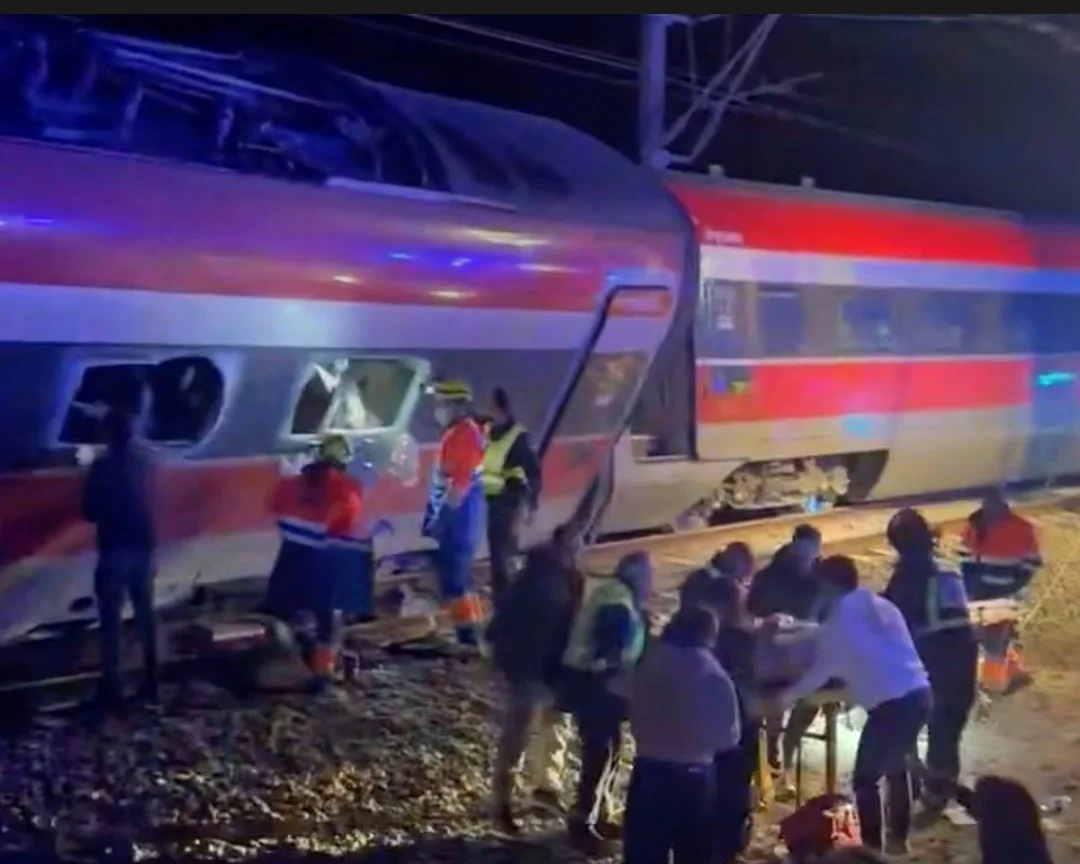
The collision took place at around 7:45 p.m. local time (18:45 GMT) on Sunday, when the rear carriages of a Málaga–Madrid high‑speed service derailed on a straight section of track near Adamuz, about 20 kilometers north of Córdoba city and some 360 kilometers south of Madrid. According to Spain’s transport minister, Óscar Puente, the derailed coaches swung onto the adjacent southbound line just as a second high‑speed train traveling from Madrid to Huelva was approaching, causing the front two carriages of the oncoming train to leave the rails as well.
Emergency authorities in Andalucía said around 400 passengers were aboard the two trains, many of them Spaniards returning to or leaving Madrid after the weekend. Rescue teams worked through the night under floodlights, clambering over twisted metal to reach survivors trapped in carriages lying on their sides in open countryside. Footage shared on social media and broadcaster RTVE showed passengers smashing windows to escape, others being carried on stretchers to an improvised field hospital, and local residents arriving with blankets and water.
By Monday morning, Spain’s Civil Guard, and state broadcaster RTVE said the death toll had risen from an initial 21 to at least 39, as more bodies were recovered from the worst‑hit coaches. Regional health officials reported 152 injured, including about two dozen in critical or very serious condition.
Rescue effort and disruption to rail services
Andalusian emergency services deployed dozens of ambulances, fire crews and medical teams to the site, assisted by Spain’s Military Emergency Unit, which specializes in large‑scale disasters. An advanced medical post was set up near the crash zone to triage the injured before they were transferred to hospitals in Córdoba, Sevilla and Jaén.
The location of the derailment on a relatively remote stretch of line complicated operations, with Civil Protection officials telling local TV that access for heavy equipment was difficult and that some victims had to be carried over fields to waiting vehicles. Rail infrastructure manager Adif said it had opened information points at Madrid’s Atocha station and in Málaga and Huelva for relatives and activated a dedicated phone line for families seeking news.
As a precaution, Adif suspended more than 200 services on Monday on high‑speed routes linking Madrid with Córdoba, Seville, Málaga, Granada and Huelva, effectively cutting high‑speed rail links to much of southern Spain for at least 24 hours. Authorities warned that disruptions could last until at least Tuesday while investigators and engineers clear wreckage and inspect the track.
Official reaction and early questions
Prime Minister Pedro Sánchez described the crash as a “terrible tragedy” and said he had cancelled other engagements to follow developments from Madrid and speak with regional leaders. Spain’s royal family issued a message offering “deepest condolences” to the families of the victims and gratitude to rescue workers. European Commission President Ursula von der Leyen and other EU leaders posted messages of solidarity, calling the images from Córdoba “heart‑breaking.”
Transport Minister Puente told reporters that it was too early to say why the first train had derailed, stressing that it was a relatively new train running on a recently renewed stretch of track and that the incident occurred on a straight section, not in a bend where excess speed might be an obvious factor. “We cannot speculate,” he said at Atocha station. “We will fully investigate, with transparency, to understand what happened and to prevent anything like this from occurring again.”
Investigators from Spain’s rail accident commission (CIAF), the Civil Guard and the judiciary have opened parallel inquiries. They are expected to examine on‑board data recorders, track condition, signaling systems, maintenance records and the actions of both train drivers, at least one of whom was reported to have survived. Prosecutors said they will study whether there is evidence of criminal negligence but cautioned that the process could take months.
Spain’s high-speed network under scrutiny
Spain has long prided itself on one of the world’s largest high‑speed rail networks, second only to China by track length, and has promoted the AVE and related services as safe, green alternatives to domestic flights. The country has, however, suffered deadly rail disasters in the past, most notably the 2013 derailment near Santiago de Compostela that killed 80 people when a train entered a curve at more than twice the speed limit.
Early reports emphasize that Sunday’s accident appears different in nature: not a high‑speed overshoot of a curve, but a derailment on straight track that led to a catastrophic side‑impact collision with a second train. Rail unions and safety experts say they will press for answers on whether infrastructure failures, rolling‑stock defects, signaling faults or external factors such as debris or weather could have played a role. The crash also comes at a time when private operators have joined state firm Renfe on some routes, a liberalization that some critics fear may create new pressures on costs and maintenance.
For EU passengers and policymakers, the disaster is likely to trigger renewed debate about rail safety standards, interoperability of signaling and emergency response along cross‑border corridors, even as the bloc promotes rail as a key pillar of its climate strategy.
Grief in Andalucía and beyond
In Córdoba, local authorities have declared days of mourning, with flags at half‑staff and plans for a public vigil once identification of victims is complete. Regional president Juanma Moreno, who visited the crash site, warned that the death toll could still rise as rescuers work through the most mangled carriage and some of the critically injured fight for their lives in hospital.
Families gathered at stations in Madrid, Málaga and Huelva overnight, clutching photos and waiting for news, while psychological support teams fanned out to receive survivors and bereaved relatives. Local media reported quiet scenes at schools and workplaces on Monday morning, with many people glued to live coverage and social networks for updates.
For Spain and Europe, the collision near Adamuz is a stark reminder that even advanced high‑speed systems carry risks when something goes catastrophically wrong. As investigators pick through twisted steel and data logs on a cold January hillside, the priority remains the same: counting the dead, caring for the injured and trying to understand how a routine Sunday journey home turned into a National Day of Mourning.