
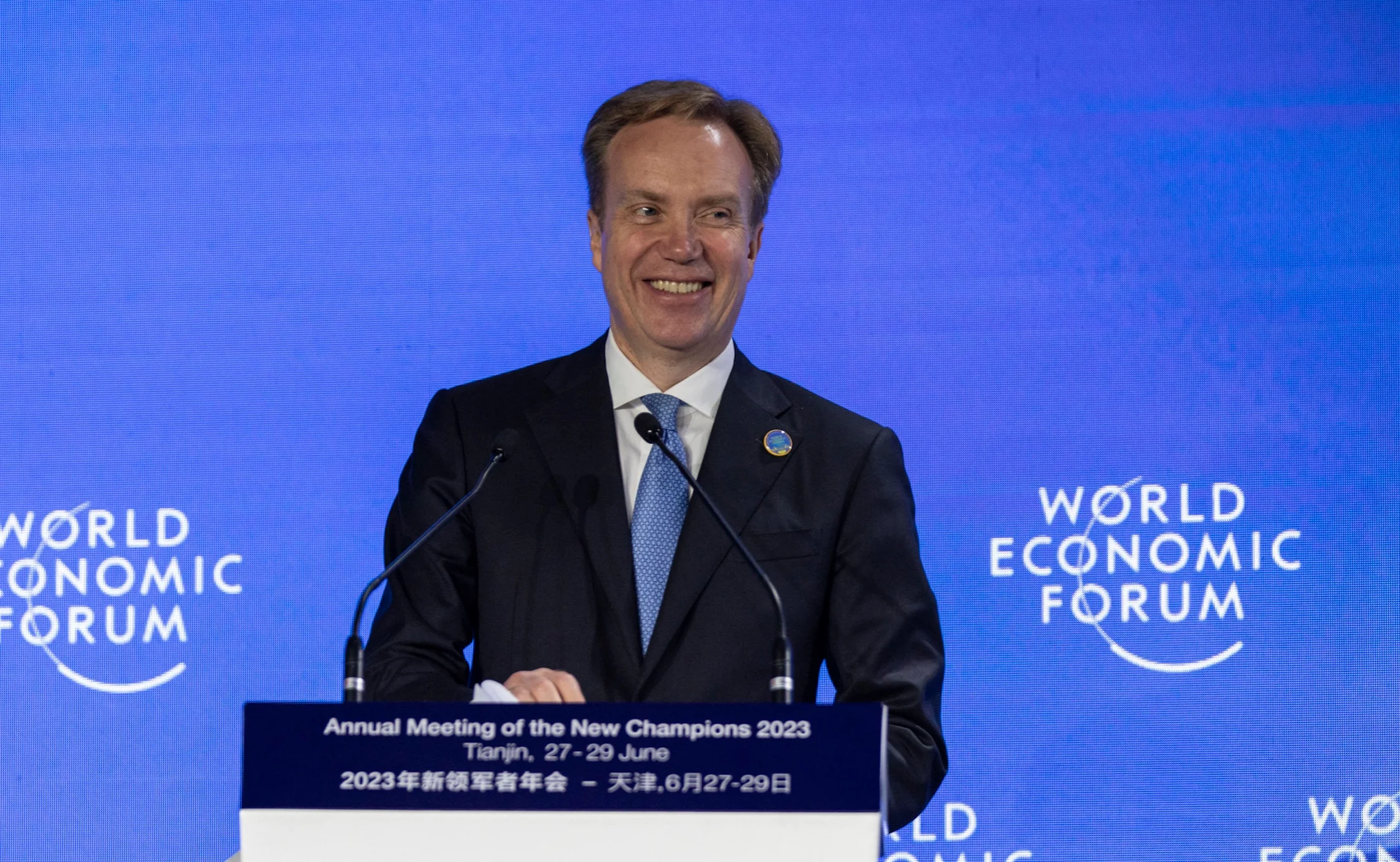
Børge Brende’s resignation as president and CEO of the World Economic Forum has turned a slow‑burn reputational problem into a full‑blown leadership crisis for the organization that convenes the global elite each year in Davos. His decision to quit, announced Thursday from Zurich, comes weeks after newly released US Justice Department documents revealed he had attended three business dinners with Jeffrey Epstein and exchanged emails and text messages with the convicted sex offender.
A resignation shaped by newly released Epstein files
In his statement, Brende said he was leaving after “thorough reflection,” calling his eight‑and‑a‑half‑year tenure “immensely fulfilling” and saying it was “the right time for the Forum to continue its vital mission without distractions”. He did not mention Epstein by name.
The distractions he referred to are clear. Earlier in February, the US Justice Department released millions of pages of documents linked to investigations into Epstein’s financial and social networks. Among them were records indicating that Brende had taken part in at least three business dinners with Epstein and had stayed in contact via emails and text messages.
Brende, a former Norwegian foreign minister, has said he was unaware of Epstein’s criminal past when they first met in 2018 and that he regretted the contact once the full history became clear. But the timing matters: by that point, Epstein had already pleaded guilty to soliciting a minor for prostitution in Florida (2008) and was widely known as a controversial figure in political and philanthropic circles.
The WEF’s governing board responded to the document dump by instructing its audit and risk committee to open an independent review into Brende’s interactions with Epstein, hiring outside counsel to conduct interviews and review correspondence.
On Thursday, co‑chairs André Hoffmann and Larry Fink said that review had now concluded and “found no further issues beyond those already made public.” Yet they also announced that senior managing director Alois Zwinggi would become interim president and CEO while the Board of Trustees oversees a broader leadership transition.
The message: nothing new was uncovered, but the existing facts were damaging enough that Brende felt he could no longer credibly lead an organization that urges companies and governments to embrace “stakeholder capitalism” and ethical governance.
Davos under pressure: reputational risk and the “Epstein effect”
The WEF’s problem is not just one man’s calendar; it is the optics of proximity between the self‑described guardians of responsible globalization and a convicted sex offender whose social circle has already implicated financiers, academics, and politicians worldwide.
Brende’s name is one of many that resurfaced in the latest tranche of Epstein‑related documents, but his role made the blow sharper. As CEO and face of the Forum’s annual Davos meeting, he was in charge of convening global leaders to discuss trust, transparency and inclusion in the global economy.
The sequence of events heightens the reputational risk:
- In early February, Reuters reported that the Forum had launched an inquiry after DOJ papers showed Brende had “business dinners” and ongoing communication with Epstein.
- Days later, media in North America and Europe began linking his name to headlines about “Epstein ties,” even while cautioning that appearing in documents did not prove wrongdoing.
- Now, Brende becomes the latest high‑profile figure to step aside as the long tail of the Epstein scandal continues to discredit institutions that once embraced or tolerated his money and access.
For critics of Davos, the episode reinforces a long‑standing narrative: that the global elite talk about ethics and inclusion on stage while operating within opaque networks behind the scenes. For WEF’s defenders, it is a case of inherited reputational damage from an era when too many institutions were prepared to overlook warning signs around a wealthy donor.
Either way, the Forum faces a sharper question from NGOs and the public: who sits at its tables, and how are those relationships vetted?
A leadership vacuum after Schwab’s exit
Brende’s departure also comes less than a year after a separate shake‑up at the Forum. Founder Klaus Schwab stepped down as executive chair in April following an internal investigation into allegations including mistreatment of staff, though he remains associated with the organization as founder and is expected to retain influence.
That means WEF has now lost both its founding architect and its day‑to‑day chief executive within a year, with no permanent successors yet named. Hoffmann and Fink said the board will “manage the transition in leadership, including a strategy to find a permanent successor,” but gave no timeline.
In the meantime, Alois Zwinggi, a long‑time insider who has managed operations and security for Davos will run the show. Zwinggi is seen as a safe pair of hands rather than a visionary; his appointment signals a desire for stability as the Forum navigates turbulence.
The risk is that, without strong, credible leadership, WEF could struggle to persuade governments and CEOs that Davos remains an indispensable neutral platform rather than an expensive networking event with a shrinking license to shape global policy debates.
What the Brende case reveals about due diligence
The independent review’s conclusion that there was “nothing beyond what is known” does not resolve the deeper issue of due diligence.
Key questions now facing the Forum and similar institutions include:
- How were Epstein’s donations and relationships vetted at the time? While there is no indication that the WEF itself received money from Epstein, its leadership’s willingness to share meals and correspondence with him speaks to how many elite networks operated before his 2019 arrest and death.
- What standards are applied now? The board’s decision to commission an outside investigation suggests a desire to demonstrate higher ethical standards. But critics will ask whether those standards are being applied retroactively only when names show up in public document releases.
- Where does individual responsibility end and institutional responsibility begin? Brende’s defense, that he did not know the full extent of Epstein’s crimes in 2018 and regrets the contact may resonate on a human level, yet it jars with his role leading an organization that advises others on risk and governance.
For multilateral bodies and universities that also once hosted or accepted money from Epstein, the WEF saga is a fresh warning: past relationships can resurface years later, and “we didn’t know” may satisfy lawyers but not the court of public opinion.
Global reaction: quiet concern more than open rupture
So far, governments and corporate members have responded cautiously. No country has announced plans to withdraw from the Forum, and major sponsors such as large banks and tech firms have stayed silent in public. But behind closed doors, diplomats and executives are re‑evaluating the cost‑benefit balance of attaching their brands to Davos.
Several dynamics are at play:
- Political optics: In an era of populist distrust toward “globalist elites,” any association with the Epstein scandal is toxic for politicians at home. Some may quietly reduce their Davos footprint or send lower‑level delegations.
- Corporate ESG pressures: Companies that trumpet environmental, social and governance standards cannot afford to be seen as indifferent when the convening organization faces ethical questions. Boards and compliance teams will be asking whether WEF’s governance reforms go far enough.
- Competition from other forums: Regional summits in Asia, Africa, and the Middle East, along with issue‑specific meetings on climate or tech, already compete with Davos for attention. A reputational hit could accelerate a shift away from relying on a single Swiss ski resort as the center of gravity for global conversation.
For now, the official line is continuity: the WEF says its mission of “improving the state of the world” goes on, and dates are already set for the next annual meeting.
What comes next for Davos
In communications terms, the Forum is trying to draw a line: emphasizing that its investigation found no hidden bombshells while allowing Brende to step aside gracefully. But the underlying issues will not vanish with a change of name on the CEO’s door.
Analysts say WEF now faces three urgent tasks:
1. Find credible new leadership. The board must identify a successor who is both trusted inside the organization and credible outside it – ideally someone with a clean record on ethical questions and a track record in public service, academia or business.
2. Review governance and vetting. Expect tighter rules on who can sponsor events, sit on panels, or host private gatherings under the Davos umbrella, along with clearer disclosure around potential conflicts of interest.
3. Re‑justify its existence. In a more skeptical world, the Forum will have to show that it delivers real public value – on climate, inequality, technology governance – rather than just serving as a networking hub for the well‑connected.
Børge Brende’s fall is, in many ways, another aftershock of the Epstein scandal, whose network continues to ensnare institutions years after his death. For the World Economic Forum, it is also a test of whether an organization built on the promise of enlightened global leadership can clean up its own house while insisting that others do the same.